From generals to officials: governing between Five Dynasties and Song
Look beyond one famous banquet to military command, appointments, examinations and books: how did early Song redistribute authority, and what remained unequal?
Making the next coup harder
Military backing and competition among commanders shaped the rapid succession of northern dynasties. Zhao Kuangyin himself rose within the Later Zhou military establishment. Early Song rulers therefore faced a pointed problem: how could armies found and defend a dynasty without allowing their commanders to repeat the founder’s coup? The familiar slogan “valuing civil over military affairs” is not a sufficient explanation.
Earlier regimes were not institution-free. They appointed officials, collected taxes, compiled regulations and drew on Han and Tang precedents. The Song inherited organizations and personnel already undergoing change. The useful question is how resources previously concentrated around powerful individuals were redistributed and tied more closely to court appointments and fiscal arrangements.
Beyond the banquet story
A celebrated story describes Zhao Kuangyin persuading commanders to relinquish military power over wine. Its precise details depend on later accounts; a memorable banquet cannot serve as a complete record of institutional reform. Redistributing authority involved offices, military organization, regional revenue and procedures of command, all requiring continuing implementation.
Early Song arrangements divided important military responsibilities, making it harder for one commander to combine control of troops, mobilization and major decisions. Regional officeholding and fiscal arrangements also changed. Such measures could prevent military networks from monopolizing resources, while creating coordination costs. Institutional design involved trade-offs among security, efficiency and trust, not a single intervention with benefits and no disadvantages.
Examinations widened access without equalizing starting points
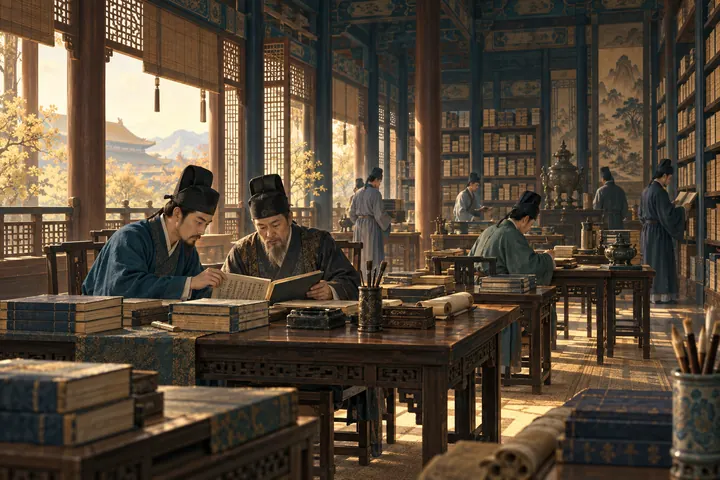
The Song did not suddenly invent competitive recruitment. Examinations existed under the Sui and Tang, but gained greater prominence as a route to office during the Song. The court sought men with literary and administrative abilities and a counterweight to military dominance. Recruitment therefore shaped both individual careers and the structure of rule.
Concealing candidates’ names and having clerks recopy scripts reduced opportunities for examiners to recognize favourites. These procedures did not equalize preparation. Sustained study required household support, books and teachers, and women were excluded from the regular examination route to office. Opportunities widened for some groups without becoming universal. Presenting the system as an entirely open modern educational competition would hide substantial differences in resources and status.
The circulation of books also mattered
The printing of classical texts associated with Feng Dao under the Five Dynasties shows that cultural projects did not wait for Song consolidation. Woodblocks allowed repeated production of the same text. Under the Song, official and private publishing interacted with local education to supply examination preparation, teaching and other reading. Changes in access to texts supported changes in the formation of officials.
Printing did not instantly displace manuscripts or make books affordable to every household. Regional conditions differed, and politics and markets influenced what was published. Nevertheless, relatively stable editions and commentaries helped families organize sustained study. Recruitment was thus shaped not only by decisions at court but also by the continuing work of printers, schools, teachers and households.
Civil government was still contentious
The growth of civil officialdom did not abolish imperial power or produce a uniform political outlook. Taxation, relief and military spending could provoke fierce disagreement. Later disputes surrounding Wang Anshi’s reforms reveal competing views of what the state should do, not merely personal rivalries among educated men.
The armed forces also remained a large and essential institution. Every Song military success or failure cannot be explained as the effect of civil officials restraining generals. Nor did celebrated writers make frontier defence and finance irrelevant. A more useful way to examine institutions is to follow responsibility, information and resources: who made decisions, who paid for them, and how arrangements were changed when they failed.
A connected but changing political world
This transformation crossed dynastic boundaries. Five Dynasties governments retained and adapted Han and Tang precedents; Song rulers continued to reorganize the military, revenue and recruitment. Established families did not lose influence overnight, and new scholarly groups did not all appear in 960. The result was a prolonged shift among social forces, not an abrupt replacement of a wholly military world by a wholly literary one.
Reading Qian Liu’s regional government alongside Feng Dao’s books and early Song institutions connects cities, culture and central politics. Wang Anshi and Su Shi then emerge as more than literary personalities: they were officials engaged in finance, local administration and public debate. Their world extended beyond the study into government offices, frontiers, markets and everyday life.
Follow the connections