The three visits and a political partnership
Five characters in the annals hold a whole partnership: a warlord of forty-seven calling thrice on a recluse of twenty-seven — and buying twenty years.
Rock bottom
The three visits came in Liu Bei’s bleakest years. He had spent half a life adrift: mat-weaver’s origins, rise through the Yellow Turban wars, then dependence on Gongsun Zan, Tao Qian, Cao Cao, Yuan Shao, Liu Biao — defeat upon defeat.
Now he lodged with Liu Biao, garrisoned at tiny Xinye. Visiting the privy one day he saw new fat on his thighs and wept: years without battle, flesh regrown, the man aging, the deed unbuilt.
Just then the counselor Xu Shu said: Zhuge Liang — the Sleeping Dragon. Would you care to meet him, my lord? Bring him to me, said Liu Bei. Xu Shu replied: this man can be visited; he cannot be summoned. You must condescend to call on him.
Three visits
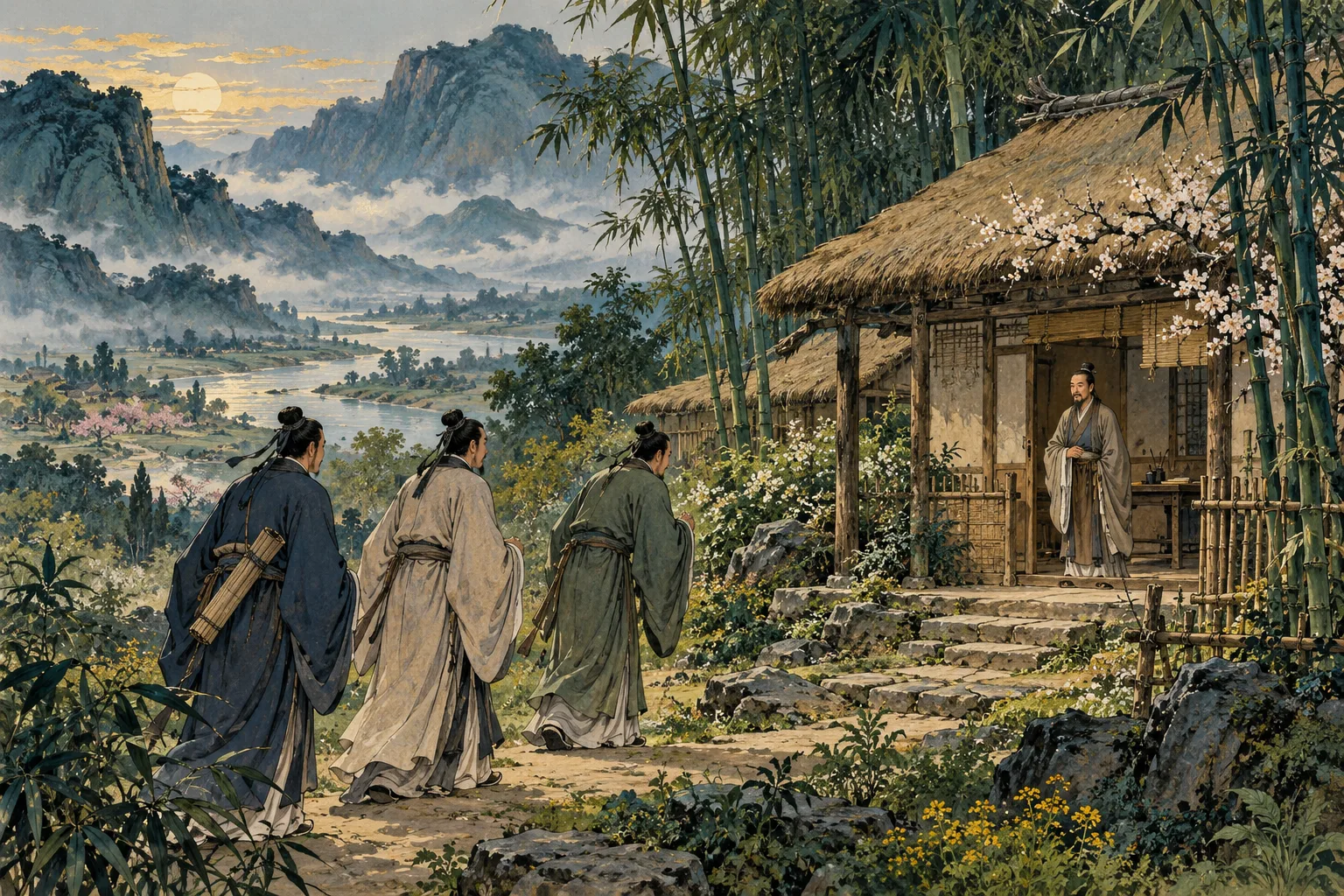
Liu Bei decided to go himself: at forty-seven, a warlord of national fame; Zhuge Liang, twenty-seven, a young man with no office in a valley at Longzhong.
Zhuge Liang’s own memoir in the Chu Shi Biao runs: thrice he visited me in my thatched hut. The first two calls missed him — deliberate avoidance, some say; a test of the imperial uncle’s sincerity, say others. On the third, the young man was home. Liu Bei dismissed his attendants, and the two talked in private.
The Longzhong Plan: a strategy memo
The Sanguozhi preserves the conversation whole — the Longzhong Plan. Zhuge Liang laid out the realm like a consultant’s brief:
Cao Cao has a million men and holds the Son of Heaven: do not contend with him. Sun Quan has held the Jiangdong for three reigns on defensible land with the people’s hearts: he can be an ally, never a target. Where then? Jing province is a land of war its master cannot hold; Yi province is rich, enclosed, the land on which Emperor Gaozu rose. Take Jing and Yi; conciliate the western tribes; gentle the southern marches; ally with Sun Quan; govern well within. When the realm shifts, send a general with the Jing army toward Wan and Luoyang while you lead Yi province out through the Qin passes — then the enterprise can succeed, and Han can rise.
A twenty-seven-year-old drew the forty-seven-year-old’s roadmap for the next twenty years. Liu Bei’s whole comment: good! From then on he and Zhuge Liang grew daily closer.
Fish and water
Guan Yu and Zhang Fei sulked: why lavish this on a nobody? Liu Bei gave the famous answer: I have Kongming as fish has water — say no more.
History weighed the choice: Zhuge Liang trained troops, managed taxes, sailed to Wu to build the Sun–Liu alliance, gathered the four southern Jing commanderies after Red Cliffs, then Yi province. When Liu Bei became emperor he made Zhuge Liang chancellor; at Baidicheng, dying, he told him: your talent is ten times Cao Pi’s… if my heir can be aided, aid him; if he is hopeless, take it yourself — whatever one makes of the words, the trust is nearly without parallel in the records.
The Romance novel stages the visits as three treks through wind and snow; the history spends five characters: thrice he went, and was seen. Five characters suffice: a forty-seven-year-old imperial uncle bowing three times to an unlettered young man — sincerity dressed in posture, and posture is itself a promise.
Follow the connections