Which were the Three Kingdoms, and when did they exist?
The Three Kingdoms were Wei, Shu Han and Wu, conventionally dated 220–280 CE. Cao Pi established Wei in 220, Liu Bei proclaimed himself emperor in 221, and Sun Quan did so in 229, after Wu had already developed as a state.
These were concurrent powers, not three successive dynasties. Wei’s center lay in the north, Shu Han was based at Chengdu, and Wu’s important capital Jianye was in the area of present-day Nanjing.
How do Cao Cao, Liu Bei, Sun Quan and Red Cliffs fit together?
Many familiar Three Kingdoms stories precede the period itself. Guandu was fought in 200 and Red Cliffs in 208, during the late Eastern Han. Cao Cao built a northern power base; Cao Pi later founded Wei.
At Red Cliffs, Sun Quan and Liu Bei allied against Cao Cao. The battle changed their opportunities without immediately fixing the later kingdoms’ borders. Separating late-Han campaigns from subsequent state formation makes the relationships easier to follow.
Who finally ended the Three Kingdoms?
Western Jin ended the division through a sequence of changes: Wei conquered Shu Han in 263; Sima Yan established Jin and replaced Wei in 265; Jin conquered Wu in 280.
Wei’s conquest of Shu did not amount to Wei unifying all three kingdoms. Jin already existed from 265 while Wu survived until 280. This is why their periods overlap on a timeline.
How did terrain and alliances shape the wars?
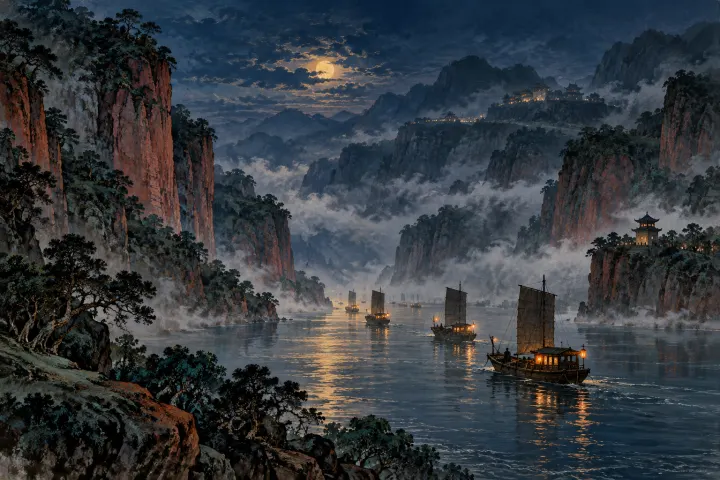
Plains, the Yangtze and the Sichuan basin affected movement, supply and defense without guaranteeing success. River crossings required ships and organization; mountain routes required transport; alliances depended on changing interests.
Consider Red Cliffs’ vessels alongside campaign supplies and Sun–Liu relations. Warfare becomes a problem of troops, resources and political choices as well as individual strategy.
How do Sanguozhi and Romance of the Three Kingdoms differ?
Chen Shou’s Sanguozhi records the period largely through biographies; Pei Songzhi’s commentary adds other accounts. Romance of the Three Kingdoms is a much later historical novel reshaping the past through character and plot.
For Red Cliffs, follow the recorded alliance, illness and fire attack, then compare the novel’s dramatic treatment. Watching a figure become loyal, brilliant or treacherous in different tellings is part of the enduring appeal.