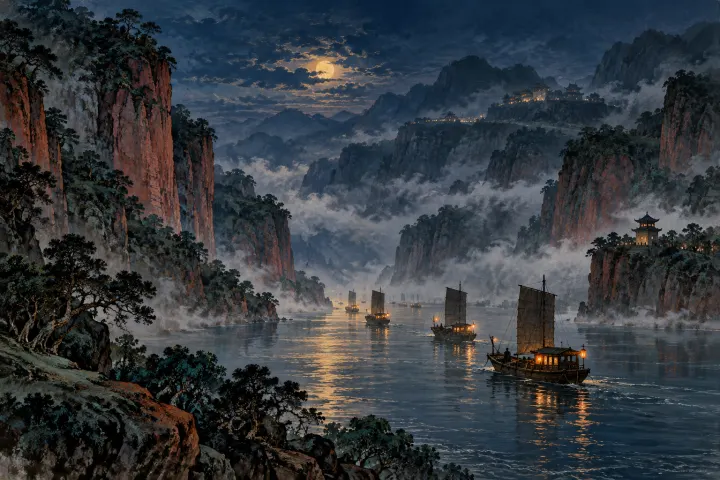
Guandu and the struggle over supplies
One letter and one granary decided a war: barefoot for a defector, fire at Wuchao, and the letters he chose to burn.
Two giants of the north
By the year 200 the Han dynasty was a shell, and the north held two giants: Yuan Shao and Cao Cao.
Yuan Shao came from the Yuan family of Runan — four generations of Three Excellencies — with clients and partisans everywhere, now master of four provinces and hundreds of thousands of troops. Cao Cao held the emperor and the capital at Xu, but his lands were small and his field army perhaps twenty or thirty thousand.
Yuan resolved to swallow the central plains in one campaign. The news shook Xu; the scholar Kong Rong thought Yuan unstoppable. Cao’s counselor Xun Yu refuted it point by point: Yuan’s laws are loose, his counselor Xu You greedy, his general Guo Tu headstrong — my lord is discerning and uses men by talent. Why worry?
Baima and Yanjin: the preliminary rounds
The opening rounds showed Cao’s speed and guile. Yuan’s general Yan Liang besieged Baima; on Xun You’s plan Cao feigned a crossing at Yanjin to draw Yuan’s strength west, then raced light troops to Baima. Yan Liang met them unready; Guan Yu — then serving in Cao’s camp — galloped through the host, cut Yan Liang down and brought back his head. The siege lifted.
At Yanjin Cao used baggage as bait: carts abandoned on the road, Yuan’s cavalry scattered to loot, formation broken — Cao’s riders charged and the general Wen Chou died in the melee.
After these preliminaries the armies faced each other on the Guandu line. The real decision would belong to one man and a pile of grain.
Stalemate: a race of granaries
The standoff stretched for months. Cao’s grain neared exhaustion, his rear kept rebelling (Yellow Turban remnants in Runan liaised with Yuan). He considered retreating on Xu and wrote to Xun Yu, who answered: whoever withdraws first loses momentum. Holding one-tenth of the enemy’s numbers against his throat at a chosen line, you have pinned him half a year; his strength shows signs of failing — this is the moment for a stratagem, not a step back.
Cao ground his teeth and held, even riding the front line to hearten the men. Yuan, meanwhile, wasted his own advantages: the strategist Ju Shou’s counsel of slow pressure was refused; Tian Feng, who had opposed the campaign, sat in prison.
Xu You defects; fire at Wuchao
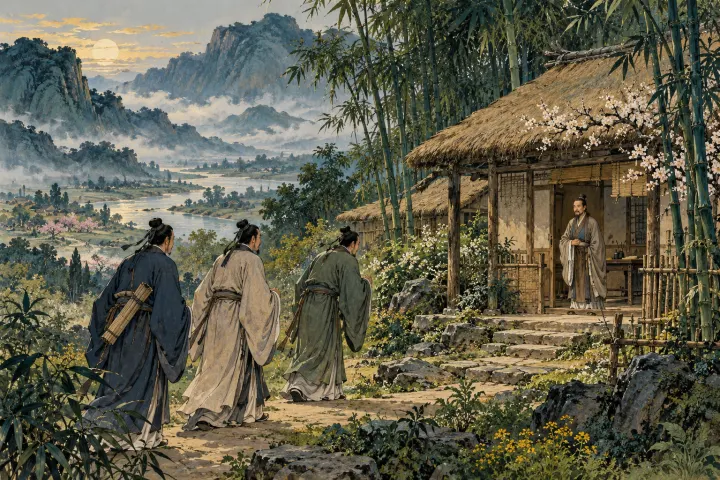
The turning point arrived theatrically: Yuan’s counselor Xu You defected to Cao.
The Caoman zhuan preserves the scene: hearing Xu You had come, Cao ran out barefoot, clapping and laughing — Ziyuan! You come, and my work is done! Xu You sat and asked: Yuan is strong — how will you answer him? How much grain have you left? Enough for a year, said Cao. No, think again. Half a year. You do not wish to destroy Yuan — why not tell the truth? Then, quietly: I was joking. One month. What shall I do?
Xu You unfolded his intelligence: more than ten thousand carts of Yuan’s grain sit at Wuchao, thinly guarded. Strike with light troops, surprise them, and within a day Yuan collapses.
That night Cao left Cao Hong holding camp and led five thousand in Yuan’s own colors, sticks in mouths and horses’ hooves muffled, straight to Wuchao by byways — then fire on all sides. Yuan’s camp panicked. Told of it, Yuan Shao refused to relieve Wuchao and slammed his main force at Cao’s camp instead — the camp held, Wuchao burned, and the front line broke: generals Zhang He and Gao Lan defected on the spot, and Yuan’s army dissolved.
Eighty thousand captives, and the north united
After Guandu Yuan Shao vomited blood and died; his sons feuded; over seven years Cao swallowed Hebei, and the north’s unification was decided.
The Sanguozhi records that eighty thousand surrendered troops were buried alive — the figure may be inflated, but the massacre (in the Caoman zhuan and Pei’s notes) stains Cao’s image permanently. A more famous postscript: sorting Yuan’s captured correspondence, Cao found secret letters from his own officers and the capital. Expecting a purge, they watched him order every letter burned: when Yuan was at his strongest, even I could not be sure of myself — let alone the rest. Winning hearts mattered as much as winning battles.
The troop figures are suspect — chroniclers loved inflating a David-and-Goliath contrast. But Wuchao decided the north, and grain decided Wuchao: Guandu remains the classic case of logistics as the decisive arm.
Follow the connections