Confucius on the road
Seven days starving, still playing and singing; called a homeless dog, laughing with delight: fourteen years bought no office — they bought the trunk of a civilization.
Leaving Lu at fifty-five
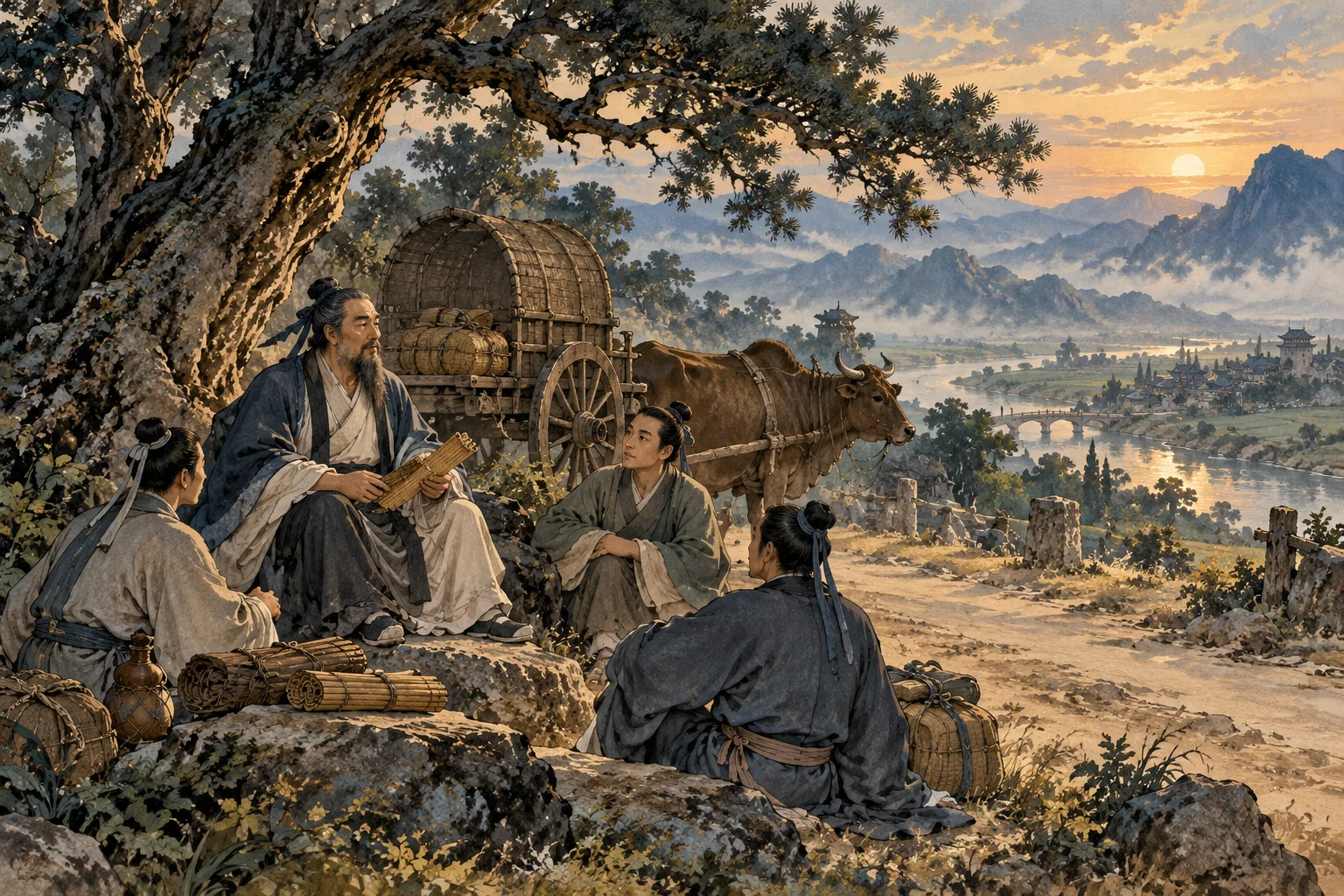
Around 497 BCE Confucius was fifty-five. He had risen in Lu to minister of crime, won back seized lands from Qi at the Jiagu summit, and governed well. Qi, alarmed at Lu’s rise, sent eighty singing girls and musicians; the regent Ji Huanzi accepted them and ignored court for three days. After the next sacrifice the ceremonial meat never reached Confucius’ house.
He understood: this state would no longer listen. He resigned and left his homeland to wander — fourteen years, with his disciples around him: Zilu brave and blunt, Yan Hui quiet and devoted, Zigong quick and silver-tongued.
Cold shoulders and close calls
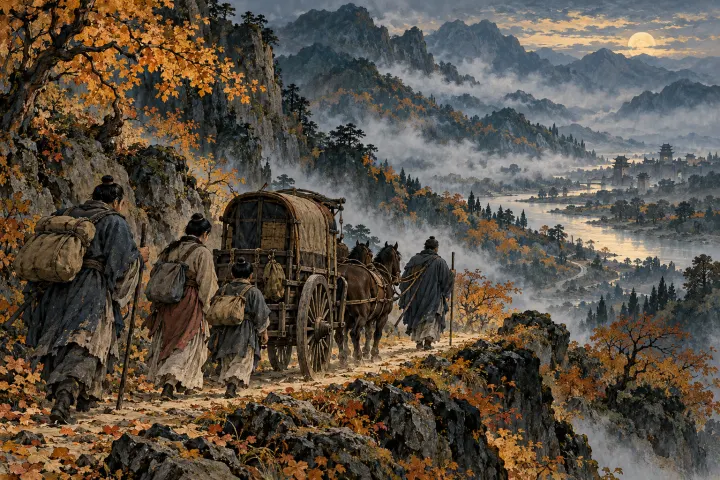
Across fourteen years he moved through Wei, Chen, Cai, Cao, Song, Zheng, the borders of Chu. Many lords received him; none gave him office.
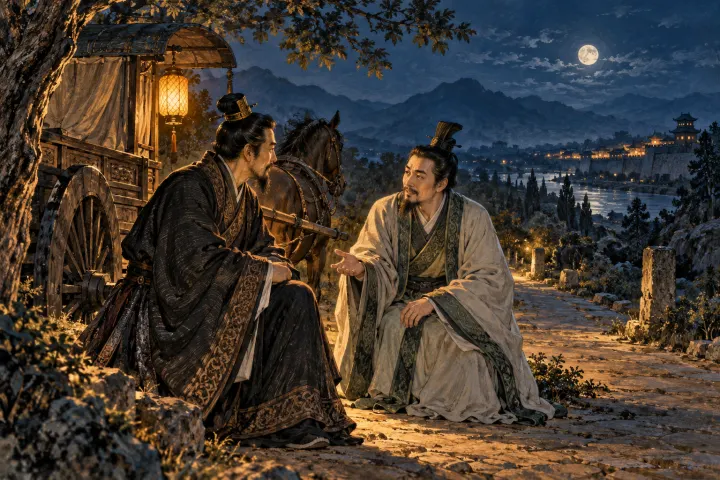
In Kuang he was mistaken for the tyrant Yang Hu (they looked alike) and besieged five days. The disciples were afraid; Confucius said: if Heaven intended this civilization to perish, what could the men of Kuang do to me?
In Song, minister Huan Tui, stung by his criticism, felled the tree where they practiced the rites and threatened his life. Urged to hurry, Confucius said: Heaven bred the virtue in me — what can Huan Tui do to me?
The worst was between Chen and Cai: cut off in the chaos, seven days without food, followers too weak to rise. Zilu demanded: does a gentleman too come to this? A gentleman holds firm in hardship, said Confucius; a small man in hardship overflows every bank.
Laughing at the homeless dog
Outside the east gate of the Zheng capital, Confucius was separated from his party. Zigong asked around, and a man of Zheng told him: at the east gate stands someone with Yao’s forehead, Gao Yao’s neck, Zichan’s shoulders — three inches short of Yu below the waist — wretched as a homeless dog.
Zigong found Confucius and repeated it. Confucius laughed with delight: the face, maybe not so much; but homeless dog — right! quite right!
That laugh is among his most moving moments: a man convinced he carried Heaven’s charge, accepting so biting a joke without flinching — what he carried inside did not depend on other people’s verdicts.
What fourteen years bought
No office. At sixty-eight, Ji Kangzi welcomed him back to Lu with rich gifts and the courtesy title elder of the state — and still no use for his program. Confucius stopped seeking office and spent his last years editing: pruning the Odes and Documents, setting the rites and music, appending notes to the Changes, composing the Spring and Autumn Annals — China’s earliest annalistic history. He died in 479 BCE at seventy-three.
Where his true influence came from is the point: not office but students. Three thousand disciples, seventy-two worthies, scattered through the states — and ru, once a Lu trade in funeral rites, became the trunk of Chinese thought for two millennia and more. Politically a total failure, culturally an overwhelming success: the tension between those two facts is the whole power of his story.
Reading him also means sorting layers: the Analects is the edited memory of disciples and their disciples; the Shiji’s biography is centuries later; and posterity made him everything from supreme sage to whipping boy. The man who starved between Chen and Cai and still played the qin and sang is stronger than all the symbols.
Follow the connections