The Duke of Zhou and a new political order
He opened the casket when rumors flew, and returned the throne whole when the boy grew up: the Duke of Zhou wrote the definition of loyalty.
Two years after Muye, King Wu dies
The victor of Muye fell ill within two years of his triumph. Dying, he proposed that his brother Dan — the Duke of Zhou, his closest aide — succeed him. The duke refused through tears, bowing with clasped hands.
The heir was Wu’s young son, King Cheng, still a child. The duke governed as regent, handling the realm in the boy’s name — one of the most dangerous seats in Chinese politics: powerful minister, regent, child ruler; together those words summon suspicion as night summons cold.
Rumor, then rebellion
The rumor came on cue. Wu’s brothers Guanshu and Caishu spread the word: the duke means harm to the child.
Worse, they joined the tyrant’s son Wu Geng, turning the very garrisons stationed to watch him — the Three Guards — into rebels. Overnight the freshly conquered east was in flames. In its second year the dynasty faced a crisis of trust and a crisis of war at once.
The duke steadied the inside first. He explained himself to Taigong Wang and Shao Gong Shi, and — per the story in the Metal Bound Casket — opened the chest holding the prayer he had once offered when King Wu lay sick: let me die in my brother’s place. He showed the text as proof he had never coveted the throne.
Three years of eastern war
Then he marched east himself. The Great Declaration in the Shangshu is that campaign’s mobilization speech, with its famous line: like one wading a deep abyss, I must find the far bank.
Three years: Wu Geng executed, Guanshu killed, Caishu banished, seventeen eastern states pacified. Out of victory the duke did two things that shaped China for three thousand years.
Build Chengzhou; hand back the throne
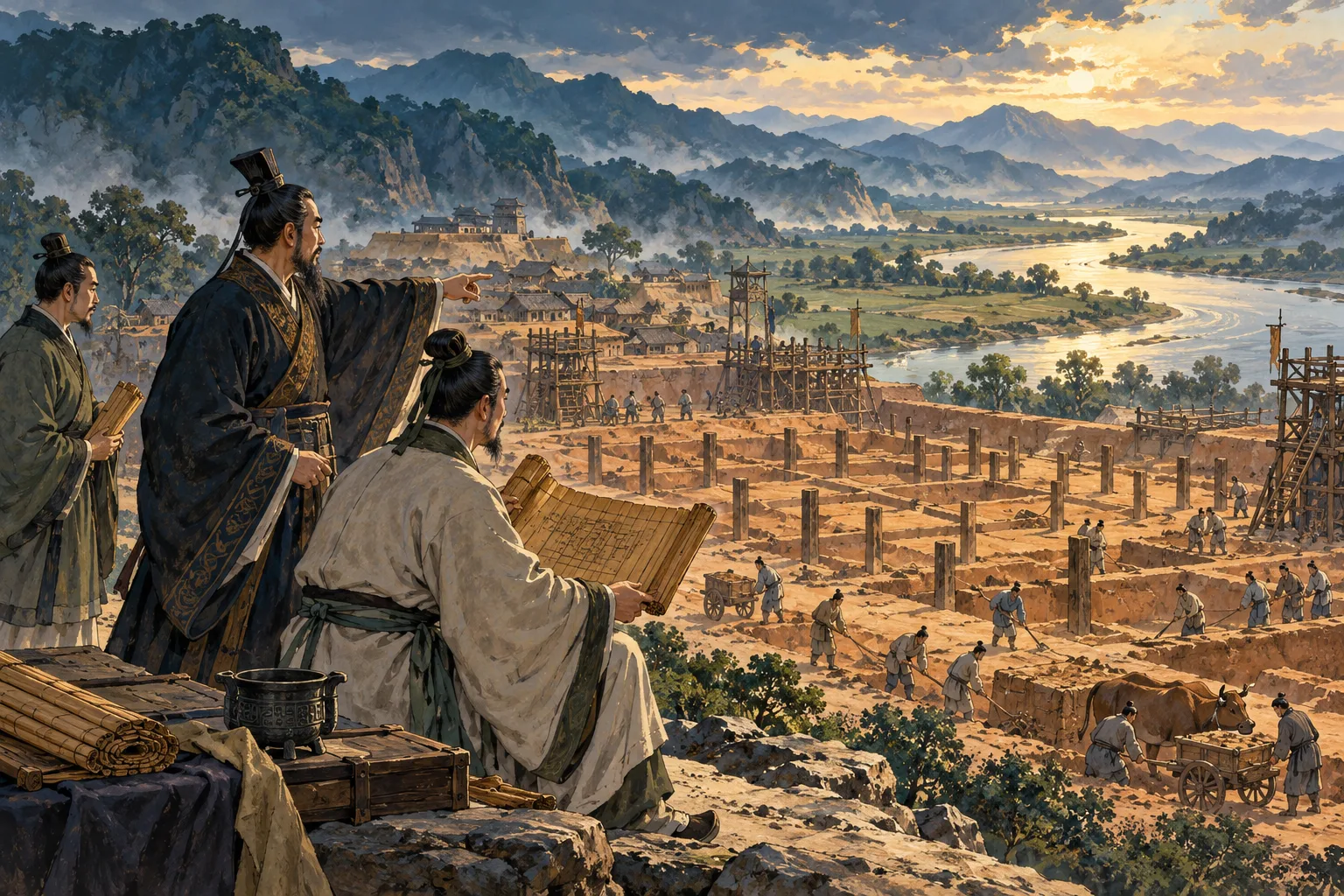
First: build Chengzhou at Luoyi. Zhou had risen in the west, but Shang’s remnant and the vast east could not be ruled remotely. The duke moved the obstinate Shang people to Luoyi under direct royal eyes, garrisoned the Eight Hosts of Chengzhou nearby — and enfeoffed Weizi Qi at Song so Shang’s sacrifices would not die out. The hard hand and the soft hand together, and the east stood firm. China’s two-capital system begins here, and with it Luoyang’s history as a capital.
Second: give back the throne. When Cheng came of age, the duke returned the government entire and took his own place facing north as a subject. That closed loop — regency, restoration — became the ideal template for every later regent and child king, and the root of the Confucian Duke of Zhou. Confucius sighed in old age: I have long ceased to dream of the Duke of Zhou. From then on the duke’s name and ritual civilization were one.
Be clear: the regency’s details and the war’s length vary by source, and later ritual books credited him with much he never did. The Zhou of history and the Zhou of memory overlap without coinciding.
Follow the connections