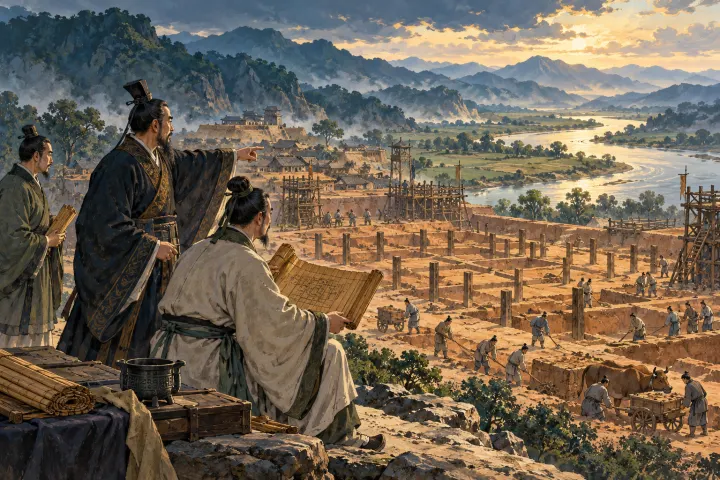
King Wu and the battle of Muye
Eight hundred lords at Mengjin and no battle; one jiazi morning of turning spears: Muye was won in hearts, and in waiting.
The last nights of Shang
Shang’s last king Di Xin — Zhou the Tyrant — was written into the same textbook of fallen rulers as Jie of Xia: brilliant, eloquent, strong, and clever above all at silencing criticism. Doting on Daji, raising the Deer Terrace, the wine pond and meat forest attach to his name too; he promoted flatterers like Fei Zhong and Elai, and the loyal died horribly: the prince Bigan remonstrated and had his heart cut out; Jizi feigned madness and was enslaved; Weizi fled in despair.
In the west, King Wen of Zhou had won over two-thirds of the lords before he died. His son King Wu, with Jiang Taigong as teacher and the Duke of Zhou at his side, moved to finish the work.
A march that was not a battle
In his ninth year Wu did something sly: bearing King Wen’s wooden tablet, he marched east and crossed at Mengjin. Eight hundred lords arrived crying: now strike Zhou the Tyrant!
Wu answered: you do not yet know Heaven’s mandate — and turned the army around. The Mengjin review was really an alliance drill and an opinion poll: he measured the lords’ hearts and waited. Two years later Weizi had fled, Bigan was dead, Jizi enslaved — the tyrant’s wings were clipped. Now, said Wu, Shang’s crimes may no longer go unpunished.
Dawn at Muye
At dawn on a jiazi day of the second month, the Zhou army reached Muye. Wu, yellow axe in left hand and white banner in right, swore the oath preserved as the Mu Shi: hens do not crow at dawn — when the hen crows, the house falls. Now Zhou heeds only a woman’s words, abandons the sacrifices, casts off his kin, shelters fugitives, oppresses the people. Advance in sixes and sevens and dress the ranks; strike in fours, fives, sixes, sevens, and dress again — be fierce as tiger and leopard, but do not meet those who flee to us: let them serve our western lands.
The hen-crowing line became immortal; the marching counts kept a huge army in formation — and offered the enemy soldiers their lives, to break their will.
The ranks turn
The tyrant met them in haste. His field army was away fighting the eastern Yi, so he armed slaves and prisoners — the sources say seven hundred thousand, certainly inflated, but a mass all the same.
The battle takes only a few words in the Shiji: the Shang host, though numerous, had no heart to fight and longed for King Wu to come in — and the Shang ranks turned their weapons about, opening the way for him.
Numbers mean nothing at such a moment. The tyrant fled to the Deer Terrace, dressed himself in jade, and burned. Wu entered, shot three arrows at the corpse, struck it with his sword, and with the yellow axe cut off the head and hung it on white — a ceremony telling the world: Heaven has executed Shang.
The victor cannot sleep
Then something strange: the victor could not sleep. Asked by the Duke of Zhou, he answered: Heaven has not yet confirmed its favor; I do not rest even in dreams.
What followed: the treasures of the Deer Terrace scattered to the poor, the granaries of Ju Bridge opened; Jizi freed, Bigan’s tomb honored; horses released at Mount Hua and oxen at Taolin — no more war; the lords enfeoffed, Shang’s remnant settled under its own heir.
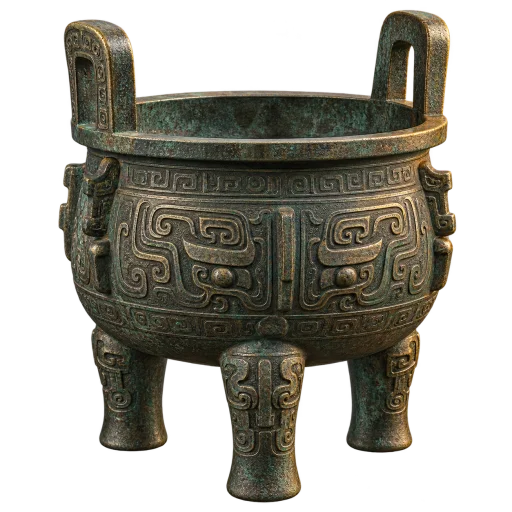
Such was Zhou’s opening move: a victor tiptoeing around his own victory. For the date, the Li gui bronze — on the jiazi morning, the year-star aligned — proves the battle fell on a jiazi day; the year itself (1046 BCE is the popular scheme) is still argued.
Follow the connections