The battle of Fei River
The boast of damming the Yangtze with whips lost to one shout from the rear: in a great army, order is the frailest thing.
Whips enough to dam the river
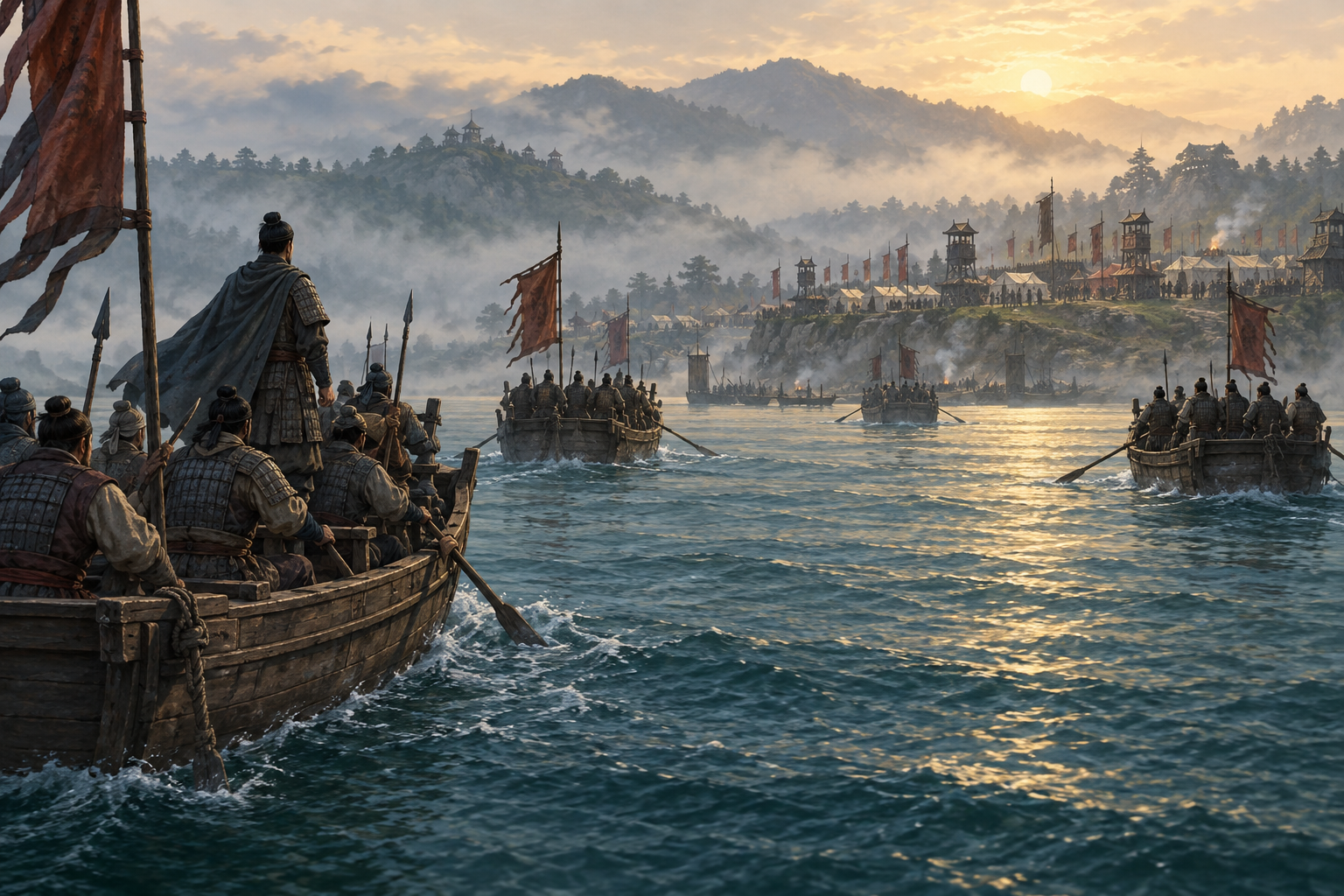
In 383 CE Fu Jian of Former Qin, having unified the north, resolved to swallow Eastern Jin and all under heaven. Conscription orders went out — one man in ten, all valiant youths under twenty made palace guards — a host billed at a million, the vanguard alone 250,000.
The court begged him not to go; the official Shi Yue pleaded Jin’s Yangtze moat, and Fu Jian answered with his most famous boast: throw my army’s whips into the river and they will dam its flow!
Jin’s regent Xie An calmly deployed: his brother Xie Shi as commander-in-chief, his nephew Xie Xuan leading eighty thousand Northern Mansion troops — the elite Xie Xuan had raised from refugee settlers at Jingkou, already blooded against Qin. The odds were roughly one to twelve.
First blood at Luojian
The Qin vanguard under Fu Rong took Shouyang with 300,000 men. The Jin commander Xie Shi meant to hold fast and let the enemy tire; instead the vanguard commanders Xie Yan and Liu Laozhi night-attacked Luojian with five thousand Northern Mansion picked men, killed the Qin general Liang Cheng and shattered fifty thousand — first blood, spirits soaring, the Jin army advancing on the Fei’s east bank.
Fu Jian climbed Shouyang’s wall and looked out. The Jin formations were crisp; gazing at the grass and trees of Bagong Mountain he fancied every bush full of soldiers — the idiom every bush a soldier was born here. Turning to Fu Rong he said quietly: this too is a strong enemy. Who called them few? — and fear showed on his face.
Please withdraw: the fatal order
The armies faced each other across the Fei. Jin’s small army could not afford to wait; Xie Xuan sent a message: you have marched deep and formed your line against the water — that is a plan for endurance, not for battle. Would you not withdraw a little, and let us cross and decide it?
Qin’s generals opposed any withdrawal. Fu Jian had his own arithmetic: yield the bank, and when the Jin are half in the water, crush them with heavy cavalry — certain victory.
He ordered the whole army back. It was the single most fatal command of the war.
One cry: the Qin host is broken
Several hundred thousand men turning around in a confined strip — the formation dissolved at once. At that instant the captive Jin general Zhu Xu, in the rear, suddenly shouted: the Qin host is broken! The Qin host is broken!
The retreating soldiers, knowing nothing, believed the front had collapsed and ran; running bred panic, panic became rout, rout became trampling — the dead covering field and stream. Fu Rong galloped the line to steady it; his horse fell, and pursuing Jin soldiers killed him. Fu Jian himself took an arrow and fled north of the Huai on a single horse.
Xie Xuan crossed with eight thousand picked cavalry and struck hard. The fleeing Qin army heard wind-sighing cranes and saw soldiers in every tree, marching day and night without rest, dying of hunger and cold by seven or eight in ten. Fu Jian gathered scraps and reached the north — where his unification promptly shattered: the Xianbei and Qiang states rose again, and two years later his own general Yao Chang killed him. Eastern Jin had bought itself decades of survival.
Why a retreat became a rout
Fei River is history’s textbook case of a withdrawal becoming a collapse. The military lesson is clean: a mass army is most fragile in motion, above all when turning to the rear; one rumor in the information system of hundreds of thousands magnifies without limit.
The sources’ exaggerations deserve note: the million was pre-battle rhetoric, Zhu Xu’s shout is the historian’s dramatization, and the deeper rot was Qin’s patchwork multi-ethnic army, Fu Jian’s blind trust in men, and a countryside exhausted by endless war. But the withdrawal on that bank was the straw that broke the camel’s back: in a great army, order is the frailest thing.
Follow the connections