The Orchid Pavilion gathering
Forty-one gentlemen, thirty-seven poems, one tipsy draft: how a spring picnic became calligraphy’s holy relic.
The third day of the third month
In 353 CE — the ninth year of Yonghe, Eastern Jin — came the Shangsi festival, when folk custom sent everyone to the water’s edge to wash away ill omen.
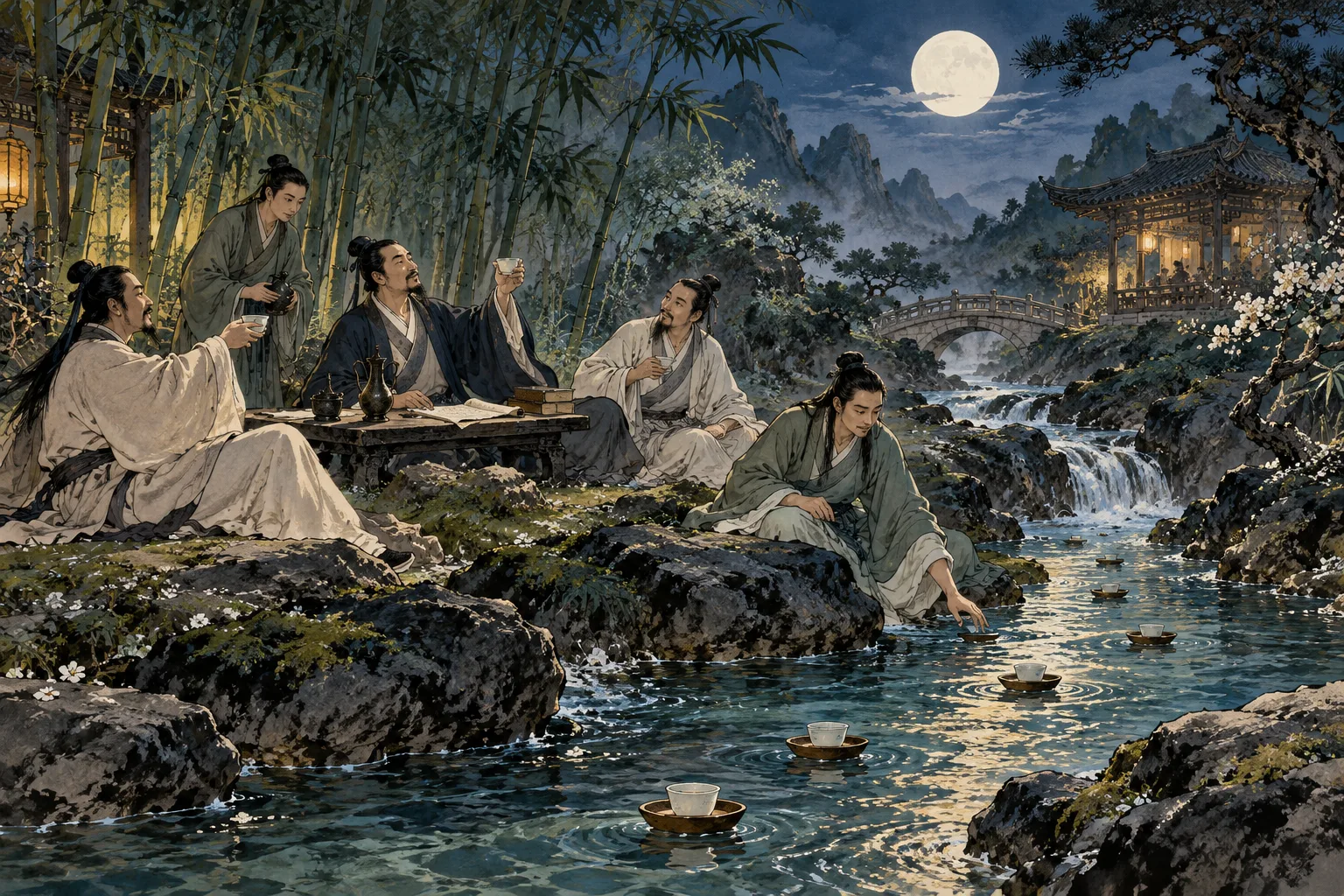
At the Orchid Pavilion in Shan’yin, Kuaiji, gathered more than forty of the age’s most elegant figures: Wang Xizhi (governor of Kuaiji, general of the Right Guard), Xie An, Sun Chuo, the monk Zhidun, and several of Wang’s sons. Seated along a winding stream, they floated wine cups; where a cup stopped before you, you drank and composed a poem — fail, and drink three forfeits. This is the winding stream and floating goblet.
The day was fair: tall trees and tall bamboo, a bright stream with racing rapids. Thirty-seven poems were written and gathered into the Orchid Pavilion Collection. Someone proposed: let Wang Xizhi write the preface.
A draft written half-drunk
Wine-warmed, Wang took a rat-whisker brush to cocoon paper and set down a preface of three hundred twenty-four characters.
The first half is spring’s delight: here are towering hills and dense woods, tall bamboo; here a bright stream with racing rapids mirrored on either hand… I gaze up at the vastness of the cosmos, look down on the abundance of things, let the eyes roam and the heart soar — truly joyful.
Then the brush turns: people pass through this world in a glance… what delighted us a moment ago has become the past, and we cannot but feel it; how much more, since life and death follow fate and all must end! The ancients said: death and life are great matters. Is it not painful!
And last: later ages will look on us as we look on the ancients. How sorrowful! So I record these men and their verses… whoever reads this later will feel it too.
Joy to pain to sorrow in three hundred characters, one breath: the Jin gentry’s sensitivity to time, in its most condensed form.
Sober, he could not match it
Legend says Wang, sobering, loved the draft and rewrote it dozens of times — never matching the original. Inspiration, wine and mood cannot be reassembled.
The Orchid Preface became the summit of Chinese calligraphy: its twenty-one characters for zhi (之), all different. Emperor Taizong of Tang worshipped Wang’s hand, hunted the masterpieces, and by tale beguiled the true Orchid scroll from the monk Biancai — and was buried with it at Zhaoling. The original has never been seen since.
What we see are Tang tracings and engravings: the Shenlong copy (sealed with Zhongzong’s era-name half-seal) nearest the original, with copies by Ouyang Xun, Chu Suiliang and Yu Shinan, plus countless engraved editions. Between the lost original and the copies stretches sixteen centuries of imagining.
The 1965 Orchid debate
In 1965 Guo Moruo, citing Eastern Jin epitaphs newly dug up at Nanjing, argued the Orchid Preface was neither written nor brushed by Wang Xizhi — the era’s epigraphy runs in clerical script, so such a mature running hand was impossible then. Gao Ershi rebutted, the famous Orchid debate began, and Mao Zedong personally had both essays printed together. It remains unsettled.
True or false, the event’s cultural life is real: the Lanting site at Shaoxing remains a scenic park, the winding stream rebuilt through the ages; sixteen hundred years of gatherings, tracings, engravings and scholarship orbit that one spring day and its tipsy draft. An ordinary literati picnic became, by one draft, Chinese culture’s eternal sign for time, death and friendship.
Follow the connections