Jingwei and the sea
A bird has carried her twig for three thousand years: the first shape of “not giving up” in Chinese story.
The Flame Emperor’s youngest daughter
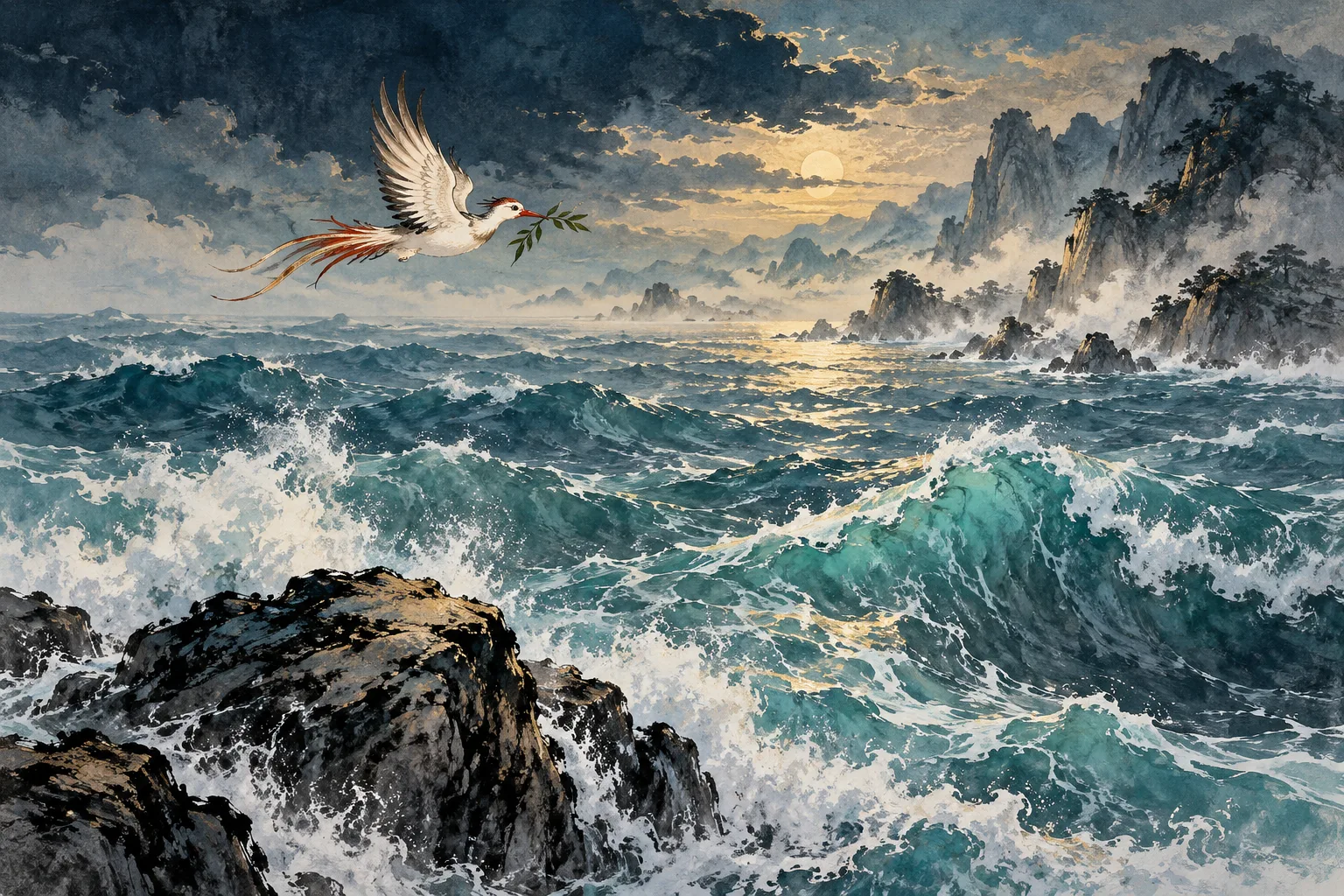
The Shanhaijing says that on Fajiu Mountain there grow many cudrania trees, and among them lives a bird: a patterned head, a white beak, red feet, whose cry sounds like it is calling its own name — “Jingwei, Jingwei.”
This bird’s origin is extraordinary. She was the youngest daughter of the Flame Emperor, named Nüwa the girl. One day she went to play on the Eastern Sea; a storm rose, and Nüwa never came back.
She becomes a bird
After her death, her spirit turned into this bird. She refused to let herself simply vanish into the sea — and refused to let the sea swallow anyone else so easily: she carries twigs and pebbles from the western mountains, flight after flight, and drops them into the Eastern Sea.
The sea is vast; the stones are tiny. One telling says the sea once mocked her: work for a million years and you will never fill me. Jingwei’s answer was simple: even ten million years, a hundred million years, until the end of the universe — I will fill you.
Why the image has lived three thousand years
One small bird against one boundless sea: the outcome is never in doubt — and yet the story deliberately stops there, with no ending told. What people remember is the image: the bird with the stone in her beak, flying again and again.
Later generations each took from that image what they needed. Tao Yuanming wrote “Jingwei carries her tiny twig to fill the vast sea” — the resolve of one who acts knowing it cannot succeed. Some read grief and a refusal to forget; in modern times it has often stood for the resistance of the weak. One image bearing so many meanings is proof of its depth.
Two things to keep straight
First: the girl Nüwa is not the goddess Nüwa. Their names are nearly identical but they have no connection in the stories — the commonest confusion. Second: Jingwei filling the sea is myth — not a water-engineering record, nor an observation of bird behavior.
What it truly preserves is an ancient attitude toward a fate that cannot be fought: I may lose, but I do not stop. As for the “inspirational” meaning, that was added by generations of later readers — the original text simply lets the bird keep flying.
Follow the connections