Pangu and the beginning of the world
A giant gives his body to become the world: China’s best-known creation myth, told whole.
An egg in the chaos
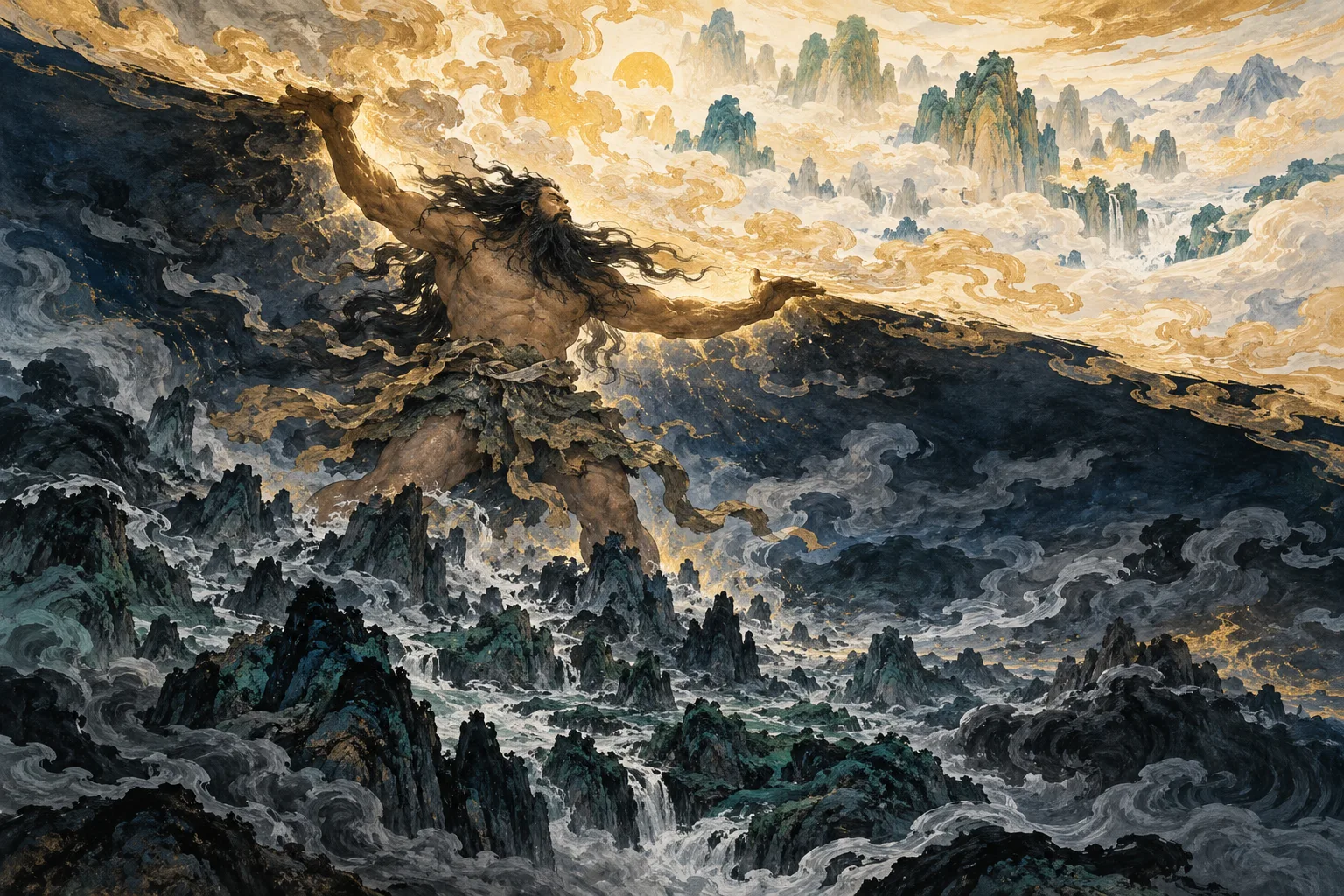
In the oldest telling there was no sky and no earth: the universe was a single mass of chaos, like an enormous egg, with no up or down, no light or dark. At the center of this “egg” slept a giant named Pangu.
He slept for eighteen thousand years. When he woke, the air around him was thick and dark and impossible to breathe. Pangu felt a natural axe lying beside him — so later storytellers explained — swung it with all his strength, and heard a thunderous crack as the chaos split: the light and clear rose slowly to become the sky; the heavy and turbid sank to become the earth.
Holding heaven apart
Though heaven and earth had separated, they might close again at any time. Pangu dared not leave. Head against the sky, feet on the ground, he stood between them like a pillar.
Each day the sky rose one zhang higher, the earth thickened one zhang, and Pangu grew one zhang taller. Another eighteen thousand years passed this way. The sky grew immensely high, the earth immensely thick, and Pangu’s body immensely long — until they could never close again. By then, his strength was entirely spent.
His body becomes the world
Pangu fell. As he died, his breath became the winds and clouds of the four seasons; his voice, the rolling thunder; his left eye, the sun; his right eye, the moon; his four limbs and torso, the four extremes of the earth and the five sacred mountains; his blood, the rivers; his body hair, the grasses and trees; his sweat, the rain that nourishes all things.
Put differently: the world was not a trophy conquered from anyone — it was a life that gave itself away completely. Mountains, rivers, sun and moon have been bound to humankind by blood ever since. That is the most moving thing in this story.
When the story was written down
But one thing must be made clear: Pangu’s name appears in no pre-Qin text. The earliest complete telling is the Sanwu Liji by Xu Zheng of Eastern Wu in the Three Kingdoms period, roughly 1,800 years ago. Scholars still debate whether the story was influenced by creation myths of southern peoples, or even by Indian mythology.
In other words, “Pangu opens heaven and earth” — China’s most famous creation myth — actually grew slowly: generation after generation of storytellers and painters added the axe, the pillar of heaven, the body become mountains and rivers, one layer at a time. It tells how the ancients imagined the world’s origin; it must not be read as an event that truly happened.
Follow the connections