Meng Jiangnü and the Great Wall: how a story of separation changes
Winter clothes, a search and a collapsing wall: hear the tale, then compare the earlier text and its changing local traditions.

A lens for this story
She leaves with clothing, hoping to find one person. Later tellings make that journey carry the grief of separation. The transformation is worth reading again.
- Follow waiting, clothing, searching and mourning to compare local tellings.
- Separate the story’s setting, the date of a text and the date of a real site.
Winter clothes and a search: a familiar legend
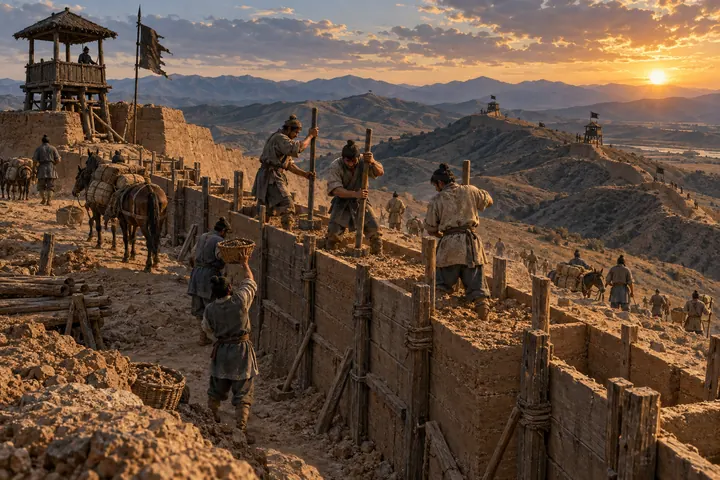
In many familiar tellings, Meng Jiangnü’s husband is taken away for wall labor. With no news of him, she prepares winter clothes and sets out to find him. Clothing is an ordinary object: it will be useful only if she finds its wearer. A small personal hope meets a vast public project.
She arrives to learn that he has died; her tears bring down a wall, the tale’s celebrated turn. Different communities tell this story in different ways. Names, marriage stories and endings can differ. Follow the emotional sequence—waiting, clothing, searching, mourning—then notice how a particular version arranges it.
In the early text, the wall is not the point
In the Zuozhuan’s account for Duke Xiang’s twenty-third year, Qiliang’s widow meets the ruler of Qi after her husband’s death in battle. She refuses condolence outside the home and asks for the proper setting; the ruler subsequently visits her residence. This passage contains neither the First Emperor nor the collapse of a Qin wall.
The passage centers on her insistence on appropriate treatment. Her agency matters. She does not only suffer grief; she also challenges how others treat her and her husband’s memory.
From a text to different local traditions
China’s intangible-heritage entries describe a Zibo tradition and a different Laiwu telling with local village and marriage connections. Placing them side by side reveals how communities make a circulating story their own, rather than identifying one uniquely authentic plot.
The story developed different tellings across periods and places. A marriage arrangement, new location or altered ending can change a character’s meaning. Record the version’s source first. Compare why she leaves, how she encounters authority and what the ending preserves instead of joining incompatible episodes into an imaginary original.
What can a temple or wall establish?
A real place can make a legend memorable without proving every event in it. A temple can illuminate commemoration, while a wall offers construction and repair evidence. The collapsing-wall episode remains part of a legend.
Intangible-heritage registration concerns transmission and safeguarding, not certification that a plot happened. The cited Zibo entry is from 2006; the Laiwu entry is a 2014 extension. Their registration histories differ. Keeping those distinctions prevents a long-lived tale from becoming a claim that every associated building has stood unchanged for a thousand years.
Why one person’s voice stays with us
The wall article approaches construction through organization, fabric and defence. Meng Jiangnü returns attention to waiting and separation. Reading the two pieces together reveals a contrast in emphasis: construction accounts foreground scale, while family stories ask who failed to return. The perspectives can coexist, but later folklore cannot calculate Qin labor deaths.
Next time you hear the tale, compare one detail: do the winter clothes reach their intended wearer? Different answers change the journey’s meaning. Record the version and that detail, then return to administration and frontier works. You will have three ways of asking about the past, not just the phrase that she wept down the wall.
Qin: an order, a wall and a story
Read Qin through administration, engineering and folklore: how offices worked, how walls belong to different periods, and how later stories express separation.
- After Qin unification: how does an order become government? →
Use a measure and county records to examine everyday government.
- Qin and Ming walls: one name, different historical sites →
Distinguish construction periods rather than date a wall by material alone.
- Meng Jiangnü and the Great Wall: how a story of separation changesYou are here
Hear the tale and separate texts, local versions and real sites.
Follow the connections