Beyond the Terracotta Army: the First Emperor’s Mausoleum
Read the mausoleum as a wider archaeological landscape, not just the terracotta pits.
A lens for this story
The faces are memorable. The harder question is how such a vast project was organized—and which traces let us investigate it today.
- Read the layout before the individual figures: the army is only part of the funerary complex.
- Keep excavated objects, textual accounts and hypotheses separate: they answer different questions.
What the well diggers found in 1974
The mausoleum of the First Emperor lies on the northern slope of Mount Li at Lintong, Xi’an. In the spring of 1974, local farmers digging a drought well struck broken terracotta heads — and the archaeologists who followed uncovered a buried army 2,200 years old. The terracotta warriors became a household name.
But remember: the figure pits are only the edge of the necropolis. Beneath the burial mound lies an unexcavated tomb chamber, ringed by hundreds of attendant pits and wall remains — a complex of roughly fifty square kilometers. Standing before Pit One, you are seeing the tip of an enormous undertaking.
An army of two millennia ago
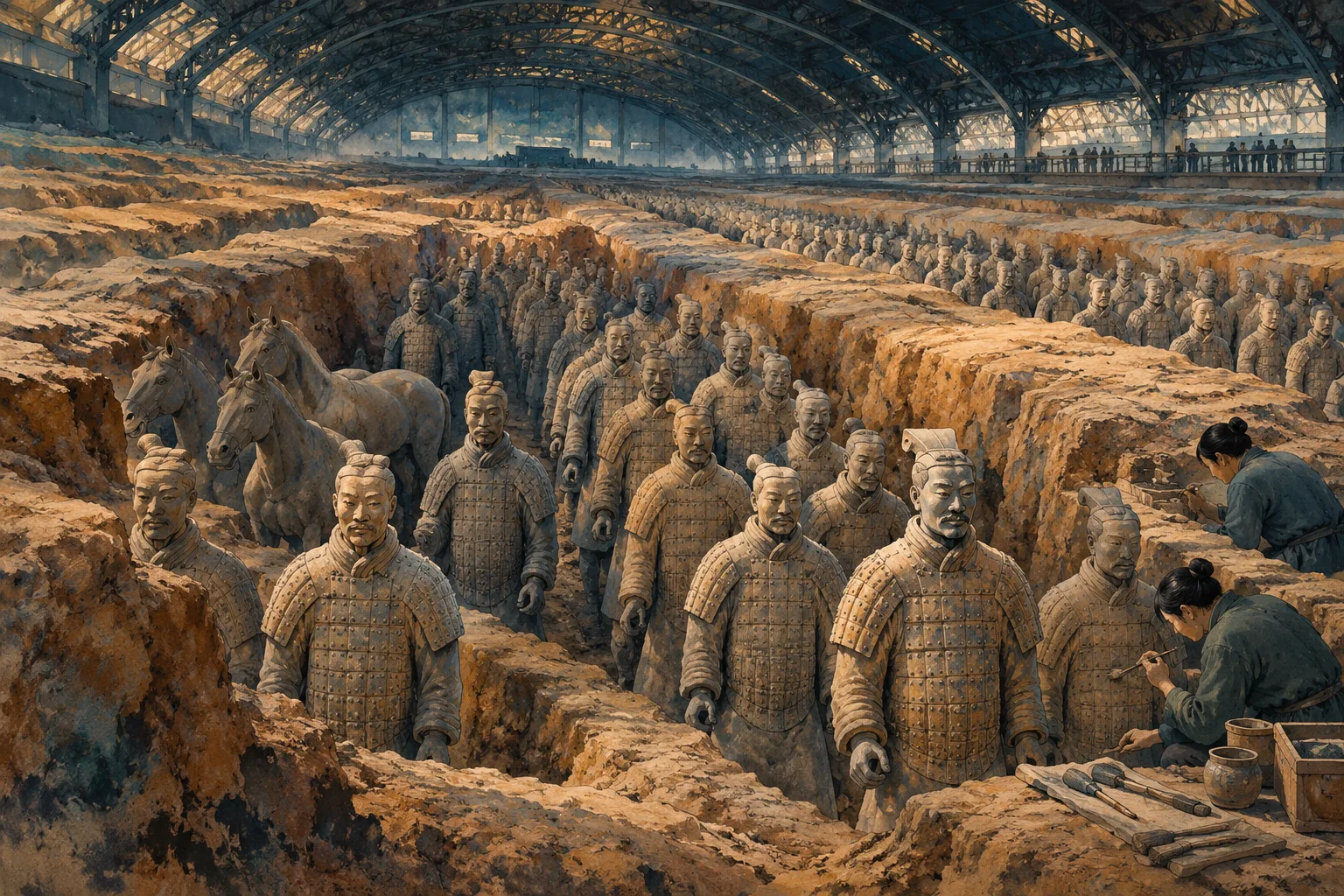
What stuns in the terracotta army is not “lifelike” but “organized.” Thousands of figures stand arrayed by formation — vanguard, main force, flanks, rearguard — chariots and infantry coordinated; every face differs, with hairstyles, armor and postures set by branch of service.
More astonishing still is the management: many figures bear their makers’ names inscribed on them — “engrave the artisan’s name, to test his honesty.” Whoever made the figure answers for it. Standardized production with accountability to the individual is the Qin state’s capacity in miniature.
Three questions to take on site
See the army carrying three questions. First: is what stands before me original site, excavated object, or display reconstruction? The bronze chariots are genuine artifacts; the exhibition halls are modern buildings. Second: how is the formation organized? Read the ranks, the weapons mix, the officers’ positions. Third: what is conjecture? Keep what the labels mark as “inferred” and “restored” separate from what they mark as “excavated.”
The tomb chamber has never been excavated — any account of its “interior scenes” is imagination. The underground palaces of film and television have nothing to do with this necropolis.
The tomb chamber and the Shiji
The Shiji records the tomb chamber as holding “rivers and seas of mercury, pumped by machines to flow” — mercury made into rivers, lakes and seas. Modern soil tests show anomalous mercury levels over the burial mound, consistent with the record; whether the chamber itself is as described must be left to future archaeology.
In 1987 the mausoleum entered the World Heritage List. Read this site holding two things apart: the excavated evidence (figures, bronze chariots, the stone-armor pit) and the unexcavated secret (the chamber). Keeping the two apart is the basic skill of visiting — and a courtesy to archaeology itself.
Follow the connections