Shang Yang’s reforms
Fifty gold to move a log: Shang Yang built credit with a pole and proved with his life that institutions outlive men.
The recruitment notice
In 361 BCE Duke Xiao of Qin took the throne. His frontier state was despised by the central powers, excluded from their councils, treated as barbarian. The twenty-two-year-old duke, in fury, issued the famous Summons for Talent: any guest or minister who can devise plans to strengthen Qin shall have high office and a share of land.
In Wei, a frustrated scion of the Wei ruling house named Wei Yang heard the summons, packed, and went west.
Move one log
Through a favorite at court Wei Yang reached the duke. His first discourse on the way of emperors put Xiao to sleep; the second, on kingly virtue, no better; the third, on the way of hegemony, had the duke sliding forward on his knees — they talked three days and nights.
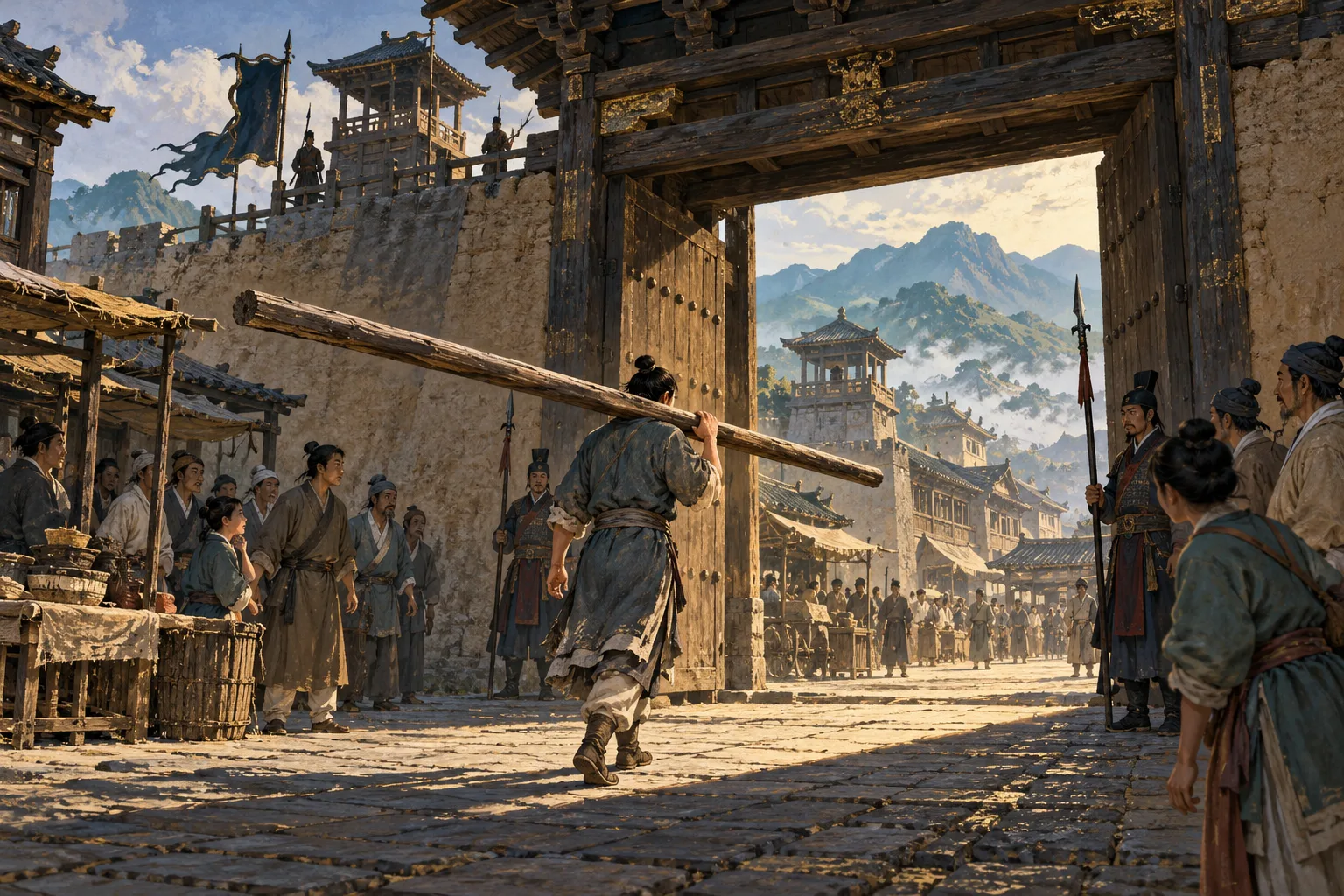
Appointed, Wei Yang did not proclaim laws at once. He set a three-zhang pole at the south gate with a notice: whoever moves it to the north gate gets ten gold. Crowds gathered; no one believed it. The reward rose to fifty gold; one man shouldered the pole, walked it across, and was paid on the spot.
Move the log, establish trust: a government that keeps its word — every reform depends on that. The next year the new laws came.
Whose cheese was cut
The laws interlocked: household registers, mutual-responsibility groups of five and ten, informing required; noble inheritance abolished, rank by battlefield merit — one enemy head, one rank; no military merit, no noble listing; farming and weaving rewarded, trade punished with slavery; hamlets consolidated into counties under governors the throne appointed.
Every clause was war on the old aristocracy. When the crown prince broke the law, Wei Yang said: the law fails because those above break it — the prince cannot be punished, so punish his tutor. Tutor Gongzi Qian’s nose was cut off at his second offense. The state grew obedient and martial; farmers brave in the king’s wars, afraid of private feuds.
The people’s grumbles later turned to praise — and Wei Yang banished the praise-sayers to the border towns as disturbers of the law. That detail splits his reputation forever.
The law outlives the man
Wei Yang beat Wei in war and was enfeoffed at Shang — hence the name Shang Yang.
When Duke Xiao died, the reckoning came. Tutor Qian’s faction accused Shang Yang of treason; the new king ordered him seized. Fleeing, Shang Yang asked for a room at a pass inn — the innkeeper replied: under Lord Shang’s law, lodging an unregistered traveler means shared punishment. His own law barred his own bed. Wei refused him entry too (his treachery in capturing their prince was famous).
Killed in battle, his corpse was torn by chariots. But the counties, the merit ranks, the registers — Qin inherited them intact. A century later that machine swallowed the six states. Lord Shang died; Qin’s law did not: he had demonstrated, at the cost of his life, his own reform’s logic — institutions outlive men.
Two ledgers at once
Judge Shang Yang with both ledgers open. The credit: a frontier state remade into a war machine and an efficiency state, whose counties and registers were never abandoned in two millennia. The debit: mutual surveillance turned every neighbor into an informer; commerce and thought were squeezed; a theory of the weak people and strong state treated citizens as fuel.
Sima Qian called him harsh by nature, and disliked him. Perhaps the best reading honors both: admire the credit the log established; beware the control that began behind it — two faces of the same reform.
Follow the connections