Qu Yuan and the memory of Chu
All the world is muddy and I alone am sober: a man who would not stir the mud, remembered by a river and a food for two thousand years.
Aristocrat, poet, minister
Qu Yuan was born into the Chu royal house: vast learning, a grasp of order and chaos, a silver tongue — good scholar, good politician, good speaker. King Huai of Chu trusted him, made him Left Minister to draft laws, receive guests, face the other states.
His program was beautiful governance: sound laws, the worthy raised, alliance with Qi against Qin. A fellow minister, jealous, whispered to the king: every law Qu Yuan drafts, he boasts — no one else could have written it. The king cooled toward him.
Two exiles
Qu Yuan’s fall tracked Chu’s. King Huai, duped by Zhang Yi’s promise of six hundred li of Shangyu land, broke with Qi, then lost two wars with Qin — eighty thousand dead at Danyang — and was finally lured into Qin, where he died in captivity. Chu never recovered.
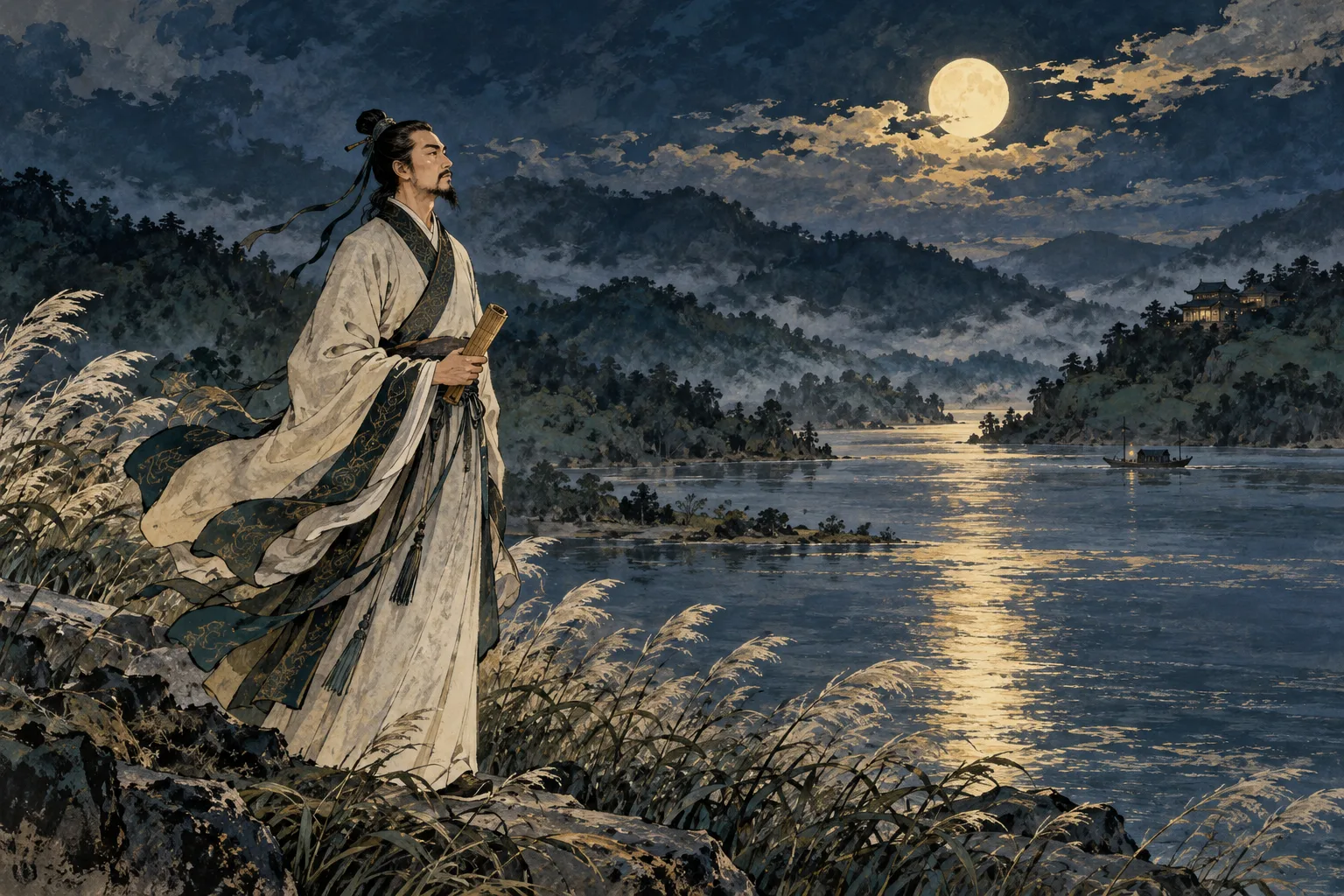
Under the new king, Lord Zilan slandered Qu Yuan again, and he was exiled south — to Dongting and the Yuan-Xiang rivers, for years. Wanderers saw him by the water, hair loose, face haggard. A fisherman asked: are you not the Third Ward Minister? How have you come to this? Qu Yuan answered with the line every Chinese child learns: all the world is muddy and I alone am clean; all men are drunk and I alone am sober — so I was exiled.
The fisherman counseled: the sage bends with things. The world is muddy — stir the mud with them; all are drunk — drink the lees with them. Why hug your jade and invite exile? Qu Yuan’s reply: how could I let this shining white be soiled by the world’s dust!
Li Sao and the Miluo river
In exile he wrote Li Sao — Encountering Sorrow — among the longest lyric poems of ancient China: three hundred seventy-odd lines, over 2,400 characters. He rides dragons and jade chariots, knocks on heaven’s gate, woos divine matchmakers, and fails at every door; fragrant plants stand for virtue, the fair one for his ideal — the sao style was born, and personal destiny first found an oceanic voice.
In 278 BCE the Qin general Bai Qi razed Ying, the Chu capital. Exiled, Qu Yuan understood that his country was finished. That year, on the fifth day of the fifth month, he clasped a stone and drowned in the Miluo river near Changsha. Legend says the people raced out in boats to save him and threw rice into the water so the fish would not touch him — the origin told for dragon boats and zongzi (the festivals’ older roots are debated; the bond with Qu Yuan is now cultural memory).
Two years later Chu moved its capital; fifty-five years on, Chu was no more.
What the poet’s death means
Qu Yuan is China’s first named great poet. Li Sao, the Nine Songs, Heavenly Questions and the Nine Pieces headwater Chinese romanticism; the road is long and far, I will search up and down remains the universal phrase of idealism. Han scholars compiled the Chu ci, and Sima Qian paired his life with Jia Yi’s — two thwarted talents gazing across the centuries.
Note the sources: the early material is essentially that one Shiji biography; the Fisherman dialogue’s literary nature and the authorship questions of Li Sao are all debated; the Duanwu customs predate him, attached later. None of it matters much: for over two millennia, every fifth day of the fifth month, the Chinese have remembered a man who would not join the mud. That fact is the greatest part of his story.
Follow the connections