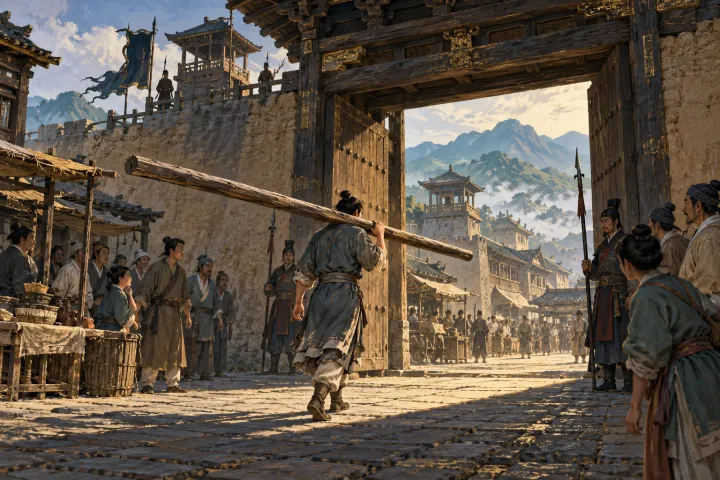
Sun Bin and relieving Zhao
A kneeless genius answered his classmate with two ambushes: never pull a snarl with your fist — besiege Wei to save Zhao.
A classmate’s betrayal
Sun Bin and Pang Juan, so the story goes, studied the art of war together. Pang went out first and became a Wei general; judging himself Sun’s inferior, he summoned Sun to Wei, framed him, and had him kneecapped — his feet’s joints cut away — and his face tattooed, hoping the genius would be buried alive.
The name Sun Bin (bin: kneecapped) preserves the mutilation. Sun did not sink. When a Qi envoy visited Wei, the crippled man sought a secret meeting; the envoy, astonished by his talk, hid him in his carriage and carried him to Qi, where the general Tian Ji took him in as an honored retainer.
The horse race and a general’s wager
Sun’s first sensation in Qi was a horse race. Tian Ji kept losing heavy wagers racing the princes; Sun studied several meets, saw that all parties graded their horses into three classes of near-equal pace — and advised: race your third-string against their first, your first against their second, your second against their third.
One loss, two wins, a thousand gold to Tian Ji. The money hardly mattered; what the race displayed was a way of thinking: victory depends not on raw strength but on combination and order.
Tian Ji presented Sun Bin to King Wei of Qi.
Besiege Wei to save Zhao
In 354 BCE Pang Juan besieged Handan, capital of Zhao; Zhao begged Qi for rescue. King Wei sent Tian Ji with Sun Bin as strategist.
Tian Ji wanted to march straight to Handan and give battle. Sun Bin stopped him with the analysis that has been taught ever since: to untangle a snarl do not clench your fist; to stop a brawl do not join the blows. Strike where they are empty: Wei’s crack troops are all at Handan — the homeland lies bare. March on Daliang, and Pang Juan must race home to save it. We relieve Zhao and wear Wei out in the same motion.
The Qi army made for Daliang. Pang Juan lifted the siege and force-marched home — into the ambush Sun had prepared at Guiling, on the route Sun had computed. Fresh troops met exhausted ones; Wei was routed. Besiege Wei to save Zhao became lesson one of every military textbook since.
The tree at Maling
Thirteen years later Wei attacked Han; Qi marched again — same pair, Tian Ji and Sun Bin, same enemy, Pang Juan. This time Sun Bin staged a play for his enemy’s mind: on entering Wei the Qi army dug one hundred thousand cooking stoves; the next day fifty thousand; the third day thirty thousand.
Pang Juan, chasing three days, counted the stoves and rejoiced: I always knew the Qi troops were cowards — three days in our land and half have deserted! He abandoned his infantry and raced ahead with light troops, day and night.
Sun Bin computed that he would reach Maling that night: a narrow road walled by defiles, perfect for ambush. Men peeled the bark from a great tree and wrote on the white wood: Pang Juan dies beneath this tree. Ten thousand crossbowmen crouched along the road with orders: when a light flares, loose everything.
Pang Juan arrived in the dark, saw the writing on the tree, struck a light to read it — before he finished, the night filled with arrows. His army dissolved around him. Knowing all was lost, he cut his own throat with the words: so that fool’s fame is made!
Qi crushed Wei, and Wei declined from that day. A note on sources: the tale rests on the Shiji until 1972, when the lost Art of War of Sun Bin surfaced in the Han tombs at Yinqueshan — proving the man and the book real, and ending a millennium-old dispute over whether Sun Wu and Sun Bin were one person. Excavated bamboo gave the crippled strategist his final proof.
Follow the connections