Shun’s trials and responsibilities
From the boy his family hunted to the chief of all: Shun’s story is about character proven under trial.
A beginning anyone can relate to
The most gripping thing about Shun’s story is how wretched its beginning is: a muddled father, a cruel stepmother, an arrogant half-brother Xiang — a whole family ganging up to treat him as an outsider.
Anyone else might have curdled into lifelong resentment. Shun’s choice: hide when hiding was needed (fleeing to survive is not foolish), while keeping every duty intact — honoring his parents, caring for his brother, exactly as before. This story was told to children for generations, and it says one thing: your circumstances can be bad; your conduct need not follow them down.
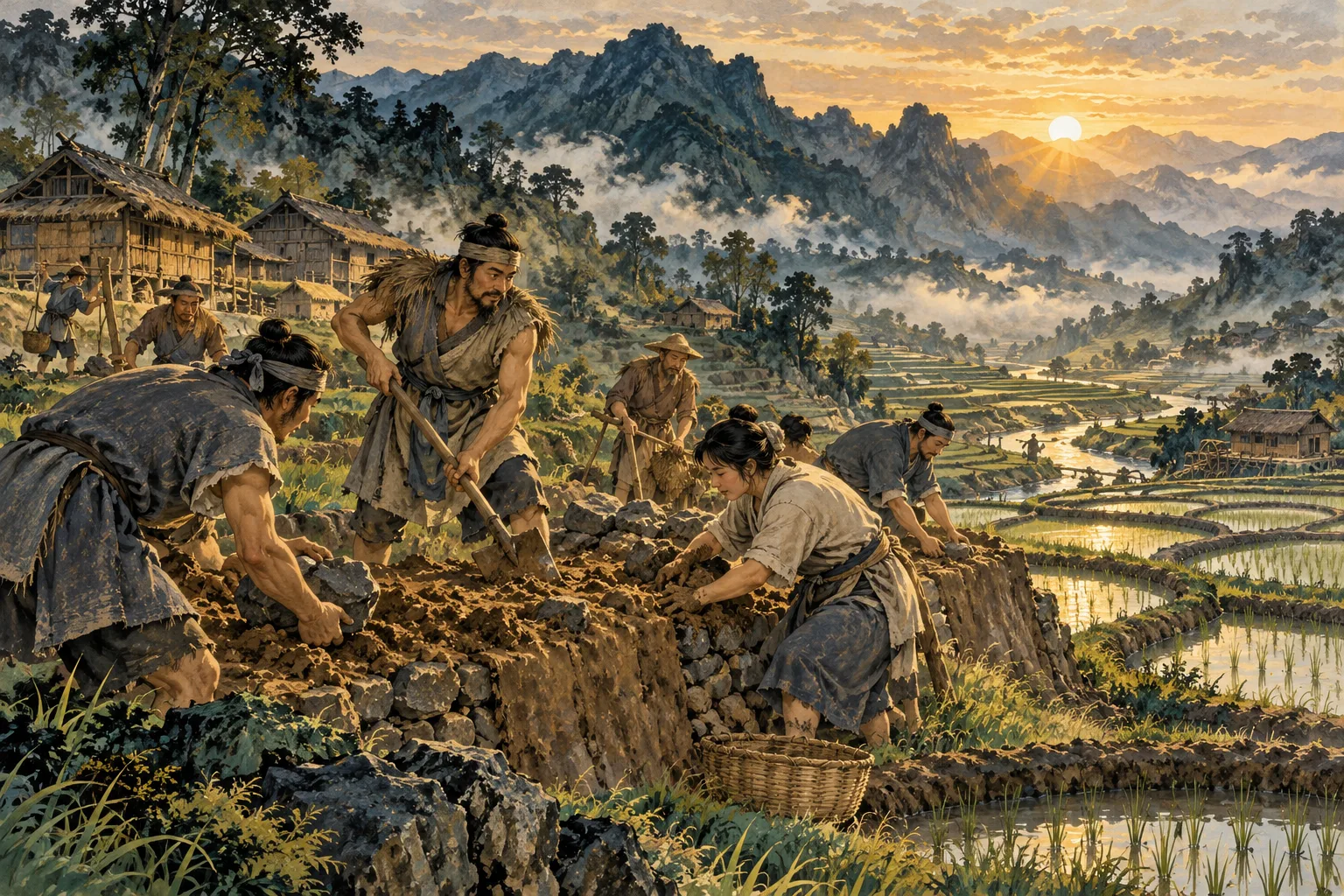
Fame grown from farming
Shun’s early livelihood crossed several trades: farming at Mount Li, fishing at Lake Lei, firing pottery by the Yellow River. Legend says that wherever he went, the local temper improved — the farmers of Mount Li stopped disputing field boundaries; the fishermen of Lake Lei yielded the good spots; his pottery was solid, without shortcuts.
What these details mean to show: Shun had a gift for gathering people. Where he lived one year, a village formed; two years, a town; three years, a city.
Yao’s “probation checklist”
Having chosen Shun, Yao assigned him duties of steadily increasing weight, like a probation review: first to spread the five teachings — righteousness for fathers, kindness for mothers, friendliness for elder brothers, respect for younger brothers, sincerity for children — to see if he could move hearts; then to preside over the hundred officials, who all kept order; then to receive the lords and guests at the four gates, who all showed respect; and finally to be thrown into deep mountains and forests through storm and thunder, to see if he stayed composed.
Shun bore each item. This narrative is practically the whole of what later ages imagined an official should be: able to govern a household, to teach, to administer, to conduct diplomacy, to bear up under pressure.
Banishing some, raising others
Shun’s first great act as regent was personnel: exiling the “Four Wicked Ones” — Hundun, Qiongqi, Taowu and Taotie — to the frontier quarters, in today’s terms clearing out the wolves; at the same time he raised up the talented of sixteen clans, letting the capable come forward.
One hand swept, the other lifted, and the hearts of the realm settled. Countless later memorials and essays cited this precedent, all circling the same question: how to use people. As for historical truth — details like farmers yielding boundaries at Mount Li belong to moral-textbook storytelling; best read as story, not cited as source.
Follow the connections