The Sui canal network
All say Sui died for this river — yet a thousand li still rely on its flow: the two ledgers of one canal.
A dynasty’s great wager
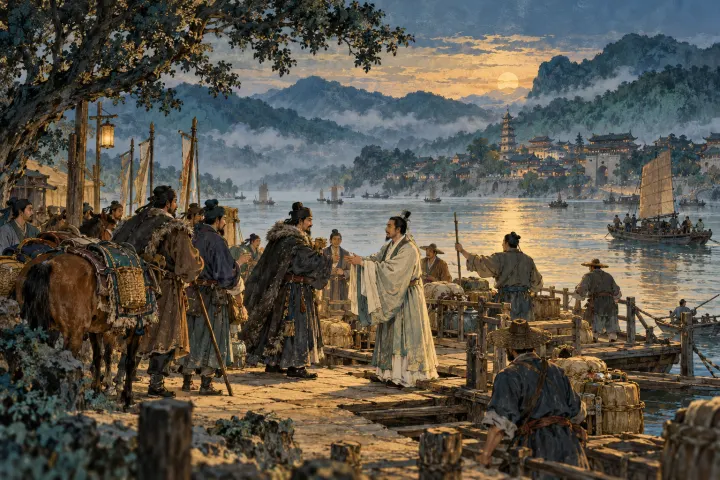
In 605, soon after taking the throne, Emperor Yang of Sui ordered the Tongji Canal cut: over a million laborers from Henan and Huaibei drew the Gu and Luo waters into the Yellow River at Luoyang, then the Yellow River into the Bian, down the Si to the Huai. That same year the old Han Gou was remade, joining the Huai to Yangzhou. Later the Yongji Canal ran north to Zhuojun (today’s Beijing) and the Jiangnan Canal south to Yuhang (Hangzhou).
Four reaches, more than 2,700 kilometers, linking the five great watersheds of Hai, Yellow, Huai, Yangtze and Qiantang — a work without precedent in world hydraulics, completed in six years, 605–610.
The sources write the price in horror: over a million men and women levied for the Yongji Canal alone; when the men fell short, women were conscripted.
Why it had to be built
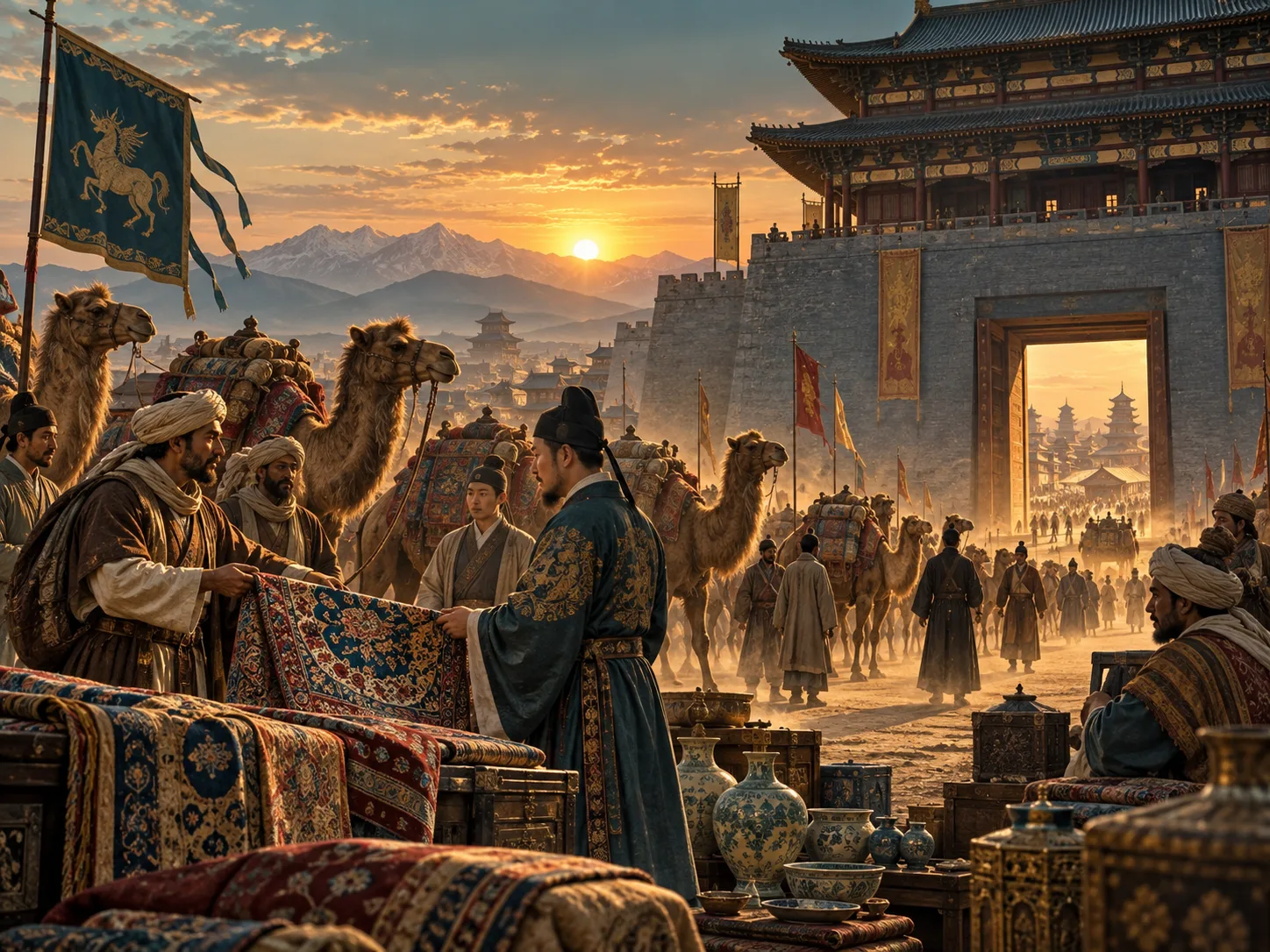
The canal was not an emperor’s whim but the empire’s need. The economic center had drifted south for four centuries — Jiangnan was the granary — while political and military power sat in the north: Guanzhong, Luoyang, and Zhuojun on the Korean frontier.
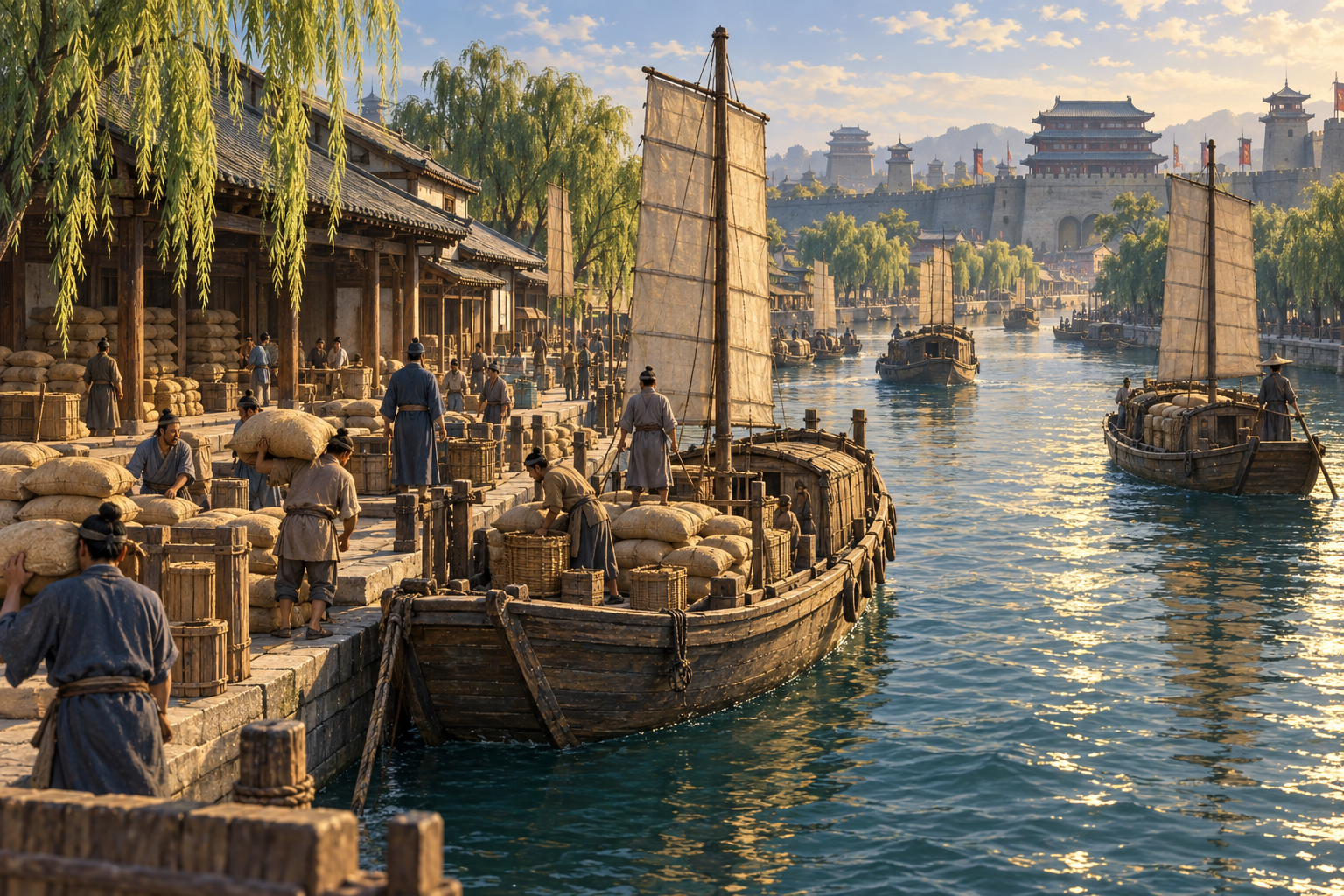
To ship one dan of grain south to north by land cost several times its price in feed and porters. Water carriage cost a fraction. Without the canal the northern court and army drank from an empty well; with it, Jiangnan’s wealth became the north’s blood.
The emperor’s own voyages were indeed obscene: the Zizhi tongjian records his four-deck dragon barge to Jiangdu with thousands of attendant vessels and eighty thousand trackers, masts touching for two hundred li. That ledger too belongs to the canal’s history.
A thousand-year artery
Once open, the canal remade China’s economic map. Yangzhou, at the meeting of canal and Yangtze, flourished for a thousand years — the Tang saying ran, first Yangzhou, second Yizhou. Hangzhou, Huai’an and Linqing rose in turn along the line.
Deeper still, the canal redefined the geography of power: political center north, economic center south, sutured by one waterway. Pi Rixiu’s Tang verdict is the most quoted: all say Sui died for this river — yet a thousand li still rely on its flow. Without the dragon barges, his merit might stand beside Yu the Great’s.
For a thousand years the line was the empire’s north–south artery: the Yuan straightened it into today’s Grand Canal Beijing–Hangzhou form, and until the railway age it was the state’s grain road.
A World Heritage site, 2014
In 2014 the Grand Canal of China — the Sui–Tang system, the Beijing–Hangzhou line and the Zhejiang canal — joined the World Heritage List, honored precisely as a living route: two millennia of continuous use.
Read the Sui canal with both ledgers open. One is cost: a million levies, broken households, the realm dying of labor. The other is legacy: south stitched to north, Tang and Song prosperity sustained, a whole belt of canal cities shaped, and water still flowing today. Condemnation and dependence coexist — that is the full understanding of this river.
Follow the connections