Sui reunification
One river crossing ended three centuries of division; a whole set of institutions stitched south to north: both faces of the Kaihuang reign.
Three centuries of division
From 304 CE, when Liu Yuan founded Han (the Sixteen Kingdoms’ start), to 589 when Sui destroyed Chen, China lay divided nearly three hundred years: the north cycled through the Sixteen Kingdoms, Northern Wei, eastern and western splits, Qi and Zhou; the south ran from Eastern Jin through Song, Qi, Liang and Chen.
The fissures ran deep: political separation, a war-torn north against a developing south, culture pulled between Xianbei and Chinese ways — even language and measures drifting apart. Reunification demanded someone with the sword and the institutions both halves could accept.
Yang Jian’s rise
Yang Jian rose from the Northern Zhou military aristocracy: his father one of the Twelve Great Generals, his wife a daughter of the Xianbei magnate Dugu Xin, his daughter empress to Emperor Xuan — he was the emperor’s father-in-law.
Emperor Xuan was tyrannical and dissolute and died at twenty-two, leaving an eight-year-old heir. As the empress’s father, Grand General and Minister of War, Yang Jian entered the palace as regent. The Sui shu describes the mood as the hopes of all converging on him. The elder statesman Yuchi Qiong rose against him and was crushed in sixty days. In 581 Yang Jian accepted abdication, founded Sui, and named his era Kaihuang — he is Emperor Wen.
Chen falls eight years later
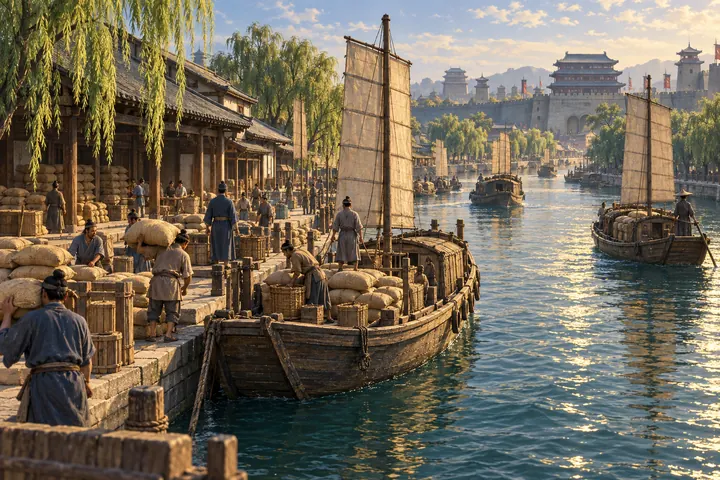
After taking Zhou, Emperor Wen spent eight years preparing unity. Within: equal-field grants eased farmers, the face-reading census flushed out hidden households, granaries were built. Without: the long-sun strategy of Zhangsun Sheng split the Turks into eastern and western halves, clearing the north, while a navy took shape.
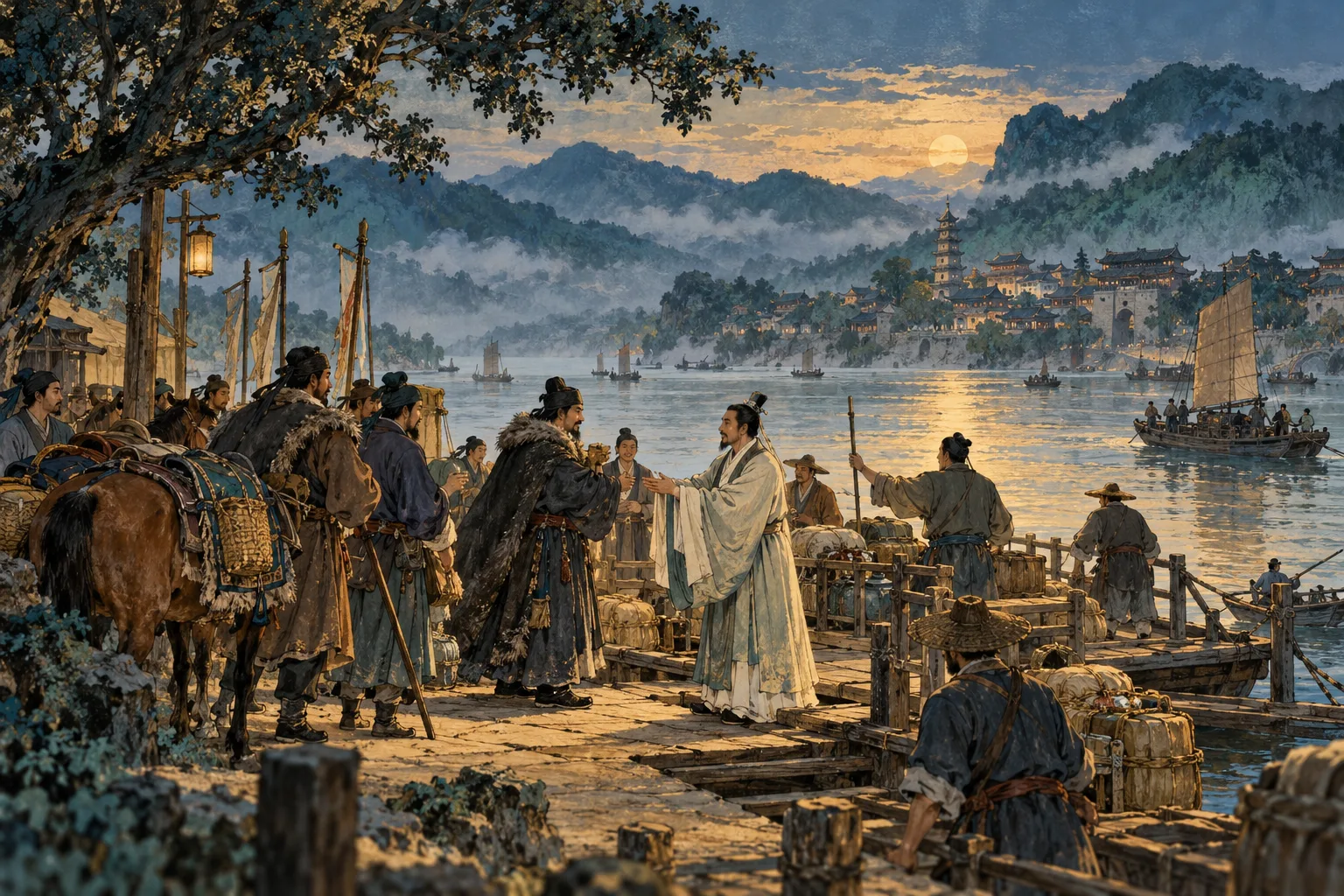
In the first month of 589 Prince Yang Guang (the future Emperor Yang) led 510,000 men across the Yangtze on eight routes. The last Chen ruler, Chen Shubao, was the empire’s archetypal poet-loser — his Jade Trees and Backyard Flowers survived him. As the Sui army crossed he was still composing to music; when the walls fell he hid with two consorts in a well and was hauled out by rope. Chen, thirty-three years old, was gone: nearly three centuries of division ended.
Kaihuang’s institutions, stitching south to north
What mattered more than conquest was the stitching: institutionally, the nine-rank system — nearly four hundred years old since Cao Cao’s day — was abolished, selection by examination began (the jinshi degree under Emperor Yang finalized it: the examination age had started); the Kaihuang Code was pruned to clarity, setting the five punishments of imperial law; equal-field and tax systems extended to the south.
Economically households multiplied and granaries filled — Sui state stores were so rich that twenty years into Tang, Sui grain was still being issued. The new capital Daxing laid out the checkerboard that became Tang Chang’an.
Yet the emperor grew suspicious in age, displacing his heir Yang Yong for Yang Guang — the seed of ruin. In 604 he died suddenly at the Renshou palace, and Yang Guang took the throne as Emperor Yang. Old history’s verdict echoes Qin’s: towering institutional achievement, thin human warmth. Read Sui by separating Wen’s institutions from Yang’s overreach: canal, examinations and code sustained the Tang golden age, while overdriven works killed the dynasty in decades — the lessons of speed and patience share one short reign.
From Qin and Han to Sui and Tang
Follow unification, division and reconstruction across dynastic boundaries.
- After Qin unification: how does an order become government? →
Begin with Qin’s transformation of the competing states.
- How Liu Bang founded the Han after the fall of Qin →
Connect the post-Qin war to early Han government.
- How the Three Kingdoms ended: from rival emperors to Jin →
Distinguish rival accessions from Jin’s eventual conquest.
- Sui reunificationYou are here
Continue to the reunification of north and south.
- Taizong and the Zhenguan era: governing after conquest →
Ask how early Tang transformed military success into government.
Follow the connections