Guo Shoujing and the Tonghui River
Why would a water route take a detour? Follow springs, terrain and shadows to explore Guo Shoujing’s work on Dadu’s waterways and the Shoushi calendar.
The making of a polymath
Guo Shoujing was born in Xingzhou (today’s Xingtai) in 1231; his grandfather Guo Rong, a master of mathematics and waterworks, sent him to study under Liu Bingzhong. When the Dahuo spring north of Xingtai silted up, the young Guo surveyed the terrain and planned a new channel that set the waters flowing again — famous for waterworks barely out of his teens.
His career began on Zhang Wenqian’s recommendation: in 1262 he met Kublai and laid out six waterworks proposals on the spot. The khan’s verdict: officials should be like this man — he shall not eat idle grain. Office followed at once: Ningxia’s Yellow River irrigation, then the capital’s waters, rising to Director of Waterways.
The Tonghui: water before boats
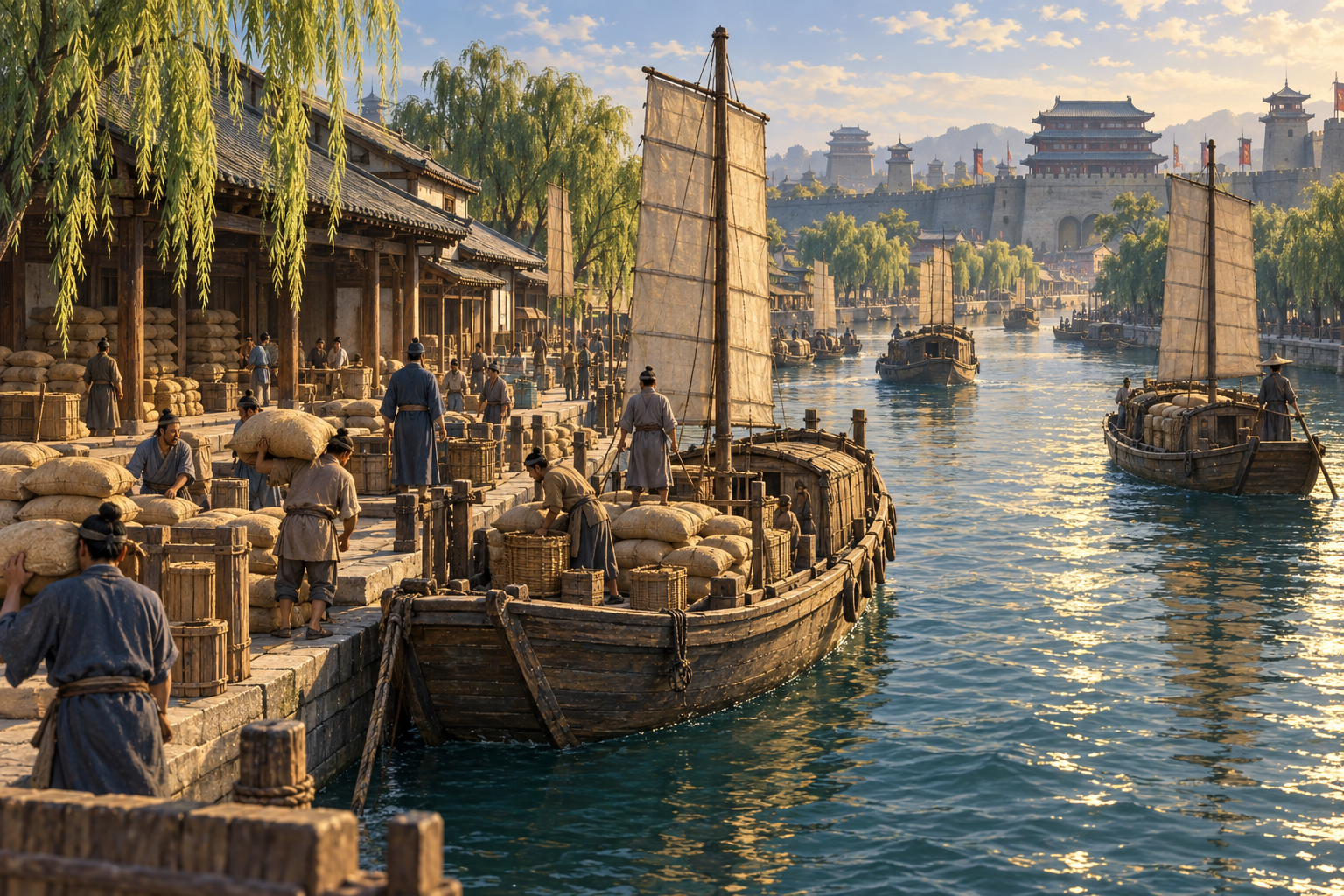
Getting grain to Tongzhou and getting boats into Dadu were different problems. The second required a navigable channel with enough controllable water. Imagine a vessel moving past the bank: transport and water supply suddenly become parts of the same urban question.
Guo’s planning connected work on the Baifu spring supply with the Tonghui waterway. Separate two questions as you read: where did the water come from, and where did the boats need to go? One concerns sources and terrain; the other concerns transport and the city’s needs. Their routes must work together, without necessarily following the shortest straight line.
Give an imagined grain route some constraints. Boats must arrive, water cannot be spent without limit, and a connection outside the city must fit the space inside it. The engineering problem becomes more than digging a channel: it is making different systems cooperate.
The Shoushi calendar: measure first
Guo also worked with Wang Xun, Xu Heng and others on the Shoushi calendar. Improved instruments, observations and comparisons of measurements all belonged to that undertaking. It was collaborative work, not a lone genius writing down a number through inspiration.
The calendar used a year length of 365.2425 days. Start by comparing that with 365 days: the fraction is hard to notice in daily life, but its accumulation changes how dates correspond to seasons. A calendar must be calculable while remaining answerable to observations of the sky.
Water engineering and astronomy concern different things, yet they invite related questions. What was measured? How did calculation use those measurements? What did the result make possible for people? Connecting a channel with a shadow through these questions makes Guo’s career a line of inquiry rather than a list of achievements.
The memory in Shichahai
The Guo Shoujing Memorial beside Xihai Wetland Park offers a way into this history of urban water. Models and displays connect Dadu’s planning with the Baifu supply and the Tonghui waterway. Looking at the waters around Shichahai afterwards gives the present landscape another historical dimension.
Take one question into the exhibition: find a water source and a place that needed water, then follow how the display connects them. Afterwards, explain in your own words what lies between having water and being able to transport grain. Check the museum’s current arrangements before visiting.
Beijing: from Yuan capital to Ming palace and frontier
Follow Dadu’s walls and waterways into the Central Axis, the Ming palace and the Great Wall. This is a reading sequence, not a one-day itinerary.
- Dadu, China: the Yuan capital in today’s Beijing →
Locate Dadu through its names, extent and remains.
- Guo Shoujing and the Tonghui RiverYou are here
Explore the capital’s water supply and transport.
- What Is Beijing’s Central Axis? History and Places to See →
Recognize successive building phases along the city axis.
- When Was the Forbidden City Built? Yongle’s Beijing →
Understand why the Ming palace is not the Yuan palace.
- Why Was the Ming Great Wall Built? Towers, Passes and Length →
Move from the capital to northern frontier defenses.
Follow the connections