The Four Treasuries: preservation and purge
3,400 works collected, 3,000 destroyed: preservation and purge in one motion — the Siku is the key to Qing cultural policy.
The greatest compilation
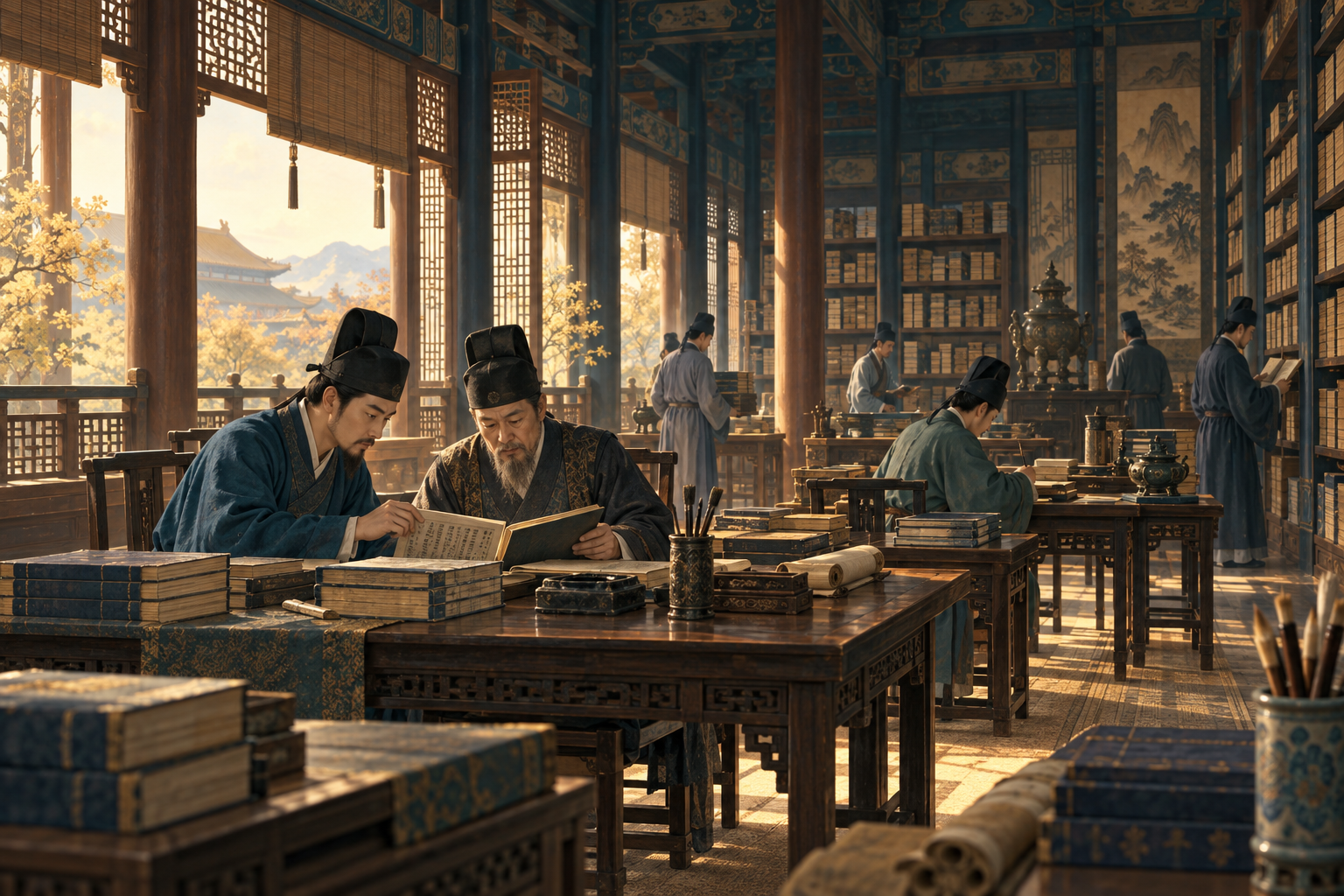
In 1772 the education commissioner Zhu Yun memorialized proposing to recover lost books from the Yongle dadian. Emperor Qianlong took the suggestion and enlarged it into a grand series embracing all learning ancient and modern — in 1773 the compilation of the Siku quanshu formally opened.
The project’s scale: Ji Yun (the famous Ji Xiaolan) as chief editor, Lu Xixiong and Sun Shiyi as chief collators; more than 3,600 scholars mobilized (some counts over 4,000); over a decade of work. Collected: 3,460-odd titles, 79,000-odd fascicles, some 800 million characters. Seven manuscript copies made: the Wenyuan Pavilion in the Forbidden City, Wenyuan at Yuanming Yuan, Wensu at Shenyang, Wenjin at Chengde (the northern four), and Wenhui at Yangzhou, Wenzong at Zhenjiang, Wenlan at Hangzhou (the southern three).
The Annotated Catalogue, and recovering lost books
The Siku’s scholarly contribution lies chiefly in two places:
The Annotated Catalogue in 200 fascicles: for every title collected, a digest collating editions and weighing merits — the most systematic reference tool in the history of Chinese bibliography, still the first stop for rare-book research. Scholars like Yu Jiaxi later showed its strongly official stance, but its scholarly framework remains valid.
Recovery work: 385 lost works in 4,946 fascicles extracted from the Yongle dadian — including major histories like the Old History of the Five Dynasties and the Extended Continuation of the Comprehensive Mirror. A great act of cultural rescue.
Collecting as banning
But the compilation’s other face was cultural purge. While books were collected, Qianlong ordered every submitted title vetted one by one: “obstacle” books — anything slighting the Liao, Jin and Yuan (the Qing’s precedents), recording late-Ming and early-Qing events, or bearing anti-Qing thought — were destroyed whole, culled in part, or emended.
By modern scholars’ counts: over 3,100 titles and 150,000 volumes banned — nearly equal to the number collected. A famous case: the Tiangong kaiwu was banned for the phrase “northern captive,” vanished in China for nearly two hundred years, and was recovered only in the Republican era from Japan. The poetry case of Xu Jun (“the clear breeze, not knowing letters, why disorder my books”) — though a separate literary inquisition — shows the atmosphere of textual terror.
“Banning inside collecting” was the darkest face of the project: the state purging thought in culture’s name.
Seven sets, seven fates
The fates of the seven copies epitomize modern China’s sufferings: the Wenyuan set burned with Yuanming Yuan in 1860 under the Anglo-French torches; Wenhui and Wenzong perished in the Taiping war; Wenlan scattered when Taiping forces took Hangzhou, then was rescued and recopied by the Ding brothers of Hangzhou until essentially whole. The Wenyuan set sailed to Taiwan in 1948 (now Taipei Palace Museum); the Wenjin set entered the capital library in 1915 (now the National Library of China), the best preserved; the Wensu set moved to Lanzhou in 1966 for war preparedness (now Gansu Provincial Library).
Reading the Four Treasuries means reading three things at once: what it preserved (the systematic ordering of the Chinese canon), what it destroyed (a great purge of thought), and how it itself survived (a wanderer’s history through war). All three together make the complete Siku story — and the key to Qing cultural policy.
Government and change in the Qing
Connect the court, public finance, regional armies and institutional crisis.
- Kangxi and the three feudatories →
Begin with consolidation under Kangxi.
- Yongzheng’s thirteen years: taxes, memorials and imperial succession →
Examine changes to revenue, information and succession.
- The Four Treasuries: preservation and purgeYou are here
Explore cultural compilation and power under Qianlong.
- Zeng Guofan and the late Qing: regional armies, war and industrial change →
Connect regional armies to the aftermath of civil war.
- The abdication of 1912 →
Finish with the imperial abdication of 1912.
Follow the connections