Tang and the founding of Shang
Nets opened on three sides, a cook made minister, tribute withheld to test an empire: Tang’s conquest was calculated step by step.
The last ruler of Xia
By the seventeenth reign the Xia dynasty stood on rot. Legend paints its last king Jie as immensely strong, able to wrestle tigers, and infinitely clever at pleasure: palaces and jade terraces raised, beauties gathered from every land — above all Mo Xi — and a pond deep enough to sail boats on, filled with wine; one drumbeat and three thousand men drank from its rim like cattle at a trough.
The people suffered past bearing. They cursed him as they cursed the sun: “When will this sun die? We would die with you!” When subjects curse their king as a poisoned sun, the dynasty’s end is not far.
The lord of Shang
Meanwhile the eastern state of Shang was quietly rising. Shang was a vassal of Xia, and its lord Tang resided at Bo.
Tang’s fame was Jie’s exact opposite. Seeing a fowler set nets on all four sides, praying that everything flying above and running below should enter his nets, Tang said: too much — strike three sides, leave one; let those that wish go left or right go free; only those that defy fate enter my net. When the lords heard of this they marveled: so humane to birds and beasts — how much more to men! They rallied to him one after another. “Opening the net on three sides” is where that idiom was born.
Tang’s indispensable aide was Yi Yin, a legendary figure who arrived among a bride’s dowry-servants carrying his cooking pots — and argued statecraft through the heat of cooking: fire too fierce burns the dish; governance too fierce burns the people. Tang was delighted and raised him to minister.
Clipping the wings one by one
Tang’s military method was highly disciplined: he never attacked Xia itself first, but cut away its vassals. The lord of Ge neglected the sacrifices; Tang sent to ask why, and Ge said there were no cattle or sheep — Tang sent cattle and sheep, and Ge ate them; Ge said there was no grain — Tang sent men to plow for them, and Ge robbed the food-carriers. Only then did Tang destroy Ge, with justice plainly on his side.
Next came Wei, Gu and Kunwu: the feathers of Xia plucked one by one. Tradition adds Yi Yin’s stratagem of state: Tang deliberately withheld tribute to test Xia’s strength. Jie raged and mustered the armies of the Nine Yi to punish him — proof he still had force — and Tang at once apologized and paid. The next year Jie summoned the Nine Yi again and nobody came. Only then did Tang know the moment had arrived.
Mingtiao, and a new founding story
Around 1600 BCE Tang formally marched against Xia. At the war oath he spoke the famous declaration: “Xia has sinned; I fear the Lord on High, and dare not fail to punish.” The armies met at Mingtiao; the Xia host collapsed; Jie was exiled to Nanchao and died there within a few years.
Tang returned to Bo, issued the Speech of Tang to all under heaven, eased taxes and encouraged production. Note carefully the founding story this new dynasty told itself: Jie lost virtue, so Heaven’s mandate transferred to Shang — henceforth every change of dynasty in China would tell the same story: we did not seize power; Heaven reassigned it because the previous house had lost virtue. That narrative tradition ran for three thousand years.
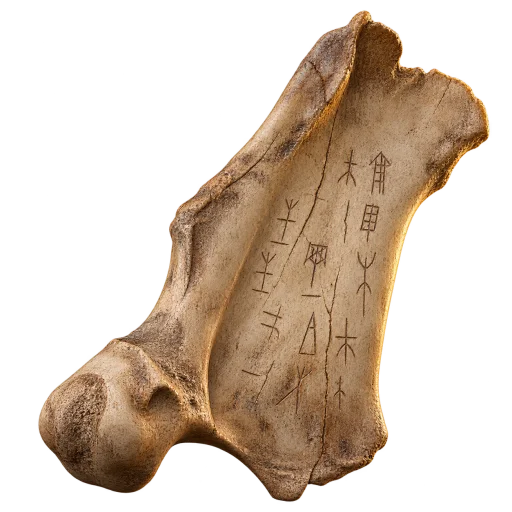
To be clear: the Shang conquest of Xia has no contemporary written proof; the location of Mingtiao and the details of the campaign all have variant accounts, and which archaeology corresponds to early Shang is still discussed. What is reliable about the story is its frame — the people after Zhou believed it and kept using it.
Follow the connections