Erlitou and Xia: what can a city without royal names tell us?
Palaces, roads, bronze casting and turquoise objects make Erlitou central to early-state research. Explore what is visible, and why its relationship to Xia remains a historical question.
Start with three different names
Xia, the Erlitou site and Erlitou culture often appear together, but they name different things. Xia is a dynasty in transmitted historical texts. The Erlitou site is a settlement in present-day Yanshi, Luoyang, which can be excavated and measured. Erlitou culture is an archaeological category defined through recurring features of material remains.
Palaces, roads and workshops help establish the scale of social organization. Identifying their makers with a named dynasty also requires comparison of dates, distribution and written traditions. Separating these steps does not diminish the site. It clarifies the difference between an excavated observation and a historical interpretation.
Why can roads be a major discovery?
Erlitou matters for more than individual treasures. Roads, building complexes and spatial divisions make it possible to discuss how a major settlement was organized. Consistent relationships between palatial areas, production and other activities indicate planning beyond a single household.
Excavation does not uncover an entire city at once. New trenches, stratigraphic relationships and dating can revise the sequence assigned to particular buildings. A plan therefore invites two questions: what kind of center does it represent, and which parts actually existed together? A city built over generations should not be mistaken for one instantaneous design.
The supply chain behind bronze workshops
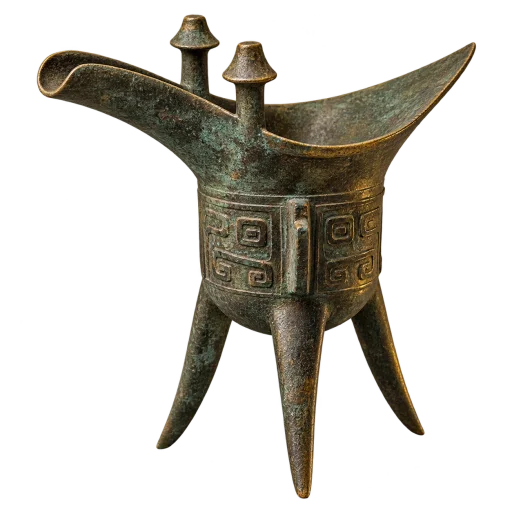
Bronze production required ore, fuel, molds, skilled workers and arrangements for transport and supplies. Evidence of specialized production at Erlitou points to coordinated craft activity. An object did not simply emerge from a palace: it was the result of linked tasks.
When ritual bronzes appeared in selected burials or ceremonies, production also became connected to authority. Those able to mobilize materials and labor and control access to finished objects could command resources unavailable to ordinary households. Even without identifying a king, the evidence allows discussion of how differences in status were made visible and maintained.
Turquoise joins technical skill to status
Turquoise objects at Erlitou, including a dragon-shaped assemblage and inlaid bronze plaques, demonstrate precise preparation and arrangement of small pieces. Their significance is not exhausted by resemblance to a familiar dragon. Manufacture, arrangement and placement in a burial are part of the evidence.
An animal image may illuminate a symbolic tradition without proving that a later myth already existed in its complete form. Comparisons of techniques and motifs across regions can reveal exchange and inheritance. Calling every elongated creature the same dragon, or assigning an ornament to a legendary individual, would conceal rather than explain what the object tells us.
Was Erlitou a Xia capital?
Many researchers connect Erlitou with the later Xia period, drawing on chronology, location and its prominence as a center. Yet no contemporary inscription securely supplies the dynastic name and royal sequence needed to settle every identification. Different proposals for the Xia–Shang transition and the site’s phases also affect interpretation.
Neither extreme follows from the evidence: finding a great center does not verify every story about Xia kings, while lacking royal names does not make the site historically empty. Archaeology can demonstrate complex society and early-state development powerfully. Establishing its exact place within the transmitted dynastic genealogy is a further question.
Let stories and remains answer different questions
Stories of Qi’s succession, Taikang’s loss of rule and Shaokang’s restoration reveal later thinking about inheritance and political recovery. Erlitou raises different questions about building, production, status and the organization of a center. They belong in a shared learning route without serving as substitutes for each other’s evidence.
A journey into early history from Luoyang need not begin by locating an individual ruler’s exact residence. Compare palatial areas and workshops, the center and its surroundings, then continue to the written world of Yinxu. The kinds of evidence change: dynastic names in later narratives can increasingly be compared with records left by ancient people themselves.
From settlements to inscriptions
Follow settlements, water management, cities and writing to understand what different kinds of evidence reveal.
- Yangshao and Banpo: how did everyday life become village life? →
Begin with homes, food and everyday craft work.
- Liangzhu and early cities: organizing life before the dynasties →
Connect large projects with social organisation.
- Taosi and Shimao: why did major centers rise across the Yellow River region? →
Compare early centres in different regions.
- Erlitou and Xia: what can a city without royal names tell us?You are here
Distinguish archaeological evidence from a dynastic identification.
- Yinxu oracle bones: how royal questions became historical evidence →
Introduce contemporary written records.
- How Western Zhou connected its realm: appointments, ritual and Heaven →
Continue into ritual, land and political relationships.
Follow the connections