From Wen and Jing to Emperor Wu: recovery and the costs of expansion
Granaries, regional kingdoms, frontiers and coinage shaped the Western Han together. Follow the accumulation of resources and the costs of turning them into imperial power.
Founding an empire did not instantly repair everyday life
Liu Bang’s foundation of Han ended the main struggle for the empire, but did not instantly restore fields, population or transport. Military demands, displacement and years of supplying armies had damaged local life. The new dynasty needed to make continued production possible, not merely celebrate victory.
Emperor Wen took the throne in 180 BCE and Jing in 157. Their reigns are remembered together for fiscal restraint and recovery. That label identifies a broad tendency rather than forty years without frontier threats, natural disasters or political crises. Nor does aggregate prosperity mean that every household prospered equally.
Restraint was a form of policy, not the absence of government
Reducing certain burdens, encouraging agriculture and restraining court expenditure allowed households more room to produce and accumulate. Wen also changed aspects of penal practice. Such measures indicate attempts to reshape the relationship between government and population, although implementation depended on officials and local conditions.
The Shiji’s economic account describes accumulated grain and money after decades of recovery, but also discusses powerful local interests, concentration of resources and luxury. Both sides matter. Growth in wealth and the distribution or use of that wealth are separate historical questions.
154 BCE: prosperity did not settle the regional kingdoms
Early Han combined directly administered commanderies with kingdoms held by members of the imperial family. Some kings controlled substantial regional resources. They were relatives of the emperor, but could also become difficult political rivals. Jing’s reductions of royal territories helped trigger the Rebellion of the Seven States in 154 BCE.
After suppressing it, the court tightened control over the kingdoms. Recovery and centralization were therefore not necessarily opposing policies. A government could reduce some burdens on society while restricting regional rulers’ independent power. Emperor Wu inherited a center–region relationship already altered by these conflicts.
After 141 BCE: accumulated resources supported wider ambitions
After Wu’s accession in 141 BCE, Han gradually pursued more active military and diplomatic policies. Wars with the Xiongnu, missions toward the Western Regions and expansion elsewhere changed its reach. Zhang Qian’s journeys are one vivid thread, not evidence that every initiative followed a single predetermined plan.
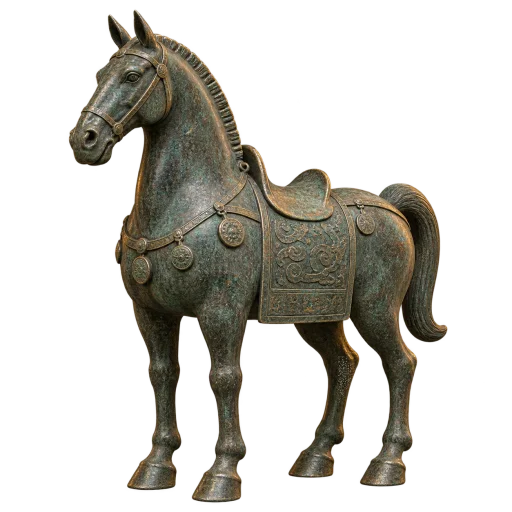
Distant campaigns and missions demanded sustained supplies of grain, horses, transport and people. What appeared as prestige in the capital could mean labor and danger for a household supporting the supply line. The enlargement of imperial reach must be read together with the social costs that made it possible.
Why did salt, iron and coinage become central political questions?
Sustained expenditure encouraged new fiscal measures. State involvement in salt and iron, control of minting and circulation, and systems for procurement and price stabilization brought the court more deeply into economic activity. Revenue, control over powerful private interests and the supply of resources were connected objectives.
Implementation raised further questions. Could official enterprises operate effectively? Did transport and collection impose additional burdens? Would one arrangement work across different regions? An imperial order did not remove those difficulties. Greater capacity enabled larger undertakings, but could also transmit mistakes more widely into everyday life.
Recovery and expansion belong to the same history
Wen and Jing are often contrasted with Wu as frugality versus ambition. The contrast is memorable but obscures their connection. Earlier recovery supplied resources for later initiatives, while expansion generated demands that reshaped finance and society. Each reign inherited conditions it had not created alone.
The Han remains around modern Xi’an invite connections between palaces, tombs and ordinary production. Zhang Qian and Sima Qian then offer two further paths: reaching outward and writing an account of the empire’s past. The transition through Wang Mang to Eastern Han asks whether accumulated institutional problems disappeared when rulers changed.
Follow the connections