Sima Qian and the Shiji
The deepest shame, the first universal history: in six characters — explore heaven and men — Sima Qian bought back the meaning of his life.
A father’s dying wish
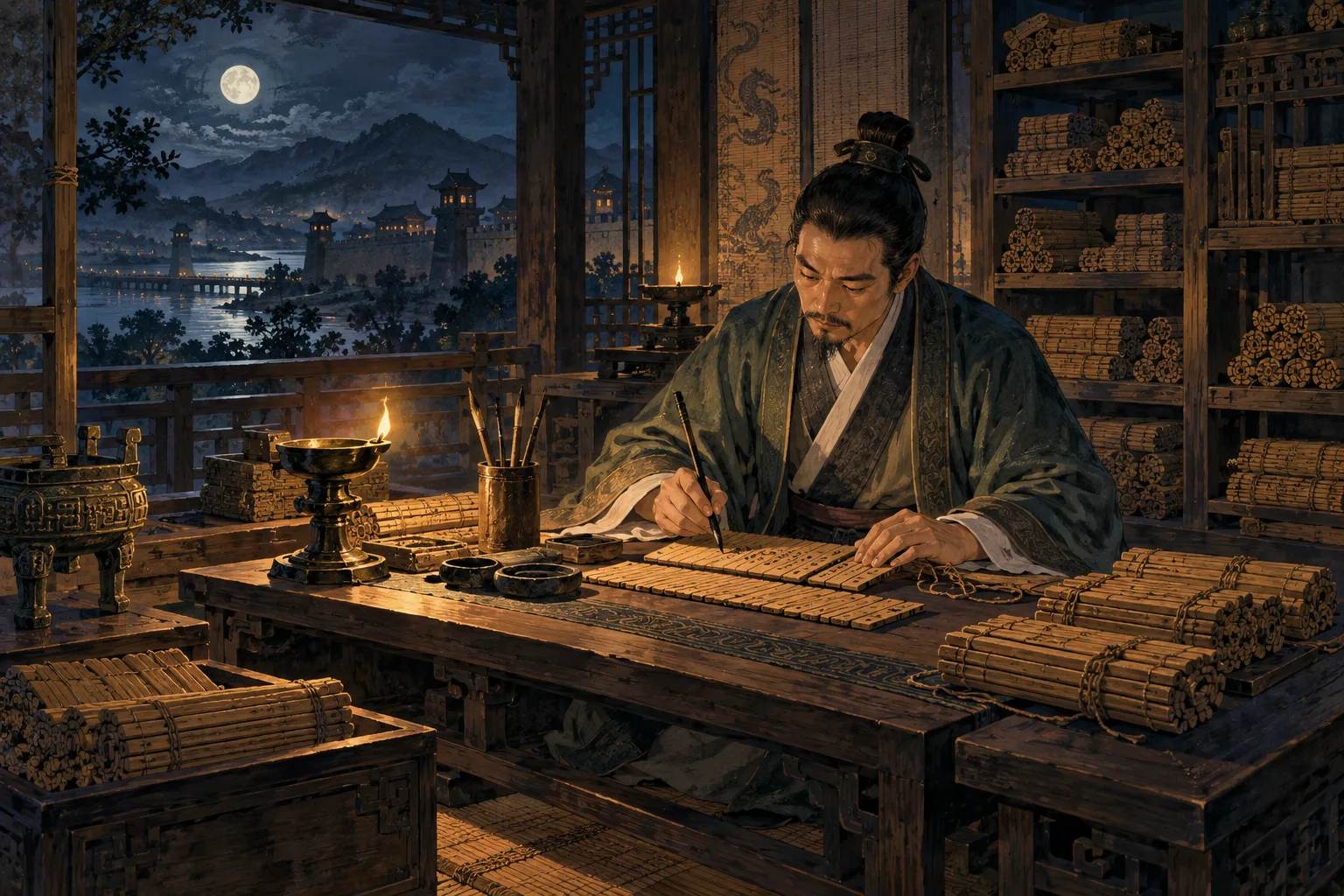
Sima Qian was born into the historians’ trade. His father Sima Tan, Grand Historian to Emperor Wu, dreamed of writing a universal history and died with the work undone, clasping his son’s hand in tears: when I die, you will be Grand Historian — do not forget the book I meant to write.
Sima Qian bowed, weeping: your unworthy son will set out in full the old records of our fathers, omitting nothing. Three years later he took the office and gained the imperial archives. At twenty he had already roamed the empire: up Kuaiji to Yu’s caves, floating the Yuan and Xiang, north through Qi and Lu — watching villagers practice ritual in Confucius’ homeland, hearing old men tell the Chu–Han wars. All that walking became the texture of the Shiji.
The disaster
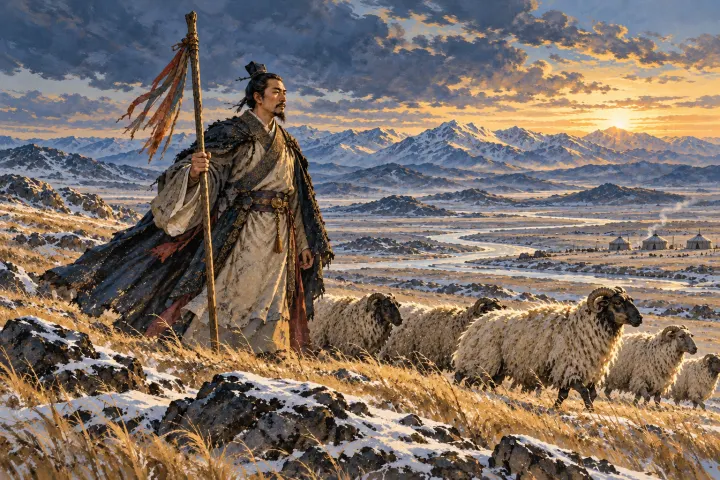
In 99 BCE the general Li Ling marched five thousand infantry deep into Xiongnu territory, was ringed by eighty thousand horse, fought eight days — and surrendered when arrows and grain ran out. The court roared for his blood. Asked his view, Sima Qian said plainly: Li Ling is filial and faithful; he fought the many with the few, and his surrender may be a plan to repay Han later.
The emperor raged — the remark stained the campaign of Li Guangli, the Ershi general, brother of the emperor’s favorite consort. Convicted of deceiving the throne, Sima Qian could redeem a death sentence with 500,000 coin. He was poor. His hands were bound, his body searched — and he took the most humiliating option: castration.
He was about forty-seven. To his friend Ren An he later wrote: no wound cuts deeper than the loss of honor to one’s ancestors, no disgrace greater than the palace punishment. He thought of dying — but my private work unfinished, my writing not shown to later ages — so he endured, living in filth, because the book was not done.
Exploring heaven and men
The letter to Ren An strings the famous roll call: King Wen, imprisoned, expanded the Changes; Confucius, in distress, made the Spring and Autumn; Qu Yuan, exiled, sang the Li Sao; Zuo Qiu, blind, wrote the Guoyu… the three hundred Odes were mostly born of worthies venting their grief.
Sima Qian enrolled himself in that lineage and turned history-writing from a post into a reason to live. His stated aim: to explore the boundary of Heaven and man, to thread the changes of past and present, and to make one house of my own.
The Shiji: 130 chapters, 526,500 characters — twelve Basic Annals, ten Tables, eight Treatises, thirty Hereditary Houses, seventy Ranked Biographies. It writes kings and also failed heroes like Xiang Yu; lords and also the commoner Confucius; and gives chapters to knights-errant, assassins, merchants, physicians and wits — in a world that judged only by success, he made room for the fallen and the marginal.
Hidden in a famous mountain
When the Shiji was done, Sima Qian knew it ill suited the powers of his day (the chapters Emperor Wu could read are said to have enraged him), so he hid the original in a famous mountain, leaving a copy in the capital, awaiting the reader of later ages.
After the Shiji, Chinese official history had a mold: all Twenty-Four Histories descend from its forms. It taught a way of seeing: do not flatter victors or erase the fallen; give institutions their treatises, people their biographies, and set every figure back into his circumstances.
His death went unrecorded — like many of his own characters, he stepped off the stage of history. But whenever anyone says history will not forget, this man stands behind the words: the one who bore the deepest shame and kept memory alive for everybody.
Follow the connections