Su Wu’s long mission
When rams give milk, you may go home: a bare staff of office stood nineteen years by Lake Baikal.
The friendly mission
In 100 BCE the new Xiongnu chieftain extended goodwill, returning detained Han envoys. Emperor Wu answered in kind, sending the palace gentleman Su Wu with a staff of office to escort Xiongnu envoys home with rich gifts.
The mission numbered over a hundred; the deputy was Zhang Sheng. It was meant as friendly diplomacy — until Zhang Sheng did something reckless.
The deputy’s blunder
A Han defector in the steppe, Yu Chang, had plotted to kidnap the chanyu’s mother and sneak her to Han — with private dealings involving Zhang Sheng. The plot leaked; Yu Chang named Zhang Sheng. The chanyu, furious, moved to kill all the Han envoys.
Su Wu said to Chang Hui: to bend my allegiance and shame my mission — even alive, with what face could I return to Han? He drew his sword and stabbed himself; Chang Hui and the others wept and dragged him back from death. Hearing of it, the chanyu honored the man who wanted to die, had him guarded day and night, and set about winning him over.
Healed, Su Wu was tried in public. Yu Chang was executed; Zhang Sheng surrendered under duress. When Su Wu’s turn came, the chanyu said: such a man is worth persuading. Su Wu did not move an inch.
Shepherding by the North Sea
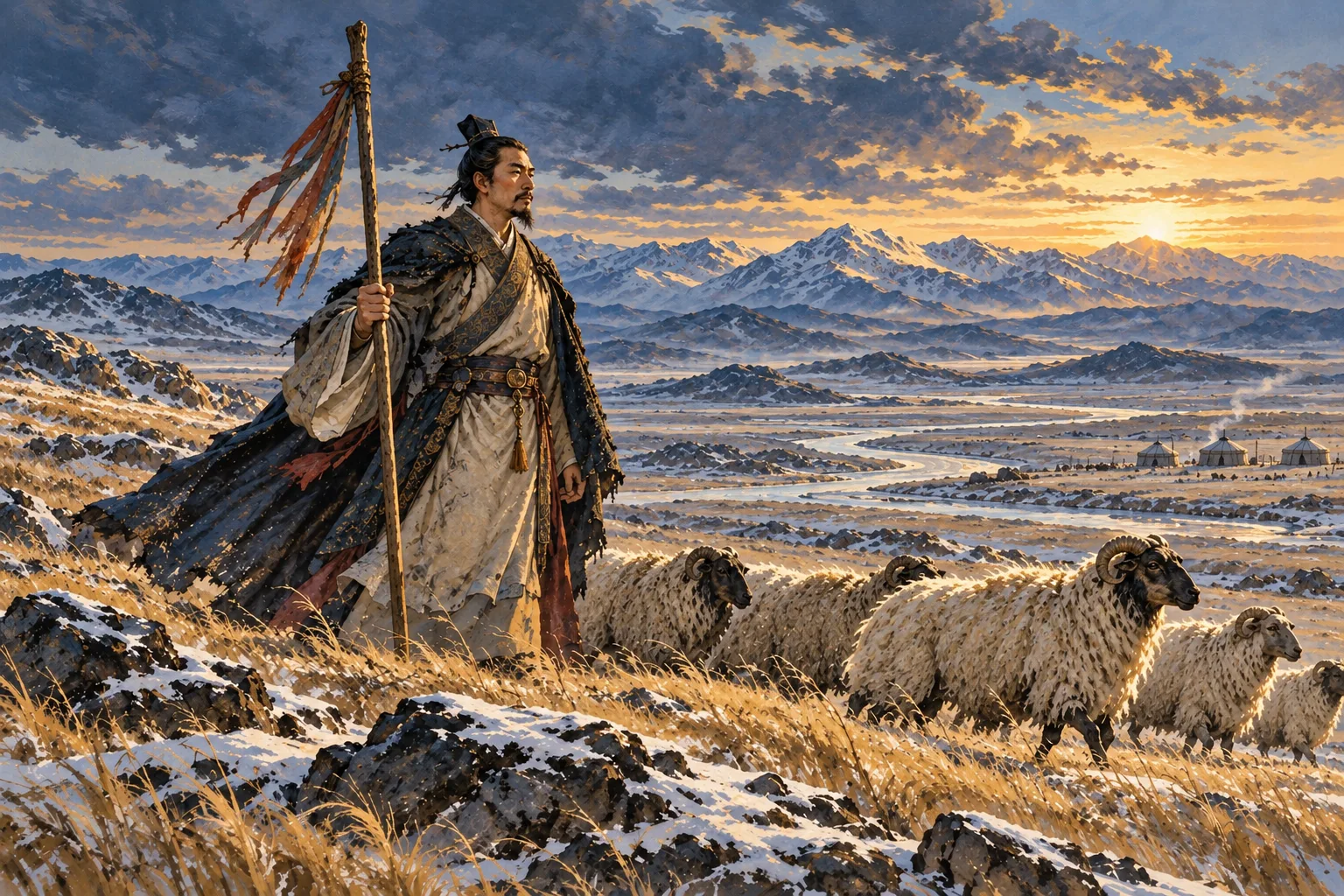
The tricks ran out. Su Wu was sealed in a pit without food; in the snow he chewed snow mixed with felt and wool and lived for days. The Xiongnu, calling him divine, exiled him to the uninhabited shores of the North Sea — Lake Baikal — to herd rams, with one condition: when the rams give milk, you may go home.
For nineteen years he dug out field mice and gathered seeds to eat, the Han staff always in his hand. In time every yak tassel fell away — a bare pole, the shape of all his loyalty to a country he could not see.
Li Ling’s visit was the last blow. The defected Han general set wine and music and argued: your brothers are dead, your mother gone, your wife remarried; life is morning dew — why torment yourself? Su Wu answered: a subject serves his ruler as a son his father; a son dying for his father has no regret. Li Ling wept till his lapel soaked: my crime and Wei Lü’s rise to heaven — and left in tears.
White-haired, home
In 81 BCE, under Emperor Zhao, Han and Xiongnu made peace. Han asked for Su Wu; the Xiongnu lied that he was dead. Chang Hui coached the envoy: the Son of Heaven shot a goose at Shanglin Park with a silk letter bound to its foot — Su Wu is in such-and-such marsh. Startled, the chanyu released him.
Of a hundred who set out, nine returned with Su Wu. In spring, staff bare of tassels, hair and beard white, he entered Chang’an to crowds moved to tears.
He served out his years as Director of Dependent States — honored, rewarded, never grand. In Emperor Xuan’s reign his portrait joined the Eleven Worthies in the Kirin Pavilion.
The source is the Hanshu biography of Su Wu. Why it has been told so often is not hard to see: his steadfastness had no worldly payoff — nineteen years bought no marquisate, only a mission everyone had half forgotten. Later ages (especially from Song on) cast him as the avatar of integrity, but he was first a real man: he wanted to die, he starved, he was moved by a friend’s tears. A true steadfastness moves more than a symbol.
Follow the connections