
Peking Man and the Tianyuan individual: what two Beijing sites tell us about human origins
Peking Man was Homo erectus. The person buried in the fossil record at nearby Tianyuan Cave about 40,000 years ago was Homo sapiens. A skull, a leg bone and a few surviving DNA fragments tell different parts of their stories.
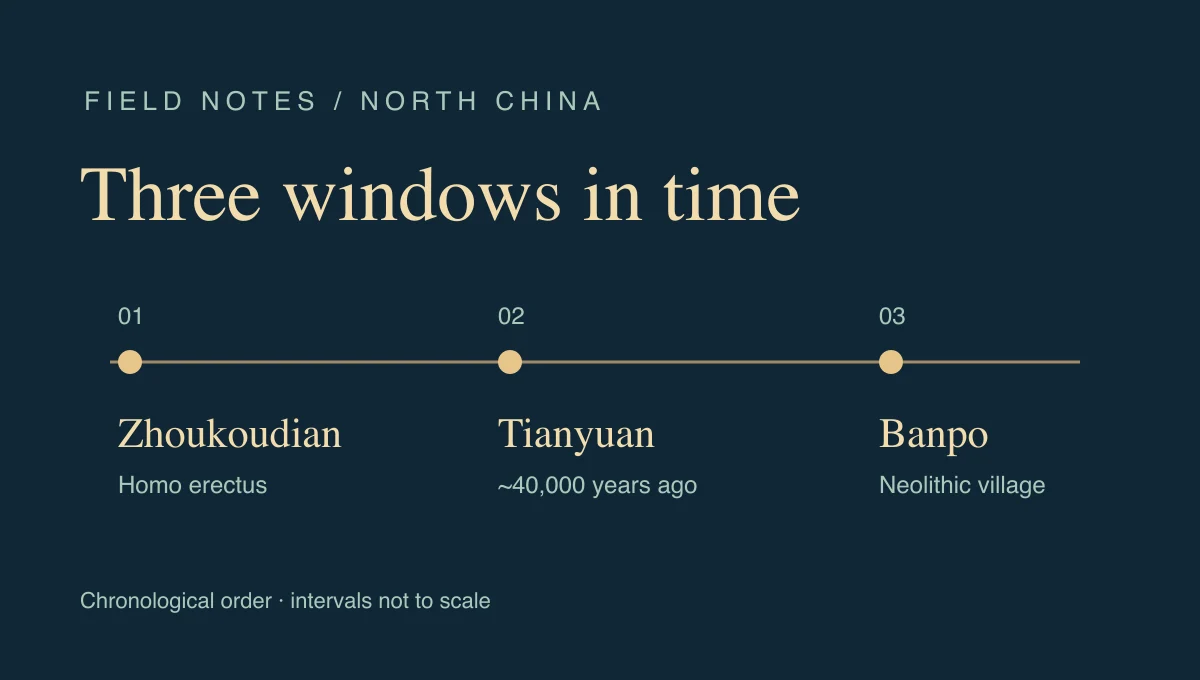
Near on a map, far apart in time
Find Zhoukoudian on a map of the Fangshan district southwest of Beijing. Tianyuan Cave lies nearby. Now replace the map with a calendar: the people known as Peking Man lived hundreds of thousands of years ago, whereas the Tianyuan individual lived about forty thousand years ago. The short journey between the sites spans an enormous interval. Peking Man is a historical name for fossils, not a resident of an ancient city called Beijing. Nor is Zhoukoudian a single chamber with a single occupant. Locality 1, Upper Cave and Tianyuan Cave are not interchangeable names. On a museum label, the locality, layer and specimen number tell you which discovery the familiar place name actually denotes.
Locality 1: how a fossil gets a name
Imagine two labels beside a specimen. One describes teeth and the shape of a skull. The other names the deposit in which it was found. Anatomical comparison helps identify the kind of human represented; stratigraphic context and dating help establish when the remains accumulated. A stone tool alone cannot tell us the biological species of its maker. Locality 1 also preserves stone artefacts, animal remains and sediments. These provide evidence about surroundings and activities that a skull cannot supply by itself. Even here, identifying an object is not the same as proving exactly how it was used. Evidence for human presence is stronger than any imagined account of one family’s day in the cave.
Tianyuan: date the bone before comparing genomes
The Tianyuan find is a partial human skeleton, not a new sampling of the Peking Man skulls. Radiocarbon dating of bone places this individual at roughly forty thousand calendar years ago after calibration. Dating a bone rather than an object nearby ties the age more directly to the person. That technique is not a universal clock for fossils hundreds of thousands of years old. A modern human was present at this place and time: that is a strong statement. How his parents reached northern China is a different question. A dated point on a map is not a migration route. Choosing between possible routes requires evidence from additional places and times, not just a line drawn between two discoveries.
Reading damaged fragments rather than a complete record
DNA extracted from old bone is a mixture. Many fragments come from microbes; handling can introduce modern human DNA as well. The 2013 Tianyuan study enriched selected human sequences and examined mitochondrial and nuclear material. Checking molecular damage consistent with ancient DNA comes before comparing genetic affinities. A well-drawn diagram of relationships is worthless if the sequences belong to a modern handler. Mitochondrial DNA follows one maternal line, just one branch among many ancestors. Nuclear DNA contains signals from many lines but carries no entry for a person’s language or community name. A 2017 study examined many more positions across the genome. It improved comparisons without turning one person into a census of northern China.
Affinity, mixture and direct descent are different claims
Sharing more genetic variants with one comparison group can support a closer population relationship. It does not establish that one sampled person was the direct ancestor of another. Cousins share ancestry too, and contact between populations can produce more than a branching tree. Tianyuan offers evidence of affinities with later people in eastern Asia and beyond, not a certificate of descent for a particular living reader. For a different time scale, researchers have compared Neolithic genomes from several sites in northern and southern China. Early differences and evidence of subsequent mixture emerged from samples situated in time and space. Neither a modern surname nor a new pottery style is a substitute: pots travel by exchange, techniques by learning, and people by migration. Those are distinct processes.
At Banpo, change the question
At Banpo near Xi’an, look first for a house floor, a pottery assemblage or traces of food storage rather than a tree connecting Peking Man, Tianyuan and Yangshao villagers as three generations. These finds may not identify anyone’s biological ancestors. They can tell us how people occupied a settlement and shared space. The journey has changed the question, not magically supplied the missing generations. Human evolution, village life and the formation of states operate on different scales. It is meaningful to tell a Palaeolithic story within the geography of present-day Beijing and then visit a Neolithic village near Xi’an. What connects these stops is a way of asking questions about the past, not a documented family pedigree.
Follow the connections
Beyond this story
A bone can preserve evidence of kinship but not its owner's speech. Farther south, place names, rice and settlements preserve different traces of human contact.
People lived by rivers long before we knew their names →