Su Shi and West Lake
With the lake dying, Su Shi wrote his memo before his poem: work relief, mud for a causeway — poetry as governance’s by-product.
Two postings to Hangzhou
Su Shi’s bond with Hangzhou came twice. First as vice-prefect, 1071–1074, a young star writing that West Lake compared to the beauty Xi Zi — lovely painted light or thick. The second time, 1089–1091, as governor — and the lake he met was another creature.
The Song history records that long undredged, West Lake was half swallowed by weeds and silt; in twenty more years there would be no lake at all. The Xi Zi of the poets was becoming a marsh.
A hydraulic memo
The governor wrote no poem first — he wrote a memorial, Petition to Open West Lake at Hangzhou, a rare specimen of ancient public-works argument. His logic ran in steps: the lake supplies the city’s drinking water (West Lake is to Hangzhou as eyebrows are to a face); it irrigates the farms; it feeds the wine monopoly, a fiscal pillar; it serves the religious function of the release pond. In one line: if the lake dies, Hangzhou dies.
The plan: work relief. Flood had struck western Zhejiang; refugees were everywhere. The court granted monk-certificates (salable) and relief funds; Su hired the starving to dredge — and the dredged weeds and mud needed somewhere to go. He piled them into a causeway across the lake, north to south.
The causeway and the three pagodas
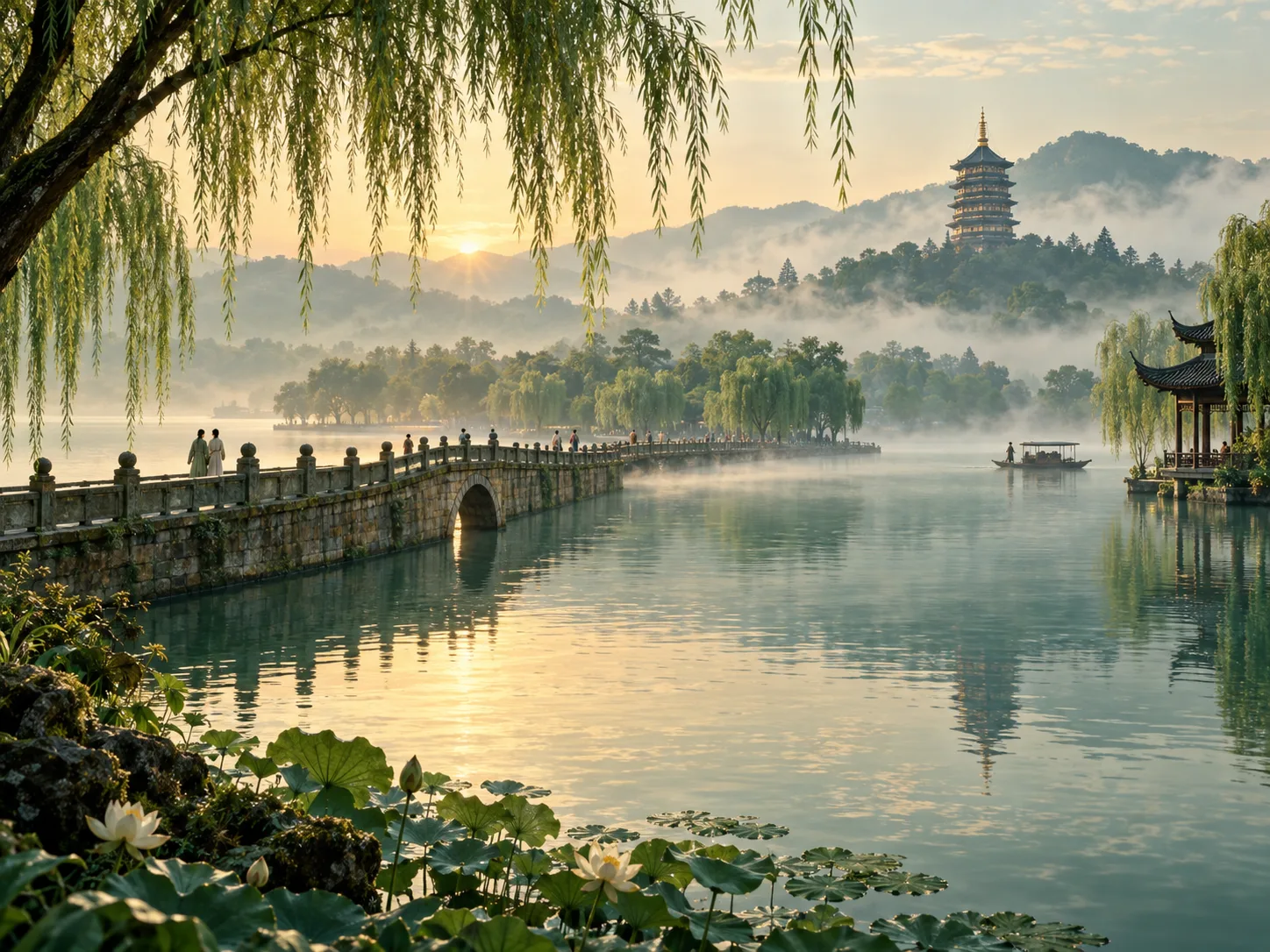
The embankment ran from Naping hill to Qixia hill, about 2.8 kilometers, planted with water chestnuts, lotus and willows, crossed by six stone bridges — the Su Causeway, named by a grateful city for his surname.
He also set three small stone pagodas as boundary markers, banning lotus cultivation within — anti-siltation zoning (later they became the scenic Three Pools Mirroring the Moon, printed on the one-yuan note). He overhauled the six-well water system so the city drank lake water again, and founded the Anle infirmary — an early prototype of public healthcare in China.
Dredging, transport, anti-silt, water supply, medicine: one hydraulic project, and at the same time one act of city governance.
Poetry as by-product
The wine-and-song legend around Su in Hangzhou — the Dongpo pork tale, anecdotes with monks and singing girls — is mostly later embellishment; today’s willowed causeway is far rebuilt from the Song embankment.
What the story is really worth is not romance: facing a dying lake, an official counted the economics and the people’s needs first, then used fiscal tools and engineering to decompose the problem cleanly. Poetry was governance’s by-product. Nine hundred years on, Hangzhou remembers not the poet Su Shi but the engineer and civil governor Su Shi.
Hangzhou: waterworks, West Lake and storytelling
Follow people and stories from different periods through the cultural memory of one landscape.
- Qian Liu and Wuyue: Hangzhou’s Seawalls, Temples and History →
Start with Qian Liu, Qian Chu and Wuyue’s urban legacy.
- Su Shi and West LakeYou are here
Move to Su Shi and West Lake in the Northern Song.
- The White Snake legend and West Lake →
Explore how the landscape became a setting for legend.
Follow the connections