Along the River at Qingming: how to read a Song city
Follow a boat, then the crowd and shops. Read the handscroll in three layers without mistaking a painting for a photograph.
A lens for this story
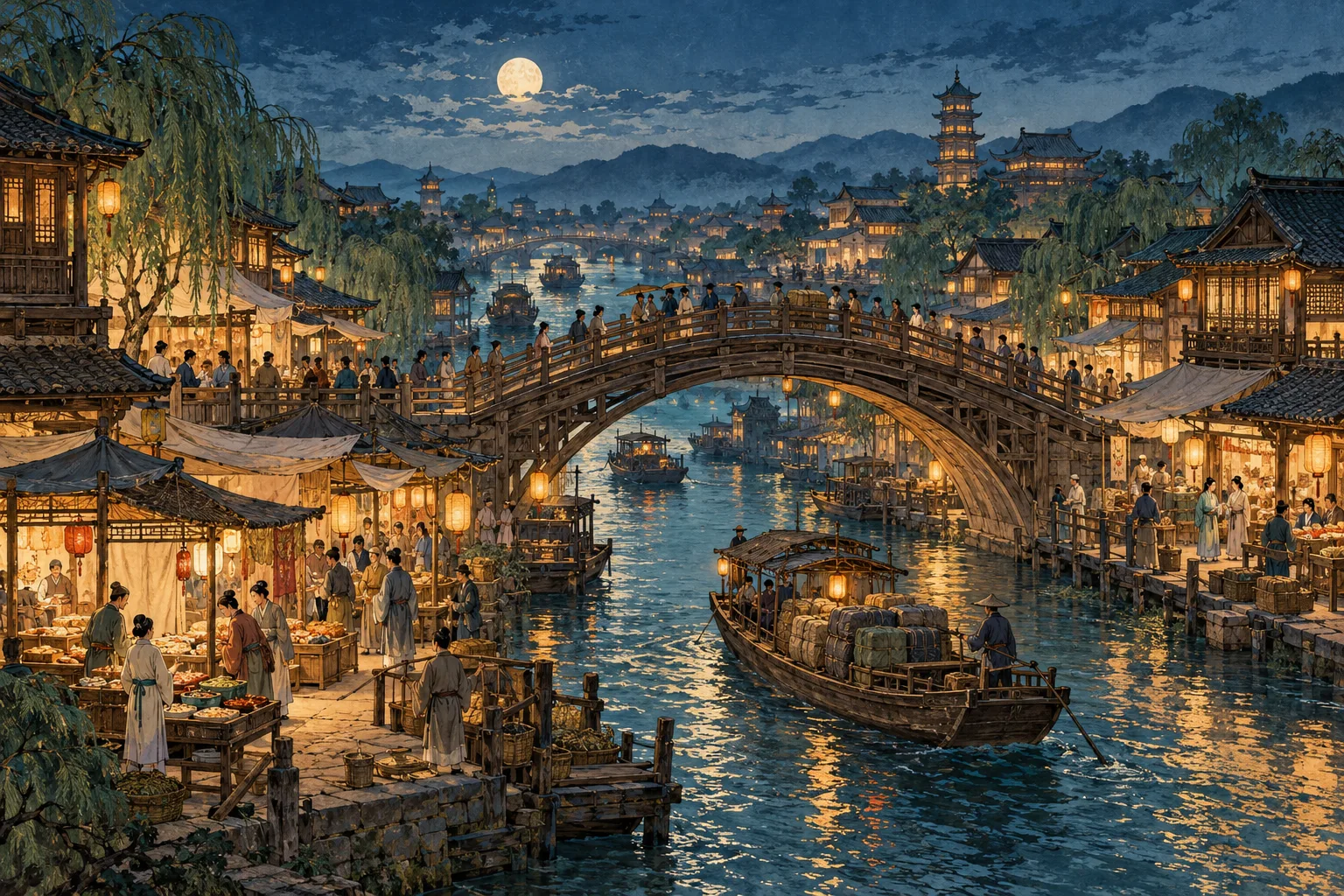
Before counting figures, find the boat beneath the bridge. Notice how it connects people on the bank, deck and water. Their relationships make a still image move.
- Describe what you see before explaining what it might mean.
- Check attribution, collection and date before comparing versions.
First identify the scroll you are looking at
This article concerns the Northern Song scroll attributed to Zhang Zeduan in Beijing’s Palace Museum. Its collection entry identifies lightly colored painting on silk, 24.8 by 528 centimeters. That unusually long format invites successive views rather than one tiny thumbnail.
When encountering another work with the same title, record its attribution, collection and period first. Later copies and reinterpretations have value of their own, but their details cannot simply be transferred back to the Song. A familiar title can survive while the city, figures and artistic choices beneath it change.
First pass: follow the boat at the bridge
The museum’s description places a river–road intersection at the timber bridge and notes a cargo boat lowering its mast, working boatmen and spectators. Pause here: why does an action on the water redirect attention above it?
Describe workers, travelers and onlookers separately, without inventing their dialogue. Who is working, moving or stopping? Build relationships from gestures and positions, then see how the painter concentrates dramatic tension where the boat and bridge meet.
Second pass: connect the shops and streets
Move from the bridge to the street without trying to decipher every sign immediately. Look at the relative positions of entrances, pedestrians and transport: who pauses at a doorway, crosses a road or shares space with a carrier? Sketch three nodes—bridge, street, shop—to notice how the composition directs attention.
The aim is not to calculate an exact urban economy from one painting, but to pose researchable questions. Where do transport and consumption meet? Which social roles share public space? Arguments about institutions, trade origins or administration need relevant written evidence as well. A painted sign or camel cannot establish every part of that argument.
Third pass: why this is not a city photograph
The handscroll arranges places and activities into a continuous viewing experience. Your eye moves; the painter selects, compresses and composes. A busy scene does not show that every part of the city was equally prosperous at every moment, and an omitted feature is not automatic proof of its absence.
Studies published by the Palace Museum offer differing interpretations of date, subject and function. The date and subject remain debated, and figure totals vary with the counting method. Instead, compare how an interpretation moves from detail to conclusion. Could another explanation account for the same visual evidence?
Afterward: make your own observation card
Choose one detail and record three sentences. First describe only what is visible. Then offer an interpretation using language such as “may suggest.” Finally identify what further evidence would be needed. A figure’s position beside the bridge can be described; an occupation, emotion or exact purpose needs a separate argument.
This small observation card is more useful than memorizing a dramatic total. Next compare the scroll’s transport and streets with geographical knowledge in Zhang Qian’s story and urban organization in the Luoyang relocation. These are different periods and kinds of evidence, but they help ask one connected question: how does a city relate to a wider world?
Cities and connections: from a scroll to a journey
A thematic path, not chronological order: observe city life, consider the organization of a capital, then follow connections beyond it.
- Along the River at Qingming: how to read a Song cityYou are here
Observe how boat, bridge and street form a city scene.
- Xiaowen moves to Luoyang: what changes when a capital moves? →
Ask which spaces and connections a capital move changes.
- Zhang Qian’s western mission: why a failed alliance still mattered →
Distinguish experience and reports in knowledge of distant places.
Follow the connections