The White Snake legend and West Lake
Broken Bridge and Leifeng Pagoda are real places; the White Snake tale is evolving folklore and literature.
A lens for this story
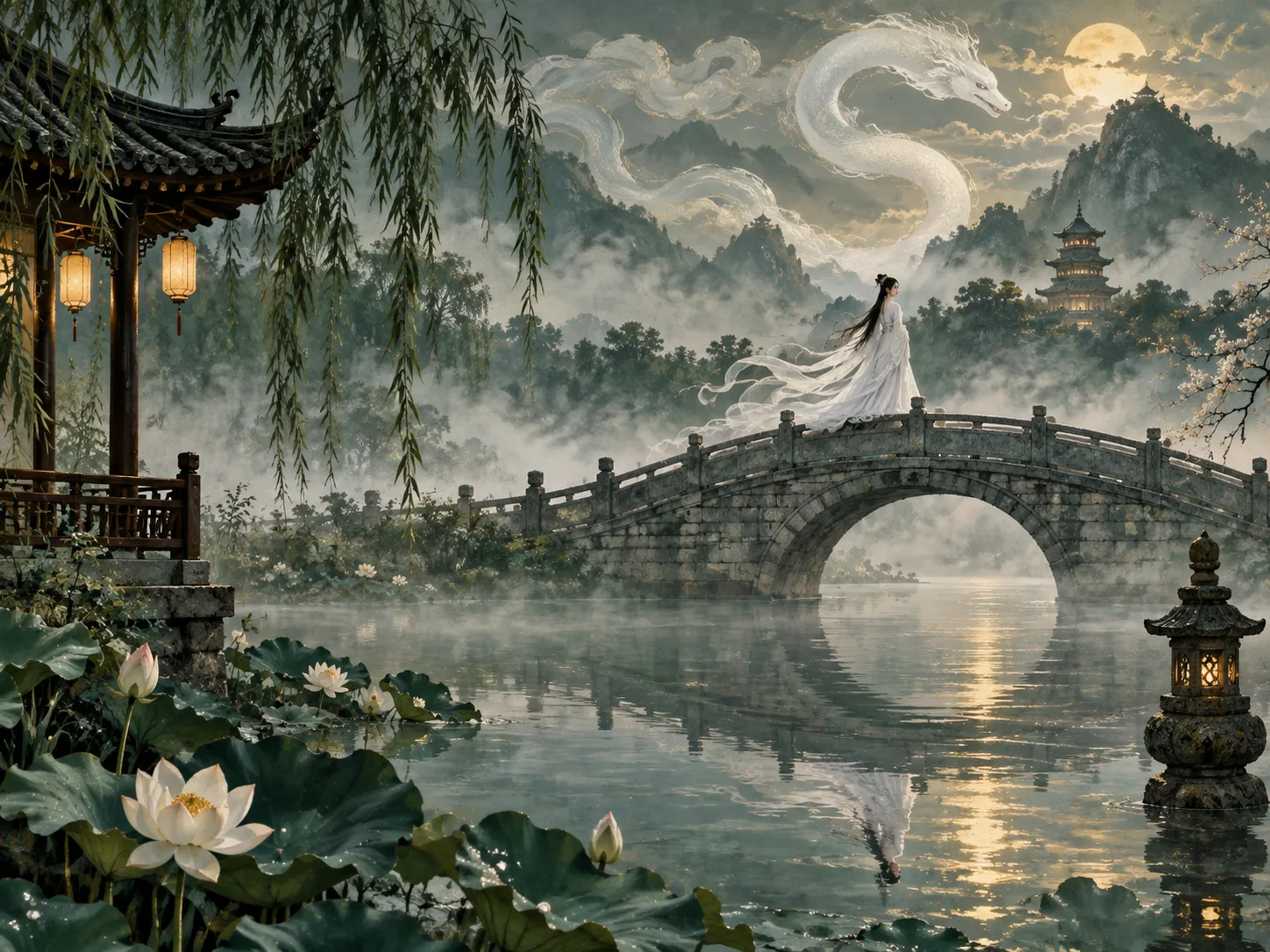
Which White Snake do you remember—an opera, a television series or a film? Choose a version before returning to West Lake: the same bridge can carry very different stories.
- Distinguish the date of a text, the period in which its plot is set and the history of a real monument.
- Comparing motives and endings reveals cultural memory better than treating every episode as a documented event.
Real places, different versions
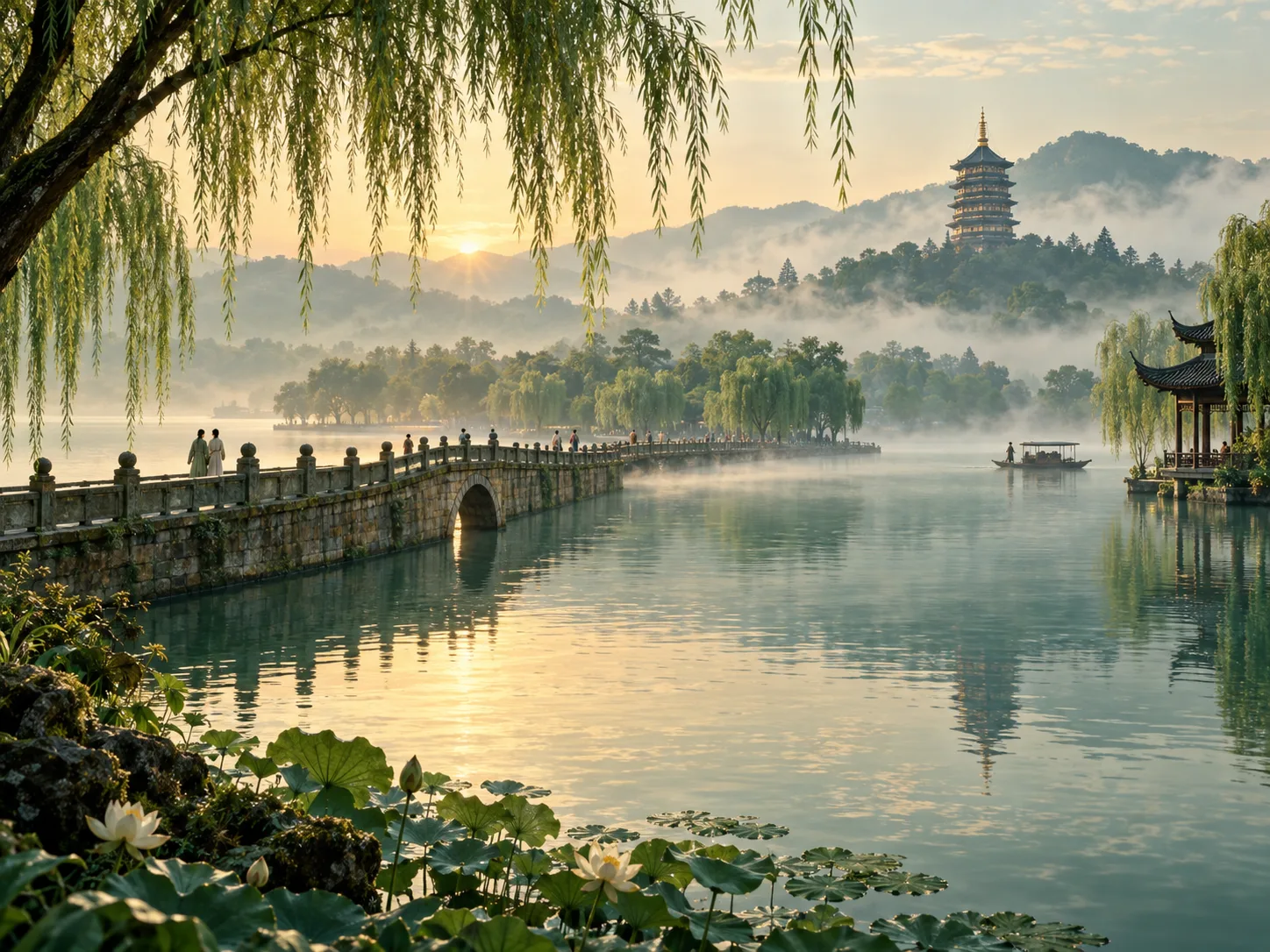
Broken Bridge, Leifeng Pagoda and Jinshan Temple in Zhenjiang are both real places and settings in different versions of the White Snake legend. The same bridge can become a place of meeting, separation or reunion in opera, film and local storytelling.
The relationships among Bai Suzhen, Xu Xian and Fahai also change between versions. Choose an adaptation you know: why do the characters come here, and what choices do they make? Compare another telling to discover how a place holds both cultural memory and imagination.
How the story grew
The White Snake tale “grew.” Tang tales hold a rough prototype of a white snake taking woman’s form to do harm; the Song storytelling script “The Three Pagodas of West Lake” supplies the frame of a demon suppressed beneath a pagoda; Feng Menglong’s Ming novella “Bai Suzhen eternally imprisoned under Leifeng Pagoda” (in Stories to Caution the World) gives the complete narrative — by then the White Snake is still a demon being punished.
The Qing adaptation “The Legend of Leifeng Pagoda” by Fang Chengpei added the classic episodes — “flooding Jinshan,” “the meeting at Broken Bridge,” “sacrificing at the tower” — and the White Snake becomes a person: one who dares to pursue love and freedom. Every rewrite carried that era’s values.
After the fall of Leifeng Pagoda
Leifeng Pagoda was built in 977 by the Wuyue king Qian Chu, and collapsed in September 1924 — Lu Xun wrote his “On the Fall of Leifeng Pagoda,” reading the collapse as the White Snake finally breaking free: the legend’s emotional force flowing back into a real building.
The new pagoda completed in 2002 preserves the old tower’s ruins inside, with an elevator rising to a panorama of West Lake. The old tower’s fall and the new tower’s rising have both become part of the story — legend and architecture complete each other, and rewrite each other.
How to walk the legend
Touring West Lake with the legend, the best approach is “paired reading”: at Broken Bridge read the official version on the signs, then watch an opera or film retelling, and count the differences in plot — who changed what, and in which era?
Be clear: the legend reflects “what people hoped West Lake would be,” not “what happened at West Lake.” Take it as an entrance into the city’s emotional history, not as place-name evidence for historical events. The two readings — one delightful, one rigorous — never obstruct each other.
Hangzhou: waterworks, West Lake and storytelling
Follow people and stories from different periods through the cultural memory of one landscape.
- Qian Liu and Wuyue: Hangzhou’s Seawalls, Temples and History →
Start with Qian Liu, Qian Chu and Wuyue’s urban legacy.
- Su Shi and West Lake →
Move to Su Shi and West Lake in the Northern Song.
- The White Snake legend and West LakeYou are here
Explore how the landscape became a setting for legend.
Follow the connections