
Wang Yangming: does being able to explain a duty mean you know it?
An exiled official and a student who refused an easy answer brought Ming moral philosophy down to a winter question: have you noticed that your parents are cold?
What happened to a good answer outside the examination hall?
In 1499 Wang Shouren, a native of Yuyao in Zhejiang, passed the highest civil service examination. Today he is better known as Wang Yangming. Like other candidates, he knew the Confucian Four Books and Zhu Xi’s commentaries. Explaining a passage to an examiner, however, was a different accomplishment from becoming the person the passage described.
Zhu Xi urged students to investigate principles in texts and particular things; he also insisted on sincerity and practice. His contemporary Lu Jiuyuan placed greater emphasis on the mind’s own capacity to discern right and wrong. Wang inherited a disagreement about how to learn to live well, not a choice between books and deeds.
Three travellers’ graves at Longchang
In 1506 Wang protested the imprisonment of officials, angering the powerful eunuch Liu Jin. He was beaten and demoted. In 1508 he reached Longchang in Guizhou to serve at a relay station. Later accounts call this period his awakening at Longchang. A piece Wang himself wrote illuminates a less celebrated moment the following year.
An official travelling to his post passed through with his son and a servant. All three died on the road. In his elegy Wang says he did not even know the official’s name. Struck by how far all of them were from home, he took two young companions to dig their graves. The elegy records an obligation to strangers, not a date for the invention of his philosophy.
An argument leaves the relay station
Guizhou was not an empty landscape where Wang thought in isolation. Guiyang had academies and scholars already engaged in disputes over the classics. In 1509 Xi Shu, an education official, invited Wang to teach at Wenming Academy. Xi’s letters preserve traces of their discussions about examination learning, Zhu Xi and Lu Jiuyuan, and the relationship between knowing and acting.
For an educator, the difficulty was practical. A candidate could produce the approved moral answer for the sake of a higher rank. Another examination might never reveal the difference in motive. What began as a question in exile became an argument that colleagues and students could challenge.
Xu Ai’s objection: people know their duty, yet neglect it
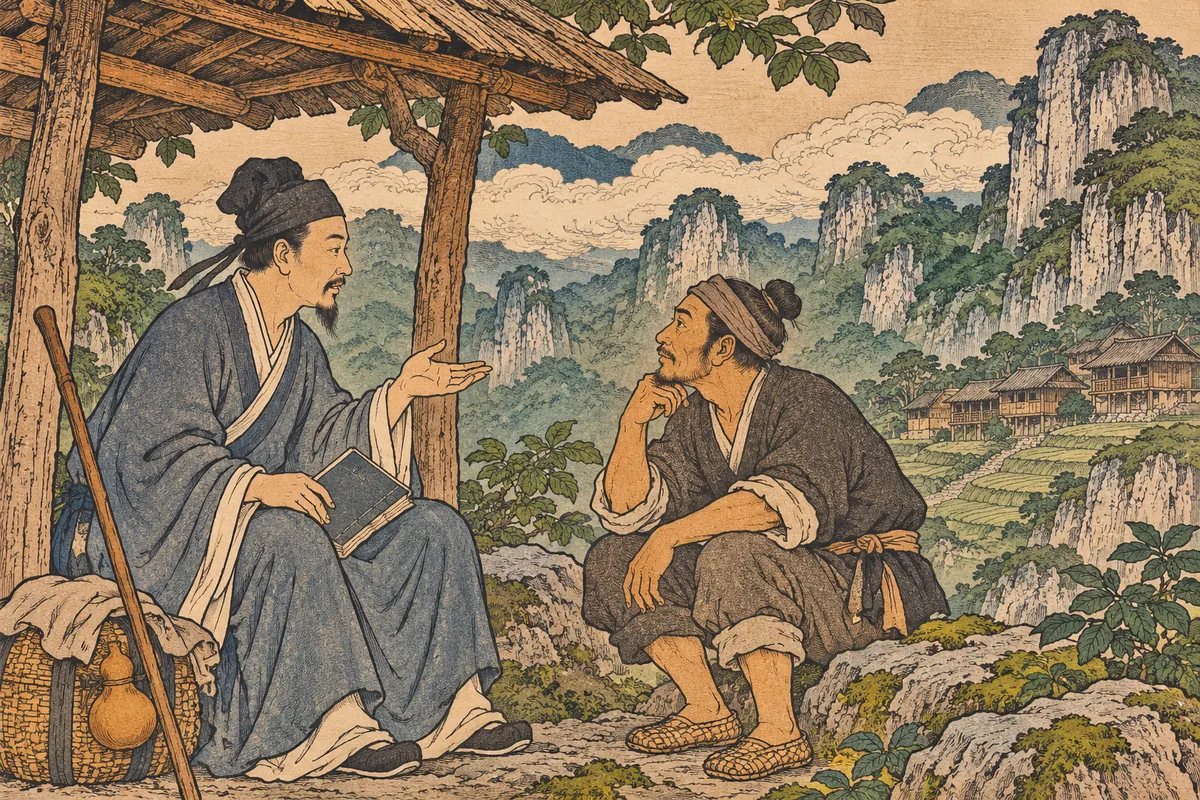
His student Xu Ai raised a stubborn objection. Some people know they owe their parents care but do not provide it. Surely that makes knowing and acting two things? Wang did not deny that such people existed. He disputed what counted as knowing. Being told that a room smells foul differs from smelling it yourself: in the latter case the aversion is already there.
This did not mean that a sincere son or daughter automatically knew how to keep someone warm in winter. Genuine concern gave a reason to notice the cold and learn what would help. Someone performing the correct gestures for an audience might look equally dutiful while leaving the parent just as cold.
Whose approval is the scholar seeking?
In a letter to Huang Chengfu, Wang worried that a scholar claiming to seek virtue might be chasing a reputation, and that a desire for distinction might conceal a desire for wealth. His later teaching on liangzhi concerned the human capacity to discern right and wrong. Acting on that capacity meant catching one’s own excuses, not assuming that every impulse was right.
Wang made public decisions too. When the Prince of Ning rebelled in Jiangxi in 1519, Wang and local officials raised forces, took Nanchang and defeated and captured the prince. The victory made Wang famous. It did not prove that every decision was morally sound: winning a contest and acting well were different standards.
A book built from students’ questions
Even before the rebellion, students’ notes had begun to travel. In 1518 Xue Kan published in Ganzhou a collection of exchanges recorded by Xu Ai, Lu Cheng and himself, an early edition of the Chuanxilu. Letters and further conversations entered later editions. Because the students’ doubts survived, readers can hear an argument in progress rather than just a four-character motto.
Wang died in 1529. Some at court praised his military service yet feared his teaching licensed private preference. Disciples kept teaching and publishing. In 1584 he was admitted to the Confucian temple for honours. Official standing had changed; Xu Ai’s question remained: when does a fine explanation of care actually change the life of someone who needs it?
Follow the connections

Beyond this story
For Wang's teaching to travel it needed lectures, academies and books. Asking who supplied rooms and money connects intellectual history with Jiangnan society.
Could a merchant pay for a school and become a scholar? →