
Why was Yu Qian executed? The Duomen coup of 1457
On the seventeenth day of the first month of 1457, Shi Heng, Xu Youzhen and their allies restored the confined former emperor Yingzong to the throne. Five days later Yu Qian, the minister of war who had held Beijing in 1449, was put to death on a charge the History of Ming calls false. Scores left open by the Tumu crisis were settled within a week.
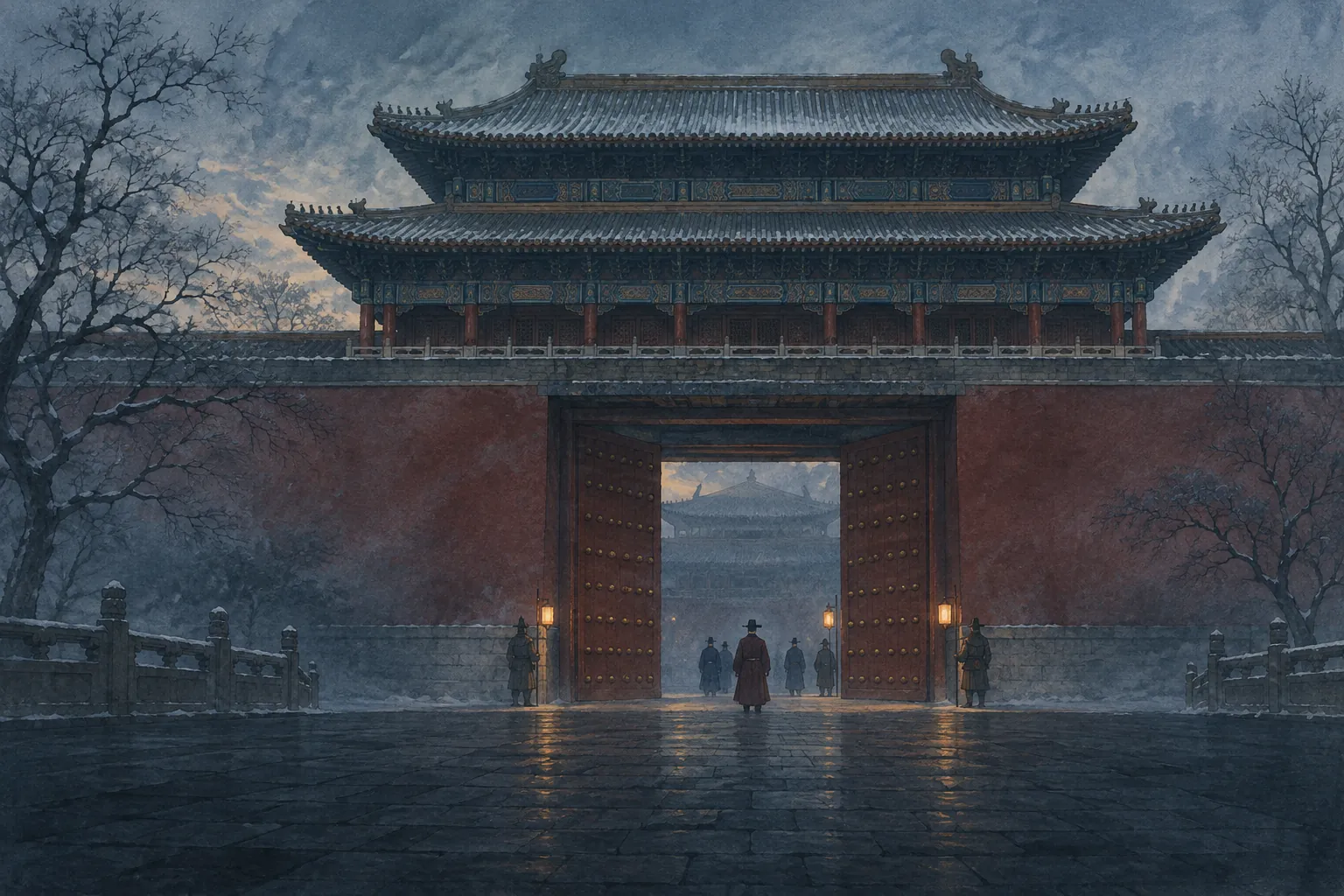
Five days: from the restoration to the execution ground
In the first month of 1457, the eighth year of the Jingtai reign, the Jingtai emperor lay gravely ill at the fasting hall of the southern suburb. His officials asked him to name an heir, and he refused. Before dawn on the seventeenth day Shi Heng, Marquis of Wuqing, the vice censor-in-chief Xu Youzhen, the eunuch Cao Jixiang and others led troops to the Southern Palace and brought out the former emperor Yingzong. He received the court at the Fengtian Gate and at noon resumed the throne in the Fengtian Hall.
That same day Yu Qian, the minister of war, and the grand secretary Wang Wen were sent to the prison of the Embroidered Uniform Guard. On the twenty-first the year was renamed the first of Tianshun. On the twenty-second Yu Qian and Wang Wen were executed and their property confiscated. The episode is known as the Duomen coup, the “seizing of the gate”.
Yu Qian was the man who had organised the defence of Beijing after the Tumu crisis of 1449. Eight years later the court he had preserved put him to death.
Two emperors left by 1449
To understand 1457 one has to return to 1449. When Yingzong was captured by the Oirat at Tumu, the capital was thrown into alarm. Some urged moving the court south. Yu Qian answered that anyone proposing it deserved death: the capital was the foundation of the realm, and to move it would be to lose everything. The Prince of Cheng acted as regent and then, at the request of the senior officials, took the throne as the Jingtai emperor.
Yingzong was returned to Beijing in 1450. From then on there was a reigning emperor and a former emperor living in the Southern Palace. In its appraisal of Jingtai, the History of Ming criticises him for hurrying to replace the heir apparent and for keeping his brother closely confined and unvisited.
A dying emperor with no settled heir created an opening. Whoever brought the former emperor back would be the founding servants of a new reign.
Who resented Yu Qian, and why
The biography of Yu Qian in the History of Ming is explicit about the grudges of the leading plotters. Xu Youzhen had once been called Xu Cheng. He was the lecturer who proposed moving south in 1449 and was denounced by Yu Qian before the court; only after changing his name did he slowly regain office. Shi Heng had been dismissed for a defeat, and it was Yu Qian who asked that he be pardoned and employed. After the battle at the Desheng Gate, Shi Heng was made a marquis although his merit was less than Yu Qian’s. Uneasy, he recommended Yu Qian’s son Yu Mian for office. Yu Qian refused, adding that a senior general who put forward no man of humble origin and recommended only a minister’s son was not serving the public interest. Shi Heng was enraged.
The biography also says that Yu Qian was unbending, looked down on timid ministers and hereditary nobles, and never favoured peace negotiations. He had been able to act because the Jingtai emperor overruled his critics. Once the emperor fell, he had no protection.
The charge: “without Yu Qian’s death, this act has no justification”
Yu Qian and Wang Wen were accused of conspiring to bring in a son of the Prince of Xiang as emperor. The censor-in-chief Xiao Weizhen drew up the verdict: treason, with the extreme penalty. The word the History of Ming uses for the charge is “false”. Wang Wen protested urgently. Yu Qian laughed and said that this was simply what Shi Heng and the others wanted, and that arguing would change nothing.
When the memorial went up, Yingzong hesitated. “Yu Qian truly has merit,” he said. Xu Youzhen replied: “If Yu Qian is not killed, this act has no justification.” The emperor’s mind was then made up.
That sentence states the problem exactly. If the chief ministers of the Jingtai court were innocent, seizing the gate had been an unnecessary gamble. Only if they had been plotting something else could bringing back the former emperor count as a service. When rewards for the coup were assigned, Shi Heng became Duke of Zhongguo, and more than three thousand officers and soldiers were promoted.
After the confiscation: no wealth, only imperial gifts
Those sent to confiscate Yu Qian’s property found that the household had no savings. Only the main room was securely locked; inside were the python robe and sword that the Jingtai emperor had given him. The History of Ming records that the sky was overcast on the day he died and that people throughout the realm thought him wronged. Chen Kui, a vice commissioner-in-chief, gathered his remains, which were buried in Hangzhou more than a year later.
The Jingtai emperor was reduced to Prince of Cheng on the first day of the second month and died on the nineteenth, aged thirty. He was buried in the Western Hills with the rites of a prince.
The men who had seized the gate did not prosper. Xu Youzhen was pushed aside by Shi Heng that same year and banished to Jinchi. A few years later Shi Heng died in prison, and Cao Jixiang’s family was exterminated after he rebelled. Chen Ruyan, who replaced Yu Qian as minister of war, was exposed for corruption within a year. Yingzong remarked to his ministers that Yu Qian had been trusted throughout the Jingtai reign and left nothing, and asked how Chen Ruyan came to have so much.
Rehabilitation, and reading this history in Beijing and Hangzhou
Early in the Chenghua reign Yu Qian’s son Yu Mian returned under an amnesty and petitioned for redress. The court restored Yu Qian’s offices and granted sacrifices. The patent said that when the state was in great difficulty he had kept the altars of the dynasty safe, and that for holding alone to what was right he had been hated by powerful and treacherous men. In 1489, the second year of Hongzhi, he received posthumous rank and the name Sumin, and a shrine called Jinggong was granted beside his tomb. Under Wanli the posthumous name was changed to Zhongsu. The Jingtai emperor’s imperial title was restored in 1475.
Two places help in reading this history. Beijing is where it happened: first the defence outside the Desheng Gate, later the restoration at the Southern Palace and the Fengtian Gate. Hangzhou was Yu Qian’s home and is where he is buried. Read together, the defence of 1449 and the coup of 1457 show more than the wrongful death of a loyal minister. They show how, when the succession was left unsettled, merit could be turned into a crime.
At a glance
| Date | What happened |
|---|---|
| 1449 | Yingzong is captured at Tumu. Yu Qian opposes moving the capital south and organises the defence of Beijing; the Prince of Cheng takes the throne as the Jingtai emperor. |
| 1450 | Yingzong is returned to Beijing and lives in the Southern Palace as former emperor. |
| 17th day, first month of 1457 | Shi Heng, Xu Youzhen and Cao Jixiang bring Yingzong out of the Southern Palace and restore him. Yu Qian and Wang Wen are imprisoned the same day. |
| 22nd day, first month of 1457 | Yu Qian and Wang Wen are executed and their property confiscated. |
| Second month of 1457 | The Jingtai emperor is reduced to Prince of Cheng and dies on the nineteenth day, aged thirty. |
| 1489 | Yu Qian receives posthumous rank, the name Sumin and a shrine beside his tomb; under Wanli the name is changed to Zhongsu. |
Common questions
- Why was Yu Qian executed?
- After the coup of 1457 he was accused of plotting to enthrone a son of the Prince of Xiang. The History of Ming calls the charge false. Xu Youzhen told the emperor that without Yu Qian’s death the coup would have no justification.
- What was the Duomen coup?
- On the seventeenth day of the first month of 1457, while the Jingtai emperor was gravely ill, Shi Heng, Xu Youzhen, Cao Jixiang and others brought the former emperor Yingzong out of the Southern Palace and restored him to the throne.
- When did Yu Qian die?
- On the twenty-second day of the first month of 1457, five days after the restoration.
- What happened to the men behind the coup?
- Xu Youzhen was banished that same year. A few years later Shi Heng died in prison, and Cao Jixiang’s family was exterminated after he rebelled.
- Was Yu Qian rehabilitated?
- Yes. His offices were restored early in the Chenghua reign. In 1489 he was given the posthumous name Sumin and a shrine beside his tomb, and under Wanli the name was changed to Zhongsu.
Follow the connections


Beyond this story
After the Prince of Yan took Nanjing, the Ming throne changed hands within the imperial family once more, this time between brothers. On a morning in 1457 there was no battle, only a palace gate forced open.
Two capitals in 1368 and a later war within the ruling family →