
How Qi Jiguang trained an army: from the Taizhou coast to the Great Wall
A cooking pot, a branching bamboo pole and a tower large enough to sleep in: each met a different need. Follow Qi Jiguang from Zhejiang through Fujian to the frontier east of Beijing.
When did a trading ship become a pirate ship?
In 1557 a fleet from Japan gathered at Cengang in the Zhoushan islands off Zhejiang. Wang Zhi, a Chinese maritime trader, had returned hoping for permission to trade. When officials detained him, members of his network and men sent by a Japanese lord held out against Ming troops. The same vessel could look like a trading mission to its backers and an armed threat to officials on shore.
Elsewhere armed bands really did burn homes and carry off residents. Restrictions on trade did not make those raids any less destructive. Wokou, the Ming label often translated as “Japanese pirates,” was no reliable guide to every participant’s origins. For the coastal commander Qi Jiguang, the immediate question was how to protect people when raiders landed.
What a missing cooking pot revealed
In a request to establish a training camp in Zhejiang in 1556, Qi asked for someone in each unit to carry a cooking pot and for men to carry rations. Otherwise a pursuing force might depend on roadside inns for food and withdraw to a town at night rather than hold its ground. Distance was measured in meals as much as miles.
Qi recruited in the Jinhua area, including Yiwu. Men drilled together under the officers who would lead them in action. Troops hastily gathered after an alarm might not know their commander’s signals; sailors did not automatically make trained infantry. Despite its nickname, the “Qi family army” was a Ming force needing public supplies and pay.
Why the shield bearer could not advance alone
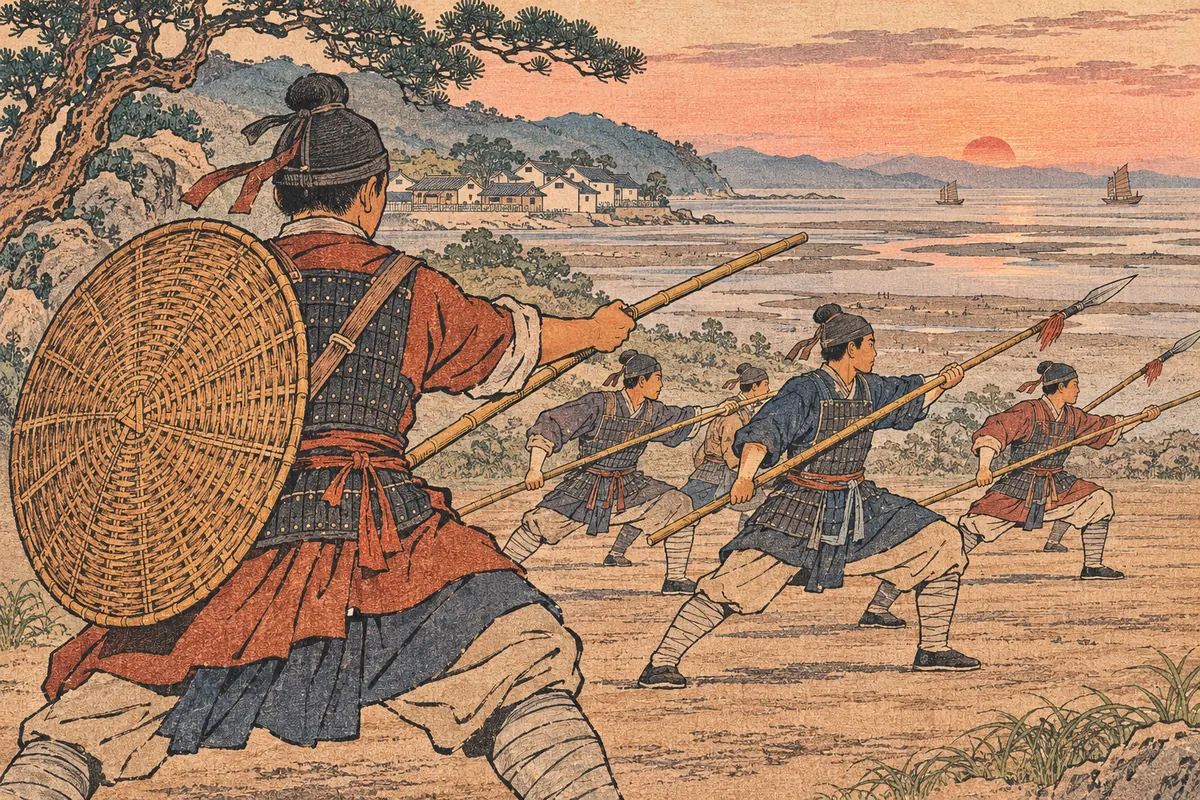
Marshes, field banks and village tracks in eastern Zhejiang offered little room for cavalry to wheel. In the “mandarin duck” formation described in Qi’s manual, weapons of different lengths belonged to one small unit. Shields covered the front. A branching bamboo pole called a langxian helped keep an opponent at a distance; spearmen worked behind it. Shorter weapons protected a spearman who had extended too far to recover quickly.
Testing how fast a man could raise a shield said little about the unit. If he dashed ahead alone, he exposed his companions. If everyone crowded together, a spear became useless. The diagram gave positions; practice taught the men when to move and whom to wait for.
Taizhou in 1561, Pinghai in 1563
In 1561 Qi fought off one raiding group at Longshan, then had to meet another threat to Taizhou’s prefectural seat. Winning in one place did not stop an enemy slipping around to the next. What became known as the Taizhou victory was a succession of engagements, not a single test of a formation on level ground.
In 1562 his troops went to Fujian and captured Hengyu, a base surrounded by water near Ningde. Yet Xinghua fell after they returned to Zhejiang. At Pinghai in 1563, Governor Tan Lun brought several forces together. Qi led the centre; Liu Xian and Yu Dayou commanded the wings. They recovered many abducted residents. A victory report could be finished in a day; reuniting a family was another matter.
A frontier tower with room for a garrison
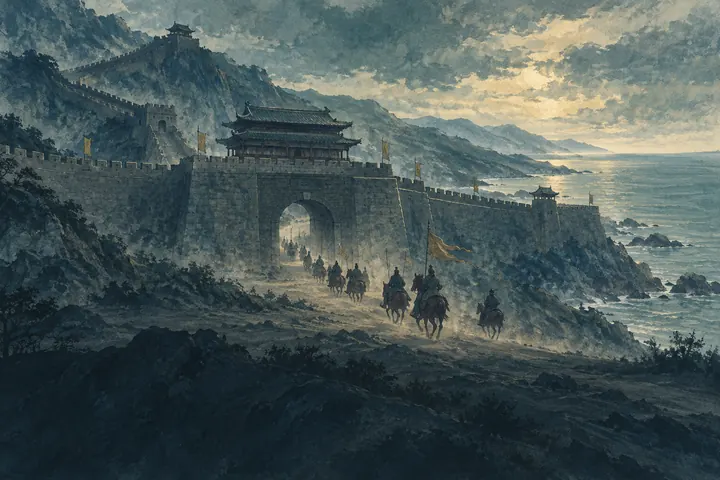
In 1568 Qi received responsibility for training in the northern commands of Jizhou, Changping and Baoding. Beyond the passes were narrow valleys; farther inland lay open ground. The transferable lesson was to fit forces to terrain, not to transplant a coastal formation. Infantry could use hills, cavalry could reinforce or pursue, and carts on flatter ground could work with troops and firearms.
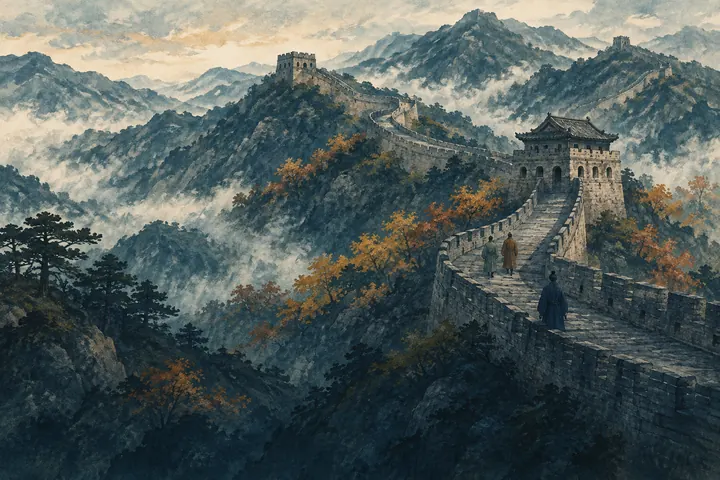
Jizhou already had border walls. Towers built astride them had rooms for soldiers, provisions and equipment, so guards need not march up from distant quarters at each alarm. Neighbouring posts had to support each other. Building inscriptions from Huangyaguan still name officers who shared in the work.
What the dispatch left out
Qi’s poem on the recovery of Ningde describes moss on the roads and roof beams standing in ruined houses. In a dispatch the town could be declared secure; the poem dwells on the unease of the night that followed. Wang Daokun, a literary friend who also served as governor of Fujian, discussed campaigns and exchanged writings with Qi. Qi even asked him to compose inscriptions for two swords. Another celebrated writer, Wang Shizhen, wrote a preface for Qi’s manual. Instructions meant for soldiers found their way into a literary collection.
In 1582 Qi collected his verse and prose under the name of his study at Jizhou: the Zhizhi Hall Collection. The training manual follows a unit preparing food and forming ranks. The poem stays in Ningde after the army has moved on.
Follow the connections
Beyond this story
Qi Jiguang's training methods outlived his coastal campaigns. Korean allies, maritime supply and distant operations posed problems no single formation could solve.
From Pyongyang to Sarhu: two different wars in the northeast →