
Why Wen Tianxiang sent a poem instead of a letter of surrender
Asked to persuade a Song commander to surrender, Wen Tianxiang offered a poem instead. Two very different captures, an escape and a brother’s different choice reveal what was at stake.
Why walk out of Lin’an to negotiate?
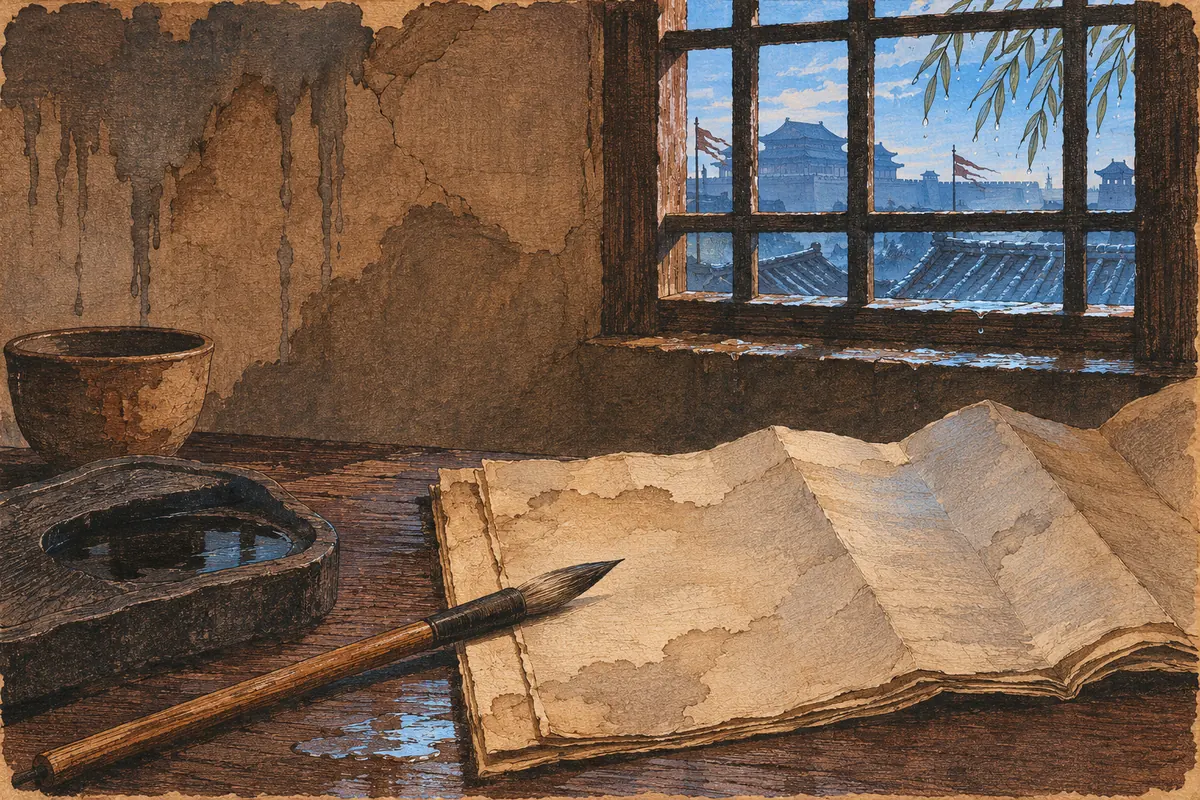
In 1276 Yuan forces stood outside Lin’an, modern Hangzhou. For people inside, the question was no longer where a border should run but who could still give orders and defend the city. Wen Tianxiang, a civil official who had raised troops in Jiangxi, went out to negotiate. The poem for which he is now famous had yet to be written.
In his afterword to Guide to the South, Wen explains that earlier envoys had gone back and forth. He wanted to judge the strength and intentions of the approaching army and return with information the court could use. The whole undertaking depended on his being allowed back. The Yuan commander Bayan detained him instead.
An escape that did not end at the city gate
Escorted north, Wen escaped at Jingkou, near modern Zhenjiang. Getting out of custody did not mean reaching safety. Patrols watched waterways and roads. A rumour had also reached Song commanders: a chancellor would come in disguise to urge them to surrender. At Zhenzhou the fugitive learned how dangerous that rumour could be. A true account and a plausible cover story might sound identical to a guard.
His route changed with his risks. He avoided checkpoints, travelled through the lower Yangtze region and eventually took a boat south by sea. He copied poems from successive stages into separate volumes. They preserve not just a survivor’s itinerary but a landscape in which information had become almost as difficult to move as people.
Losing the capital did not end the war
The surrender of Lin’an did not dissolve every Song force. Members of the imperial family and their officials formed successor courts in the south. Wen was not escaping simply to go home. As long as troops could make contact and supporters could supply them, he continued to act as a Song official. Resistance across Jiangxi, Fujian and Guangdong now depended on people and supplies far from the capital’s stores and offices.
Wen was captured at Wupoling in Haifeng, Guangdong. This time he was a defeated commander, not an envoy. Other Song forces, including those under Zhang Shijie, remained at sea. That overlap explains why the victors wanted a letter from a prisoner who could no longer command troops: his name might still move a former colleague.
A poem in place of the requested letter
The History of Song relates that the Yuan commander Zhang Hongfan asked Wen to write to Zhang Shijie and urge surrender. Wen supplied Crossing Lingding Ocean instead. It contains no instructions for a naval battle. Indeed, he does not address Zhang Shijie directly. Study and an official career give way to displacement in war. The names of a shoal and an estuary double as words for fear and loneliness.
A letter urging surrender would borrow the writer’s authority to recommend a course of action. The poem explains what he would not lend that authority to, even in defeat. The Song court at sea was lost at Yamen in 1279. The poem did not change that outcome; it made a particular refusal available to later readers.
Two brothers and two different obligations
In the Yuan capital, Wen remained imprisoned and refused office. The preface to his Song of Righteousness starts not in a grand hall but in a cramped earthen room where damp and heat accumulate. Its physical discomfort gives weight to the exemplary figures he invokes in the poem. Integrity, here, was something to maintain day after day in a place he could not leave.
His brother took office under the new dynasty. In a poem responding to news of his arrival, Wen sets a rider beside a prisoner, both born to the same parents. Its ending is not a simple denunciation. Service, family and responsibility could draw different answers even from brothers. Wen’s line for himself was not a universal order to everyone who had lived under Song.
What period does the Beijing shrine preserve?
Wen was executed at Dadu in 1283. At his shrine in Beijing’s Fuxue Hutong, even the writing on a wall belongs to more than one moment. A stone version of the Song of Righteousness reproduces calligraphy by the Ming scholar Wen Zhengming. Poet, calligrapher and present-day visitor encounter the same words in different centuries.
The language used to commemorate him also has a history. Later readers can honour his patriotism while listening for the obligations he described in his own setting: service to a court, responsibility to family and the refusal to turn a former colleague. On a dynastic table Southern Song ends in 1279. A single life shows why obligations did not end for everyone on that date.
Follow the connections

Beyond this story
Wen Tianxiang faced a court losing its territorial base, quite unlike the Song negotiating with Jin. Loyalty had to operate under sharply different conditions.
Why did the Southern Song seek peace after Yue Fei’s campaigns? →