
The fall of Shu Han, 263 CE: how Deng Ai reached Chengdu by the Yinping trail
In the autumn of 263 Wei attacked Shu by three routes. Zhong Hui’s main army was stopped by Jiang Wei at Jiange. Deng Ai led his men more than seven hundred li through uninhabited mountains from Yinping, defeated Zhuge Zhan at Mianzhu, and received Liu Shan’s surrender. Shu Han was the first of the Three Kingdoms to fall; within months Deng Ai and Zhong Hui were both dead in Shu.
The outcome first: Shu Han was the first of the Three Kingdoms to fall
In the winter of 263, the fourth year of the Wei reign period Jingyuan, Liu Shan, the second and last ruler of Shu Han, surrendered to the Wei general Deng Ai. Only a few months had passed between the start of the campaign and the opening of Chengdu. The Records of the Three Kingdoms relates that Liu Shan came to the gate of Deng Ai’s camp with his hands bound and a coffin carried behind him. Deng Ai untied him, burned the coffin and received him courteously.
In the third month of the following year Liu Shan and his household were moved east to Luoyang, where he was made Duke of Anle. One of the three states was gone. Wei itself was replaced by Jin in 265, and Wu did not fall until 280.
The best-known part of the war is Deng Ai’s crossing from Yinping. To understand it, the three Wei armies and the Shu defence have to be seen together. The mountain trail was passable because the main Shu army was held elsewhere.
Sima Zhao’s plan: three armies
According to the biography of Zhong Hui, Sima Zhao, who held real power in Wei, judged that the Shu general Jiang Wei had repeatedly attacked the frontier while Shu itself was “a small state with an exhausted people and depleted resources”, and that it could be taken by a major campaign. Zhong Hui agreed, and the two studied the terrain together. In the winter of 262 Zhong Hui was made General Who Guards the West with command of the forces in Guanzhong. At the same time Sima Zhao ordered the eastern provinces to build ships, as if the target were Wu.
The order came in the autumn of 263. Deng Ai and Zhuge Xu each led more than thirty thousand men. Deng Ai was to advance on Gansong and Tazhong and pin down Jiang Wei, who was stationed there. Zhuge Xu was to march on Wujie and Qiaotou and cut off Jiang Wei’s way back. Zhong Hui, with more than a hundred thousand, entered Hanzhong through the Xie and Luo valleys.
The point of the plan was to keep Jiang Wei from returning. If he could be held in the north-west, Zhong Hui would face only a few isolated strongholds in Hanzhong.
The defence of Shu: a suppressed memorial, and Jiange
The biography of Jiang Wei records that he learned in advance that Zhong Hui was preparing troops in Guanzhong. He asked the court to send Zhang Yi and Liao Hua to hold the Yang’an pass and the Yinping bridgehead “against what has not yet happened”. The eunuch Huang Hao trusted the word of spirit mediums that the enemy would not come, and persuaded Liu Shan to set the request aside. The other officials were not told. Only when the Wei armies were on the move did Shu send troops in haste.
In Hanzhong the Shu forces withdrew, as ordered, into the two strongholds of Han and Le, each with five thousand men. Zhong Hui left detachments to besiege them and pressed on westward. At the Yang’an pass the officer Jiang Shu opened the gates and surrendered, and Fu Qian died fighting.
Jiang Wei, beaten by Deng Ai at Tazhong, withdrew eastward and slipped past Zhuge Xu, who missed him by a single day. He joined Zhang Yi and Liao Hua and fell back on Jiange. Zhong Hui could not take the position. His supply lines were long, and he was already discussing a withdrawal.
Seven hundred li from Yinping: Deng Ai’s march
It was Deng Ai who broke the stalemate. He reported that the main Shu force had been shaken and that the moment should be used. He proposed to go from Yinping by a side route and strike at Fu, emerging a hundred li west of Jiange and little more than three hundred li from Chengdu, “a surprise force driving at the heart”. If the defenders of Jiange turned back to save Fu, Zhong Hui could advance freely. If they did not, Fu would be thinly held.
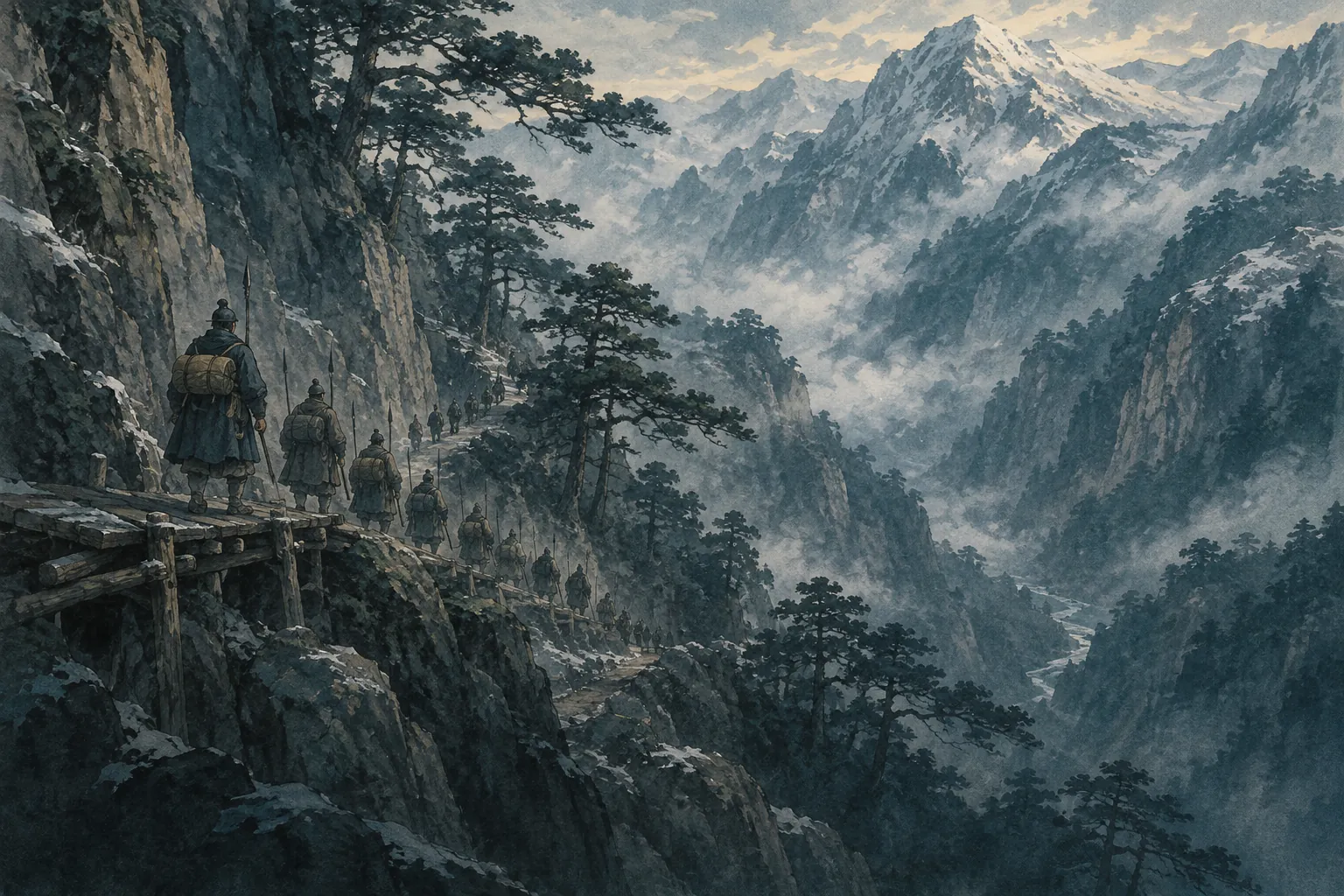
The biography of Deng Ai describes the march: “In the tenth month, in winter, Ai went from the Yinping road through more than seven hundred li of uninhabited country, cutting through mountains to open a way and building bridges and plank galleries. The mountains were high and the valleys deep; the route was extremely dangerous, the supply of grain was about to fail, and they were repeatedly on the brink of disaster. Ai wrapped himself in felt and rolled down the slopes. Officers and men climbed by trees and along cliffs, advancing in single file.”
The vanguard reached Jiangyou, where the commander Ma Miao surrendered. The army had no line of retreat and almost no food left. Whether it could win a battle on the plain would decide whether it was a surprise force or a lost one.
Mianzhu and Chengdu: one battle, one surrender
Zhuge Zhan, the Shu General of the Guards, fell back from Fu to Mianzhu and drew up his army there. Deng Ai sent his son Deng Zhong against the right and the officer Shi Zuan against the left. Their first attack failed, and they came back saying the enemy could not be beaten. Deng Ai was furious. “Survival or destruction is decided by this one action. What is there that cannot be done?” He was about to have them executed. The two rode back, fought again and routed the Shu army. Zhuge Zhan and the imperial secretary Zhang Zun were killed.
Deng Ai advanced to Luo county. Liu Shan accepted the advice of the grandee Qiao Zhou and sent envoys with his seals to ask for terms. On that day his son Liu Chen, Prince of Beidi, “grieving at the ruin of the state, first killed his wife and children and then himself”.
Jiang Wei, still holding Jiange, laid down his arms only on receiving Liu Shan’s order, and went to surrender to Zhong Hui at Fu. His officers and men, in their anger, “drew their swords and hacked at the rocks”. The Record of Shu, quoted in Pei Songzhi’s commentary, preserves the figures on the register handed over: 280,000 households, 940,000 people, 102,000 armoured soldiers and 40,000 officials.
After the victory: neither commander went home
After entering Chengdu, Deng Ai kept his troops in hand and allowed no plunder, for which the people of Shu praised him. But without waiting for the court’s approval he conferred offices on Liu Shan and the Shu officials in the emperor’s name, and he boasted of his achievement to the gentry of Shu. Zhong Hui, Hu Lie, Shi Zuan and others reported that he was acting rebelliously, and an edict ordered him sent back in a caged cart.
In the first month of 264 Zhong Hui reached Chengdu. The biography of Jiang Wei says that he “declared himself Governor of Yi province and rebelled”. According to his own biography, he meant to send Jiang Wei ahead through the Xie valley with the Shu troops and follow with the main army. The Wei officers and soldiers refused to follow and stormed in. Jiang Wei and Zhong Hui were both killed; Zhong Hui was forty. Deng Ai’s former troops overtook the cart, meaning to bring him back. Wei Guan sent Tian Xu after them, and Deng Ai and his son were killed west of Mianzhu. The biography of Liu Shan says that soldiers looted in Shu and that order returned only after several days.
Two years later, in 265, Sima Zhao’s son Sima Yan replaced Wei and took the throne. With this episode in mind, the account of how the Three Kingdoms ended under Jin makes the place of 263 in that sequence clearer.
At a glance
| Date | What happened |
|---|---|
| Winter of 262 | Zhong Hui is given command in Guanzhong; Sima Zhao orders ships built in the east as if to attack Wu. |
| Autumn of 263 | Wei attacks by three routes: Deng Ai and Zhuge Xu with over thirty thousand men each, Zhong Hui with over a hundred thousand. |
| Tenth month of 263 | With Zhong Hui stopped at Jiange, Deng Ai marches more than seven hundred li from Yinping and takes Jiangyou. |
| Winter of 263 | Deng Ai defeats Zhuge Zhan at Mianzhu. Liu Shan surrenders; Jiang Wei lays down his arms on Liu Shan’s order. |
| First month of 264 | Zhong Hui rebels in Chengdu and is killed with Jiang Wei. Deng Ai is killed west of Mianzhu. |
| Third month of 264 | Liu Shan, moved to Luoyang, is made Duke of Anle. |
Common questions
- When did Shu Han fall?
- In the winter of 263, when Liu Shan surrendered to the Wei general Deng Ai outside Chengdu. Shu Han was the first of the Three Kingdoms to fall.
- Who conquered Shu Han?
- The state of Wei, under the direction of Sima Zhao. Zhong Hui led the main army and Deng Ai led the force that reached Chengdu.
- How did Deng Ai get past Jiange?
- He did not attack it. He marched from Yinping through more than seven hundred li of uninhabited mountains, cutting paths and building plank roads, and came out behind the pass at Jiangyou.
- Why did Liu Shan surrender?
- After Zhuge Zhan was defeated and killed at Mianzhu, Liu Shan followed the advice of Qiao Zhou and sent his seals to Deng Ai. His son Liu Chen killed himself that day.
- What happened to Deng Ai and Zhong Hui?
- Deng Ai was arrested for granting offices without authority. Zhong Hui rebelled at Chengdu in the first month of 264 and was killed by his own troops together with Jiang Wei; Deng Ai was killed soon after.
Follow the connections
Beyond this story
The trail from Yinping reached Chengdu in a single winter. After Liu Shan surrendered, neither of the two Wei commanders, Deng Ai and Zhong Hui, left Shu alive.
The gates at Gaoping and the mountain road through Yinping →