
How did Eastern Han become the Three Kingdoms? Rebellion, governors and Dong Zhuo
The rebellion of 184 did not immediately end Han. Trace factional persecution, regional armies, powerful governors and the crisis of 189 to understand the world before Guandu.
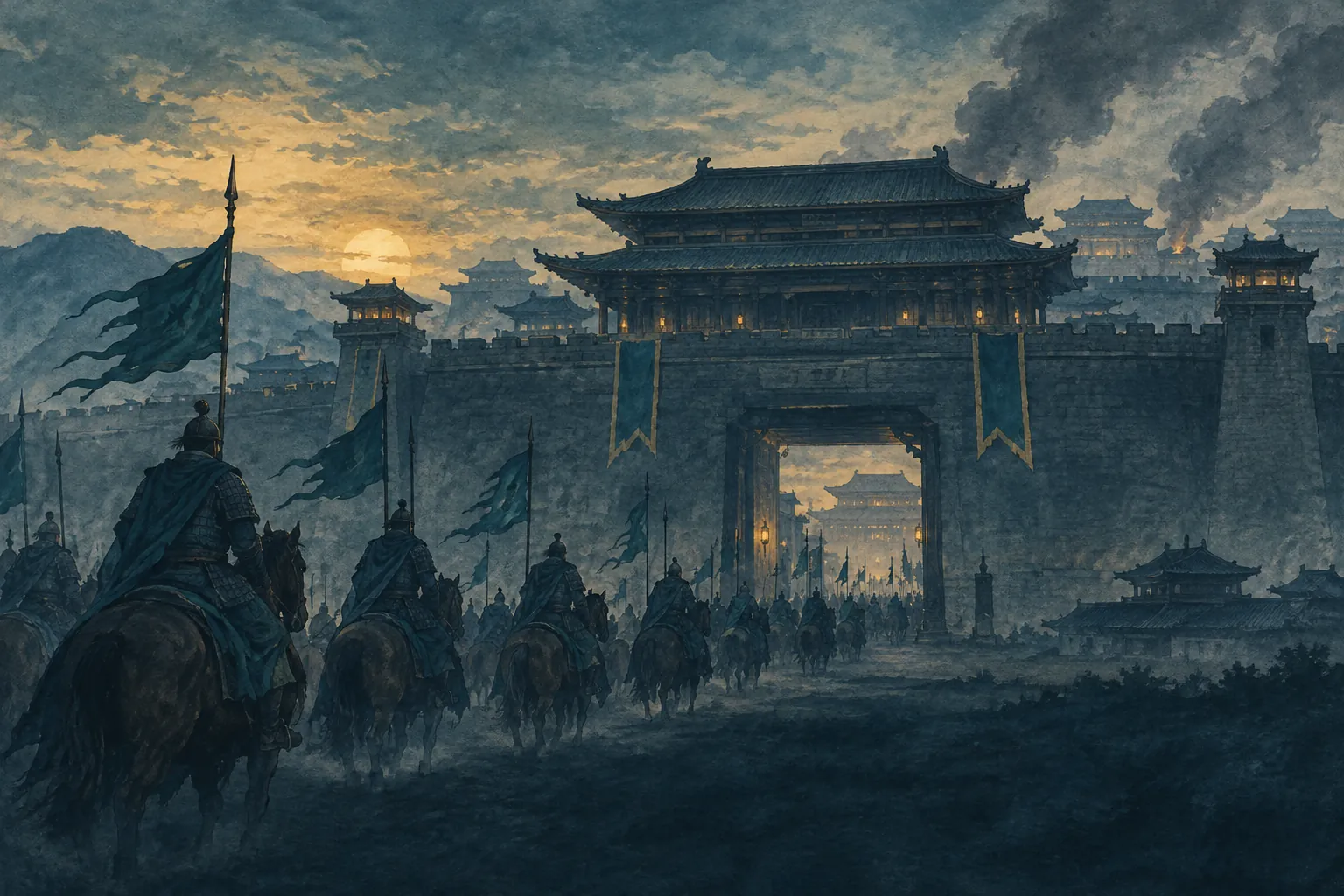
An emperor remained, but could his orders be carried out?
After Emperor Guangwu restored Han, the court at Luoyang continued for more than a century. By the later second century, the difficulty was not that everyone had forgotten the dynasty. Cooperation among the palace, officials and regional society was becoming harder to sustain. Imperial relatives could govern through a regency, while emperors might rely on eunuch attendants to escape those relatives’ control. Officials also depended on recommendations, reputations and personal networks. These relationships could support administration but could carry factional conflict beyond the palace. Disputes over character were also disputes over appointments, legitimate authority and access to the resources of government.
Factional prohibitions reached beyond one official
The factional prohibitions associated with 166 and 169 brought arrest, exclusion from office and worse consequences to respected officials and scholars. Associations with a targeted person could affect others’ careers. Exclusion from government did not necessarily destroy local prestige, so official position and social standing could diverge. It would be misleading to turn this into a single claim that Confucian ideas collapsed and therefore Han had to fall. Rival groups continued to appeal to loyalty, filial duty and imperial legitimacy. The same political language could support incompatible choices. Intellectual change is part of the story, not a substitute for following the institutions, decisions and wars of the following decades.
184: rebellion could be defeated without restoring the old balance
Zhang Jue and his followers launched the Yellow Turban uprising in 184. Hardship, illness and religious organization helped mobilize people, though participation varied by region. Imperial commanders fought the rebels while local officials and resourceful families also assembled forces. Defeating major rebel concentrations did not recover every capability that had been dispersed during mobilization. Soldiers needed continuing supplies, transport and recruitment networks. People able to provide them could acquire political authority as well. Some later contenders had fought the Yellow Turbans; others developed power in different frontier conflicts. The warlord forces did not all descend from one rebel army or follow one identical path.
188: strengthening governors to restore order
The province had long served as a supervisory region, although its arrangements changed over time. In 188, Liu Yan advocated stronger regional leadership and received appointment as governor of Yi province; senior men also took other provincial commands. This was not a simultaneous renaming of every inspector throughout the empire. From the court’s perspective, stronger governors could restore order without waiting for every intervention from Luoyang. Locally, however, office, troops and revenue could become concentrated around one leader. Liu Yan’s subsequent position in Yi demonstrates how a delegated representative could establish a territorial base. The purpose of a reform and its consequences were not necessarily the same.
189: who could dismiss the army invited to the capital?
After Emperor Ling died, a succession struggle intensified the crisis in Luoyang. He Jin’s attempt to remove the eunuchs ended with his own murder, followed by slaughter of eunuchs. Dong Zhuo entered this power vacuum with troops, took control of the court and replaced the emperor. The imperial title survived, but access to its holder became a resource military leaders could control. The coalition raised against Dong did not remain a unified authority. In 190, Dong moved the court west to Chang’an, while Luoyang suffered devastation. Appeals to defend Han could coexist with territorial ambition. Guandu would emerge from these struggles over men, supplies and legitimacy, not simply from two generals arranging a duel.
The end of Han and the Three Kingdoms were not one event
In 196, Cao Cao received Emperor Xian and established the court at Xu. Acting in Han’s name did not automatically secure obedience from every regional power. Guandu in 200 and Red Cliffs in 208 were further stages of military realignment. Cao Pi replaced Han with Wei in 220; Liu Bei claimed the imperial title in 221, while Sun Quan did so in 229. Territorial competition and the adoption of imperial titles had separate chronologies. The transformation is better understood through relationships that came apart: reputation and appointment, orders and military command, possession of the emperor and provision of grain. Those distinctions connect this story to Guandu, Red Cliffs and the later reunification under Jin.
Follow the connections
Beyond this story
As court authority unravelled, former subordinates and local ties could matter more than a seal. Networks of recruitment became resources for mobilisation.
Whose recommendation opened an office door in Luoyang? →