
The Battle of Kunyang, 23 CE: how a few thousand men broke Wang Mang’s army
In the sixth month of 23 CE Wang Mang’s army, mustered at 420,000 men, surrounded the small town of Kunyang, which held eight or nine thousand defenders. Liu Xiu rode out with thirteen horsemen to find help, returned, and led three thousand picked men against the enemy’s centre, killing its commander Wang Xun. A thunderstorm turned the retreat into a rout. Three months later Wang Mang was killed in Chang’an.
The outcome first: one day outside a small town
In the sixth month of 23 CE the great army sent out by Wang Mang collapsed beneath the walls of Kunyang. One of its two commanders, the minister over the masses Wang Xun, was killed. The other, the minister of works Wang Yi, got back to Luoyang with only a few thousand soldiers from Chang’an, while the rest of the troops fled to their home commanderies. The Book of Han says that the region within the passes was terrified at the news and that bandits rose everywhere. In the ninth month of the same year Wang Mang was killed in Chang’an and the Xin dynasty ended.
Kunyang was a county town in Yingchuan commandery. The Tang commentary on the Book of Later Han places the old town north of Ye county, in what is now Henan. That spring the forces opposed to Wang Mang had made Liu Xuan emperor at Nanyang under the reign title Gengshi, and their main army was besieging the city of Wan. Kunyang was a small town recently taken by a detachment and held by eight or nine thousand men. The officer who argued for holding it was Liu Xiu, then only a subordinate general.
“A million” and 420,000: how to read the numbers
The two histories describe the size of Wang Mang’s army in similar terms. The annals of Guangwu in the Book of Later Han say that Wang Xun and Wang Yi “led a million troops, of whom 420,000 were armoured soldiers”. The biography of Wang Mang in the Book of Han says he called up “a million” men from the commanderies under the name “Tiger-Fang Five-Might Troops”, that 420,000 actually assembled at Luoyang, and that more were still on the road. The force that first reached Kunyang is given in the Book of Later Han as “nearly a hundred thousand”.
The army also carried specialists from sixty-three schools of military writing as staff officers, a giant said to stand one zhang tall as a camp commandant, and tigers, leopards, rhinoceroses and elephants to add to its menace.
“A million” was the proclaimed strength, and 420,000 the muster the histories report. Both books come from the Han side. Ban Gu, author of the Book of Han, lived under the Eastern Han, and the Book of Later Han tells the founding story of the victor, Liu Xiu. The larger the enemy, the more remarkable the victory, so these figures are best read as what was said at the time, not as a verified count.
Hold or scatter: thirteen riders leave the town
Seeing the size of the enemy, the Han officers fell back into Kunyang. They were frightened, anxious for their wives and children, and wanted to disperse to the towns each of them held. Liu Xiu objected. Their men and grain were few and the enemy strong, he said; if they resisted together there was still a chance of success, but if they scattered none of them would survive. Wan had not yet fallen and could send no help. If Kunyang were taken, every detachment would be destroyed within a day.
At first the officers were angry and asked how General Liu dared speak to them in this way. Just then scouts rode in to report that the main army was approaching the north of the town, its formations stretching for hundreds of li with no end in sight. The officers then asked Liu Xiu to plan for them again.
The plan was that Wang Feng and Wang Chang would hold the town, while Liu Xiu, Zong Tiao, Li Yi and others, thirteen riders in all, left by the south gate at night to gather reinforcements outside. Nearly a hundred thousand of the enemy had already reached the walls, and Liu Xiu barely got out.
Why Wang Yi would not bypass Kunyang
Not everyone in Wang Mang’s army misread the situation. General Yan You advised Wang Yi that Kunyang was small but strong, and that the man who had taken the imperial title was at Wan. If the main army advanced quickly the rebels there would flee, and once Wan was defeated Kunyang would submit of its own accord.
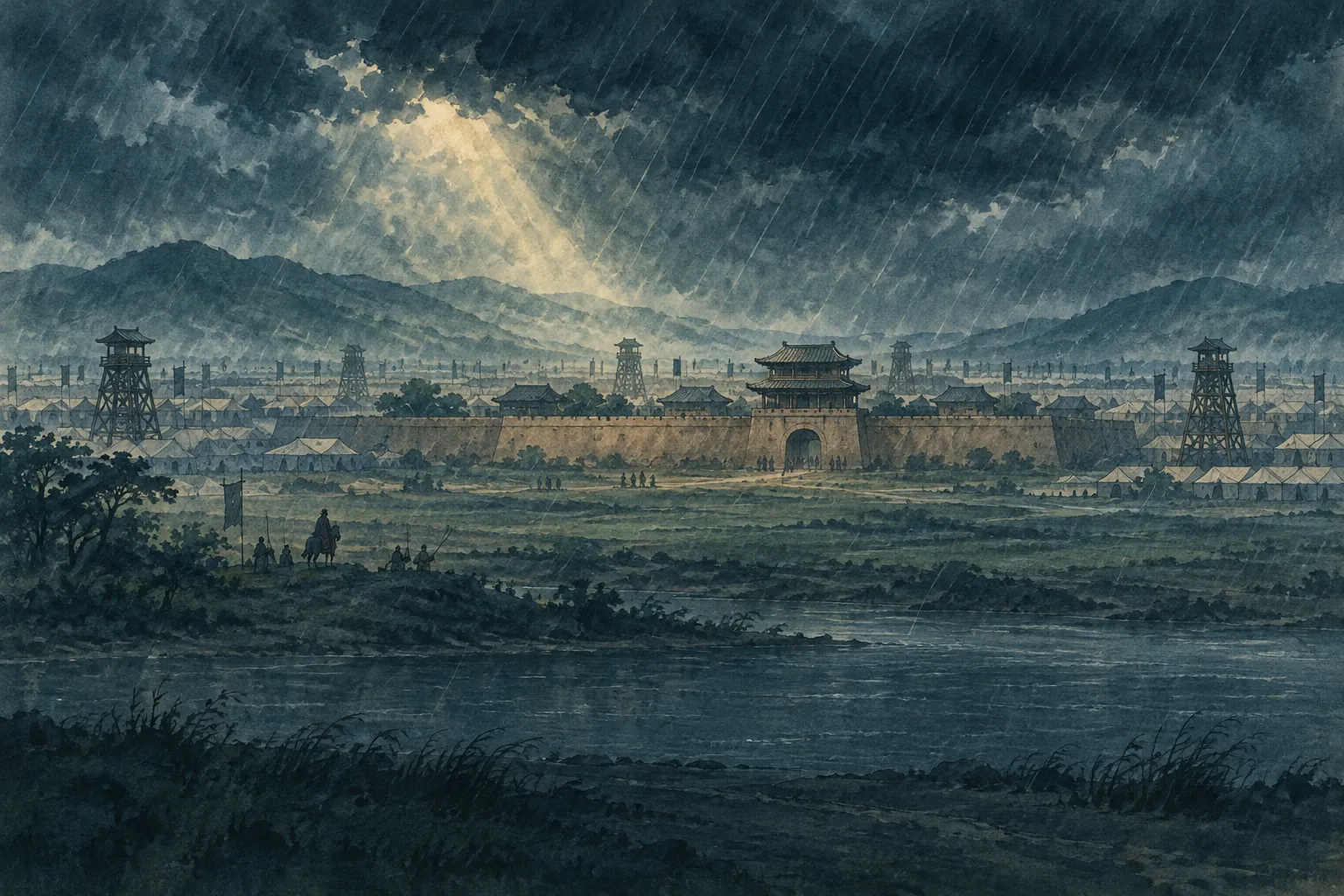
Wang Yi refused. He recalled that he had once been reprimanded for failing to capture the rebel Zhai Yi alive. Now he commanded a million men: what would be said if he met a town and could not take it? He surrounded Kunyang many ranks deep and set up more than a hundred camps. Siege towers more than ten zhang high looked down into the town; tunnels were dug and rams brought against the walls. Arrows fell like rain, and people inside had to carry doors on their backs to fetch water. Wang Feng and the other defenders asked to surrender. Wang Yi would not allow it.
Yan You then cited the rule of war that a besieged town should be left a way out. He proposed leaving a gap so that the garrison would escape and spread fear among the Han troops at Wan. Again Wang Yi did not listen.
The decisive day: three thousand against the centre, then a storm
Liu Xiu returned with the troops he had collected from the camps at Yan and Dingling. On the decisive day in the sixth month he went ahead with over a thousand foot and horse and drew up four or five li from the enemy. Wang Xun and Wang Yi sent a few thousand men to meet him. Liu Xiu charged and took several dozen heads. His officers remarked how strange it was that General Liu, usually timid before a small enemy, should be so bold before a great one.
After several small successes Liu Xiu took three thousand men ready to die and struck along the river west of the town at the enemy’s centre. The Book of Han adds a crucial detail. Wang Xun and Wang Yi held their opponents in contempt. They came out with only some ten thousand men and ordered every other camp to stay in place and not move without orders. When the fight went badly, “the main army did not dare go to their aid on its own authority”. Wang Xun was killed. The garrison came out shouting, and the besiegers were caught between two forces.
Then came violent thunder and wind. Roof tiles flew, rain poured down and the Zhi river flooded. The fleeing troops trampled one another as they struggled to cross, and those who drowned were counted in the tens of thousands.
After Kunyang: credit, a brother’s death and Luoyang
Victory at Kunyang did not bring Liu Xiu immediate power. At about the same time his elder brother Liu Yan took Wan and was then put to death by the Gengshi emperor. Liu Xiu hurried from the front to Wan to apologise. He did not mention what he had done at Kunyang, did not mourn his brother, and “ate, drank, talked and laughed as usual”. The emperor, ashamed, made him a general-in-chief and Marquis of Wuxin.
In the ninth month, leading men of the capital region killed Wang Mang and sent his head to Wan. The Gengshi emperor prepared to move north and make Luoyang his capital, and sent Liu Xiu ahead to put its palaces and offices in order. In the tenth month Liu Xiu crossed the Yellow River with imperial credentials to settle the commanderies of the north. His later power was built from there.
Kunyang destroyed the last large army Wang Mang was able to assemble. It did not settle who would replace him. Two years separate the fall of the Xin from the founding of the Eastern Han, and reunification had to wait until 36 CE.
At a glance
| Date | What happened |
|---|---|
| Spring of 23 CE | Liu Xuan is made emperor under the reign title Gengshi. The main Han army besieges Wan; a detachment takes Kunyang. |
| The siege | Wang Xun and Wang Yi arrive with an army mustered at 420,000 and surround Kunyang, held by eight or nine thousand men. |
| During the siege | Liu Xiu leaves by the south gate at night with thirteen riders to gather reinforcements. |
| Sixth month | Liu Xiu leads three thousand picked men against the enemy centre. Wang Xun is killed, the garrison sallies out, and a storm floods the Zhi river. |
| Ninth month | Wang Mang is killed in Chang’an. |
Common questions
- Who won the Battle of Kunyang?
- The Han forces of the Gengshi emperor, with Liu Xiu leading the relief attack. Wang Mang’s commander Wang Xun was killed and Wang Yi fled to Luoyang with a few thousand men.
- When was the Battle of Kunyang?
- In the sixth month of 23 CE, three months before Wang Mang was killed in Chang’an.
- How large was Wang Mang’s army at Kunyang?
- The histories say “a million” were called up and 420,000 assembled at Luoyang; nearly a hundred thousand first reached the town. Both accounts come from the Han side, so the figures are best read as what was said at the time.
- How did Liu Xiu win at Kunyang?
- He rode out with thirteen horsemen to bring in troops, returned, and struck the enemy centre with three thousand men. Wang Xun and Wang Yi had come out with only some ten thousand and ordered the other camps not to move, so no help came. A thunderstorm then turned the retreat into a rout.
- Where was Kunyang?
- In Yingchuan commandery. The Tang commentary on the Book of Later Han places the old town north of Ye county, in what is now Henan.
Follow the connections
Beyond this story
The name Han did not disappear under the Xin. In 23 CE a small force fighting under the Han banner changed the course of the war outside Kunyang.
The names under a lacquer cup and the name Han →