
The partition of Jin: how a Spring and Autumn power became three states
What changed in 453, 403 and 376 BCE? Follow the siege of Jinyang, royal recognition and the end of Jin to understand why the Warring States did not begin in a single afternoon.
A powerful state, a less powerful ruler
Jin had been a major power in the alliances of the Spring and Autumn period, especially under Duke Wen. Yet a strong state did not necessarily have a ruler who directly controlled every soldier or estate. Ministerial lineages commanded resources of their own while serving the state. Their dependants, lands and offices could support ambitions that diverged from the duke’s. By the later Spring and Autumn period, explaining Jin required following the Zhao, Han, Wei and Zhi houses as well as its ruler. The important change was organizational: durable centres of power had developed inside a polity whose ducal title still survived.
At Jinyang, an ally could change sides
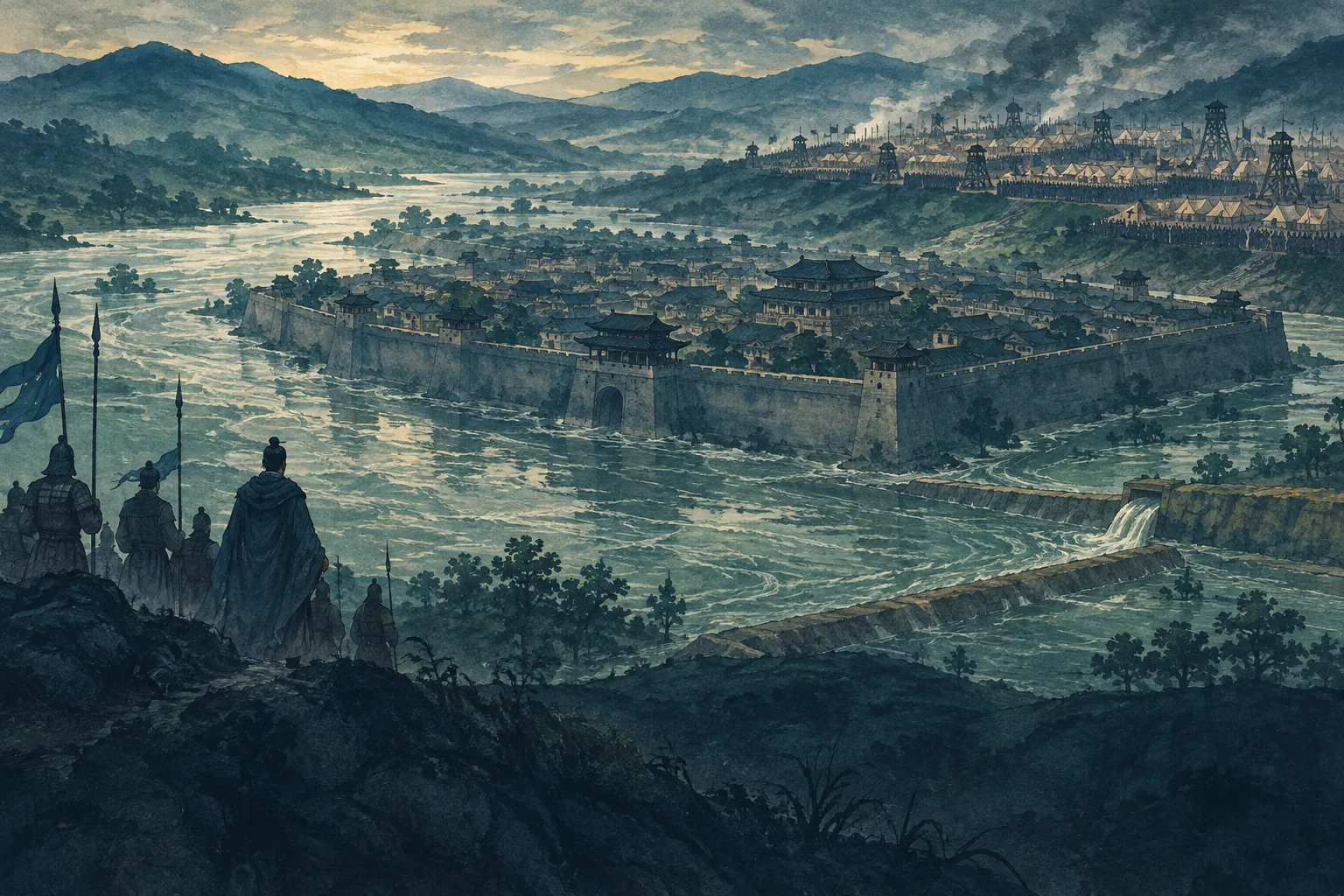
The siege of Jinyang is conventionally dated to 453 BCE. In the Shiji account, Zhi Bo attacked Zhao with Han and Wei, while Zhao Xiangzi sheltered in Jinyang and faced flooding. The coalition contained its own weakness: Han and Wei could wonder who would restrain the victor once Zhao was gone. They ultimately joined Zhao against Zhi, whose holdings were divided. The transmitted narrative includes speeches and dramatic incidents rather than a contemporary transcript. Its political outcome matters most here: three houses became predominant, but Jin’s ruler did not immediately disappear and recognition of three separate states was still another step.
What did royal recognition mean in 403 BCE?
In 403 BCE, King Weilie of Zhou recognized Han, Zhao and Wei as regional lords. Recognition did not mean that the Zhou court had regained the ability to command all their troops. The houses already possessed substantial resources; investiture gave their position a status within the inherited political language of Zhou. They were no longer simply ministerial houses beneath the duke of Jin. Titles still mattered, even though power had shifted. Sima Guang later began the Zizhi tongjian with this year, emphasizing legitimacy and hierarchy. That influential choice should not be mistaken for unanimous agreement about a single starting date for the Warring States period.
Why keep 376 BCE on the timeline?
After the recognition of the three houses, a reduced Jin continued to exist. Han, Zhao and Wei divided its remaining territory in 376 BCE. The partition was therefore a process with distinguishable stages: defeating a dominant rival, securing recognition and disposing of the old state’s remainder. Dates such as 481, 475 and 403 BCE also appear as boundaries between the Spring and Autumn and Warring States periods in different conventions. Check a book’s periodization before comparing its sequence of events with another. A period label organizes historical change; it was not a notice simultaneously delivered to everyone living through it.
From lineage rivalry to competing states
The partition does not explain every Warring States development, but it reveals one route into a larger transformation. Rival governments needed grain, registered households, capable officials and sustained military organization, not merely precedence at an aristocratic meeting. Reforms in Wei, military changes in Zhao and Shang Yang’s measures in Qin belonged to different settings and dates. Changes in ironworking, agriculture and taxation likewise need regional evidence; no single invention ended aristocratic power everywhere at once. The story of Jin offers a more useful question than simply which of seven states won: how were competing governments acquiring the capacity to mobilize people and resources?
Put the three dates on one line
Return to Duke Wen and Shang Yang after separating the three stages: Zhi’s defeat, royal recognition and the final division of Jin. Duke Wen’s alliances and Shang Yang’s registration of households and rewards for military service were not disconnected episodes, but neither were they one system changing overnight into another. The memorable sequence is that effective power changed before formal status, and the older state survived both for a time. Carry that distinction into the debates of the Hundred Schools. Questions about appointing officials, financing government and sustaining order make more sense when read alongside the changing institutions that thinkers were trying to explain.
Follow the connections
Beyond this story
Han, Zhao and Wei inherited Jin's resources; Qin did not. Wei's early lead is a good reason not to read the beginning of the Warring States backward from Qin's victory.
Why did early reform not deliver victory to Wei? →