
Flags above the rooftops: firefighting in Song Kaifeng and Hangzhou
In Southern Song Hangzhou, the number of flags on a watchtower gave a fire’s location. From northern patrol posts to southern firefighting crews and disaster relief, discover the work behind safer city streets.
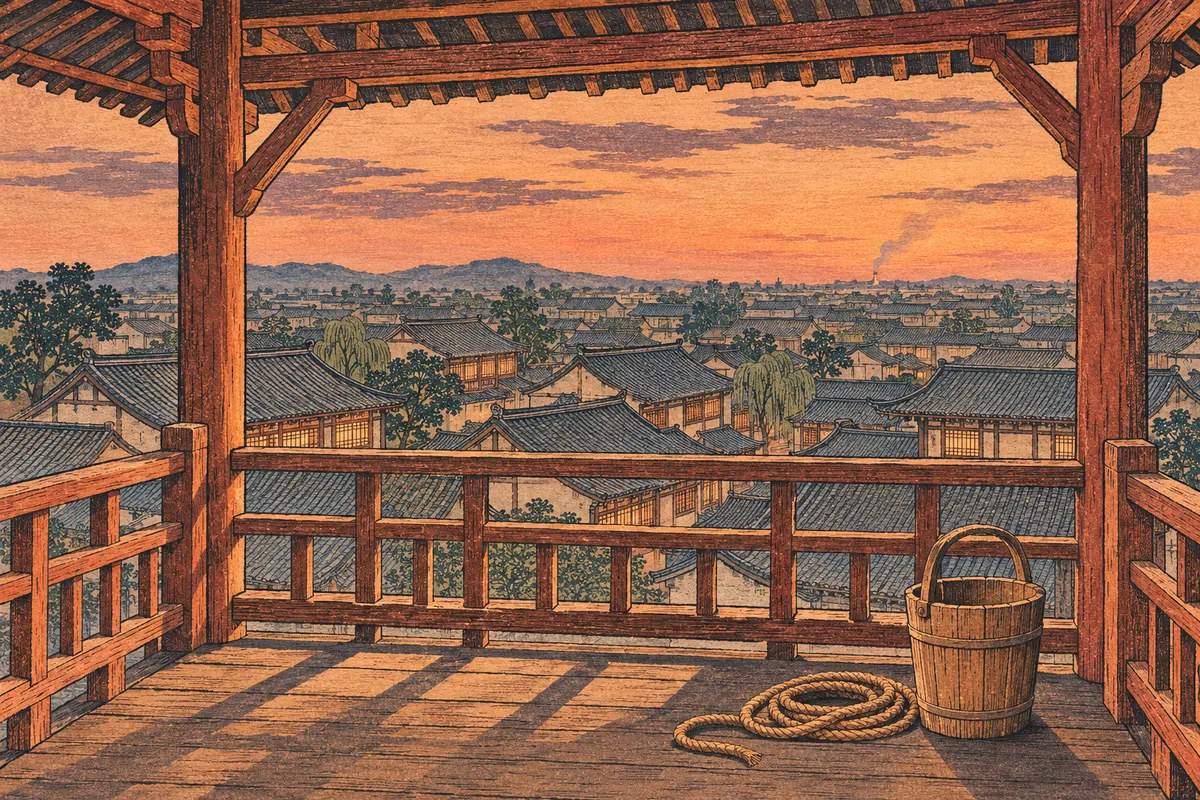
Why a watchtower still needed street patrols
From a tower above Northern Song Kaifeng, a lookout might see smoke behind the roofs without knowing which lane it came from. Someone on foot knew the nearest corner and its households but could not see across several blocks. Meng Yuanlao’s recollections of the former capital describe both elevated fire lookouts and military patrol posts spaced along the streets. The soldiers also handled other matters on their night rounds. Cooking and lighting made flames a necessity; close-set houses made delay dangerous. A distant sighting and a report from someone who knew the street answered different parts of the same question.
What was waiting at the foot of the tower?
Meng describes soldiers quartered below a lookout and lists the equipment kept there: buckets, ladders, axes, saws and lengths of rope. Reaching the flames could be as difficult as finding water. A high roof, a fallen timber and the need to pass equipment forward each called for something a bucket alone could not supply. Mounted messengers carried alarms, and the Kaifeng prefecture and military commands could each send personnel. Storage near the watch saved time otherwise spent borrowing tools. Meng admired the organized response. His account does not record the outcome of every fire or rule out residents helping themselves.
In Lin’an, count the flags
Wu Zimu records a signalling convention in Southern Song Lin’an, present-day Hangzhou. By day the watch used flags; after dark it used lights. Three meant a fire inside Chaotian Gate. Two indicated the area beyond the gate but still within the city walls. One indicated a location outside the city. The same counts applied at night. A crew some distance away could distinguish one signal from three more easily than it could identify a particular storefront. The signal named a district, not an address: someone on the ground still had to locate the fire. This code belonged to Lin’an’s geography, not Kaifeng’s.
Who went first, and who waited?
Lin’an organized parts of its defence by districts called yu. A local gazetteer from the Chunyou period lists district posts and their nominal strengths, and separately lists seven qianhuo firefighting crews. The two lists are not interchangeable, nor can their numbers be added to discover how many people attended any one fire. The gazetteer distinguishes a local alarm, to which a commander could respond immediately, from one in another district, for which troops assembled and awaited orders. If everyone rushed to one blaze, another district lost its guard. If the nearest crew always waited for permission, valuable time was lost.
When the flames were out, where could families go?
In 1201, a fire in Lin’an burned for days. Records of relief mention distributions of money and rice. A family might survive and yet lose its grain, cooking equipment and the shop that supported it. Stopping flames before they reached another street did not put that household back in business. Records from other Song fires mention measures including reductions in certain rents or taxes and relief from charges on rebuilding materials. Food and shelter answered immediate needs; timber and tools mattered once rebuilding could begin. These measures varied. They were not a guaranteed schedule of compensation for every household in every city.
Two capitals, seen from their own streets
Asking only which city had the first “fire brigade” turns a Kaifeng rider and a lamp in Hangzhou into the same answer. They served different streets, and the accounts preserve different things: a resident’s recollection of equipment, a description of signals people recognized and official instructions about when troops should move. Revisit a Song market with those distinctions in mind. A shop serving a late hot meal was a convenience to its customers and one more flame its neighbours had to watch. Life there depended on people who saw danger, people who understood the alarm, and arrangements for those whose homes could not be saved.
Follow the connections
Beyond this story
After a fire, one household might rent again while another had no relatives to turn to. Firefighting and relief for displaced residents met different needs.
After losing a home, was renting from the state the same as receiving relief? →